Titanium Ore & Ilmenite Magnetic Separation

Titanium Ore Magnetic Separation for Ilmenite & Magnetic Mineral Removal

Corvelan reviews titanium-bearing ore by mineralogy, magnetic response, liberation, particle size and process position to determine where magnetic separation should sit in the beneficiation flowsheet.

IlmeniteTitanomagnetiteHeavy Mineral SandTitanium TailingsTramp Iron Removal
Quick answer: Need to remove magnetite, titanomagnetite or tramp iron? Magnetic separators can help remove magnetic minerals and ferrous contaminants from titanium ore. For ilmenite recovery, separator selection depends on mineral properties, particle size and separation requirements.
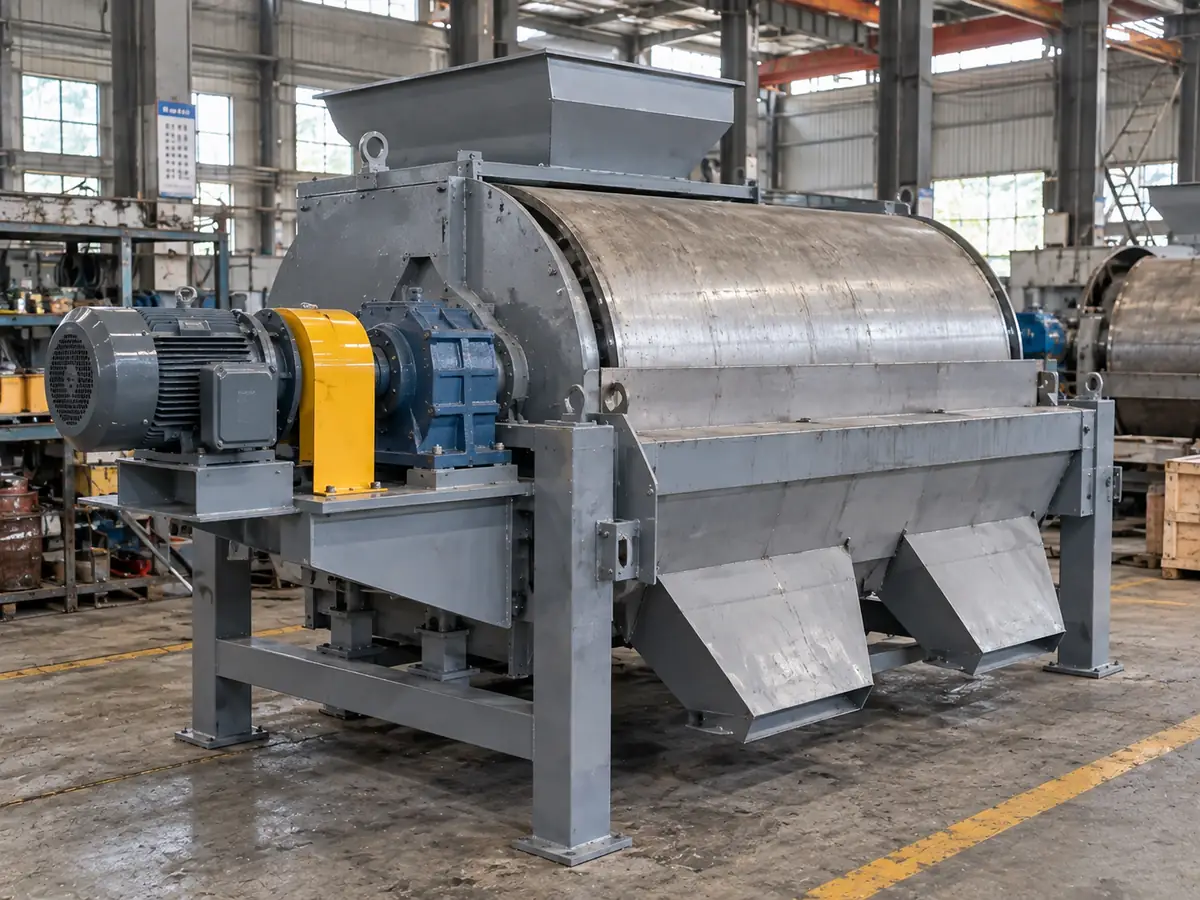
Conceptual magnetic drum separator for titanium ore magnetic separation

Check Your Ore and Separation Goal

What Are You Trying to Separate From the Titanium Ore?

Titanium ore magnetic separation can be used for removing magnetic impurities, recovering ilmenite, or upgrading heavy mineral concentrates. The right separator depends on your material characteristics and separation target.

Tramp Iron RemovalRemove bolts, steel fragments or other ferrous contamination before crushers, mills, conveyors or downstream beneficiation equipment.
Magnetite / Titanomagnetite SeparationRemove or recover the strongly magnetic iron-bearing fraction before further titanium beneficiation.
Ilmenite RecoveryRecover a weaker-magnetic titanium mineral fraction where liberation, particle size and magnetic response control the route.
Heavy Mineral Sand SeparationStage ilmenite and associated heavy minerals by their different physical and magnetic properties.
Titanium Tailings RecoveryEvaluate whether remaining fine titanium-bearing material can be pre-concentrated before further beneficiation.

Selection Guide

Choosing Magnetic Separation Equipment for Titanium Ore

Start with your ore type and separation target, then choose the most suitable magnetic separator. Understanding the material characteristics helps avoid selecting equipment that does not match the application requirement.

Ore / FeedMain TargetRole of Magnetic SeparationLikely Next Step
Titanomagnetite-bearing hard rockMagnetite / titanomagnetiteRemove or recover the strongly magnetic fractionReview dry or wet magnetic route from the real feed condition
Ilmenite-bearing concentrateIlmeniteRecover a weaker-magnetic fractionCheck liberation and magnetic response before equipment approval
Heavy mineral sandIlmenite plus associated heavy mineralsStage mineral fractions by magnetic responseCoordinate magnetic separation with gravity and other physical separation stages
Fine titanium tailingsFine ilmenite / titanium-bearing mineralsPre-concentrate a recoverable fraction if the material respondsClassification, desliming and representative material testing
Rutile-bearing titanium feedMagnetic iron-bearing impurities or associated mineralsRemove magnetic minerals rather than assume rutile is the captured productReview mineralogy and the downstream beneficiation route

Mineral Response

Can Magnetic Separation Recover Your Titanium Mineral?

Short answer: magnetite is strongly magnetic, titanomagnetite response depends on composition, ilmenite is a weaker magnetic target, and rutile is generally treated as the non-magnetic or less-magnetic product in conventional magnetic-separation decisions. The final magnetic separator selection depends on the actual ore characteristics and required product quality.
Strong response

Magnetite

Usually the easiest titanium-ore-associated magnetic fraction to remove or recover. Working distance, burden depth and feed presentation still affect practical capture.

Composition dependent

Titanomagnetite

Often treated earlier in the flowsheet than direct ilmenite upgrading. Its real response should be interpreted with the mineralogy rather than the name alone.

Weaker magnetic target

Ilmenite

Direct recovery may require stronger field gradient or another separator class. Liberation and representative material response are critical selection inputs.

Usually not the captured fraction

Rutile

Magnetic separation is commonly used to remove or stage accompanying magnetic minerals so the rutile-bearing fraction can continue to the next beneficiation step.

Process Integration

Where Corvelan Magnetic Equipment Fits in the Titanium Beneficiation Flowsheet

The following examples show common titanium ore magnetic separation applications. Actual equipment selection depends on the ore characteristics, feed conditions and required separation results.

Hard-Rock Titanomagnetite / Ilmenite Ore
Crushing→Grinding→Classification→Strong Magnetic Fraction Separation→Titanium Fraction Treatment→Further Beneficiation
Ilmenite Concentrate Upgrading
Pre-Concentration→Magnetic Response Assessment→Magnetic Separation→Cleaning / Further Beneficiation
Heavy Mineral Sand
Washing / Screening→Gravity Concentration→Drying if Required→Magnetic Separation→Further Physical Separation
Fine Titanium Tailings
Classification / Desliming→Magnetic Test→Magnetic Pre-Concentration→Further Beneficiation
Selection tip: magnetic separation should be treated as one stage inside the beneficiation flowsheet. The correct question is not “Which magnetic separator is strongest?” but “Which fraction must move at this process position, and what does the representative material do under controlled conditions?”

Material Testing

Test the Titanium Ore Before Freezing the Equipment Specification

Not sure whether the ilmenite is responsive enough for the proposed magnetic route? A representative ore test helps confirm whether the selected magnetic separation method matches the material before choosing the final equipment configuration.

01Set the Required Separation ResultRemoval, recovery, pre-concentration or product cleaning.
02Describe the SampleOre source, mineralogy, PSD, moisture or slurry condition.
03Lock Test ConditionsFeed condition, separator setting and measurement method.
04Run the TrialCollect magnetic and non-magnetic fractions under recorded conditions.
05Evaluate the FractionsUse the agreed analysis or acceptance metric where available.
06Choose the Next Test or Equipment OptionWe recommend suitable equipment, further material testing or another separation method based on the test result.

Check Equipment Fit

Checks the agreed geometry, interfaces, access and mechanical scope. It does not prove mineral recovery.

Check Magnetic Performance

Checks magnetic condition at defined points and measurement conditions. It does not equal moving-ore performance.

Test the Ore Sample

Checks the representative material split under recorded test conditions. The conclusion stays within that sample and test window.

Have Representative Titanium Ore, Concentrate or Tailings?

Send the sample description, particle-size range, existing process position and the decision the test needs to support.

Request Material Testing

Magnetic Separator Solutions for Titanium Ore

Match the Magnetic Separation Stage to a Confirmed Equipment Capability

Corvelan publicly confirms engineered magnetic drum separators with dry and dedicated wet process routes, Ferrite or NdFeB magnetic systems, application-specific magnetic circuits, discharge arrangements and line-specific mechanical interfaces.

When a Corvelan Magnetic Drum May Be Suitable

✓
Dry mineral feed: where a controlled bulk feed and magnetic drum position fit the process objective.
✓
Dedicated wet duty: where the slurry route, tank, flow path and magnetic discharge are engineered for the process.
✓
Strongly responsive fraction: magnetite, titanomagnetite or ferrous contamination when working distance and feed presentation are compatible.
✓
Custom integration: feed, splitter, outlets, drive, access and mounting around the approved line interface.

When a Different Magnetic Separation Route Is More Appropriate

!
Weak direct ilmenite response: evaluate whether another separator class is required instead of forcing a conventional drum into the duty.
!
Ultrafine or slimed feed: classification, desliming or another separator principle may control the outcome.
!
Insufficient liberation: grinding and classification may matter more than increasing magnetic strength.
!
Complex multi-mineral product: coordinate the magnetic stage with gravity, flotation, electrostatic or other downstream beneficiation as required by the mineralogy.
Conceptual magnetic drum separator showing drive, drum and discharge structure

Equipment Principle

How a Magnetic Drum Separates a Responsive Mineral Fraction

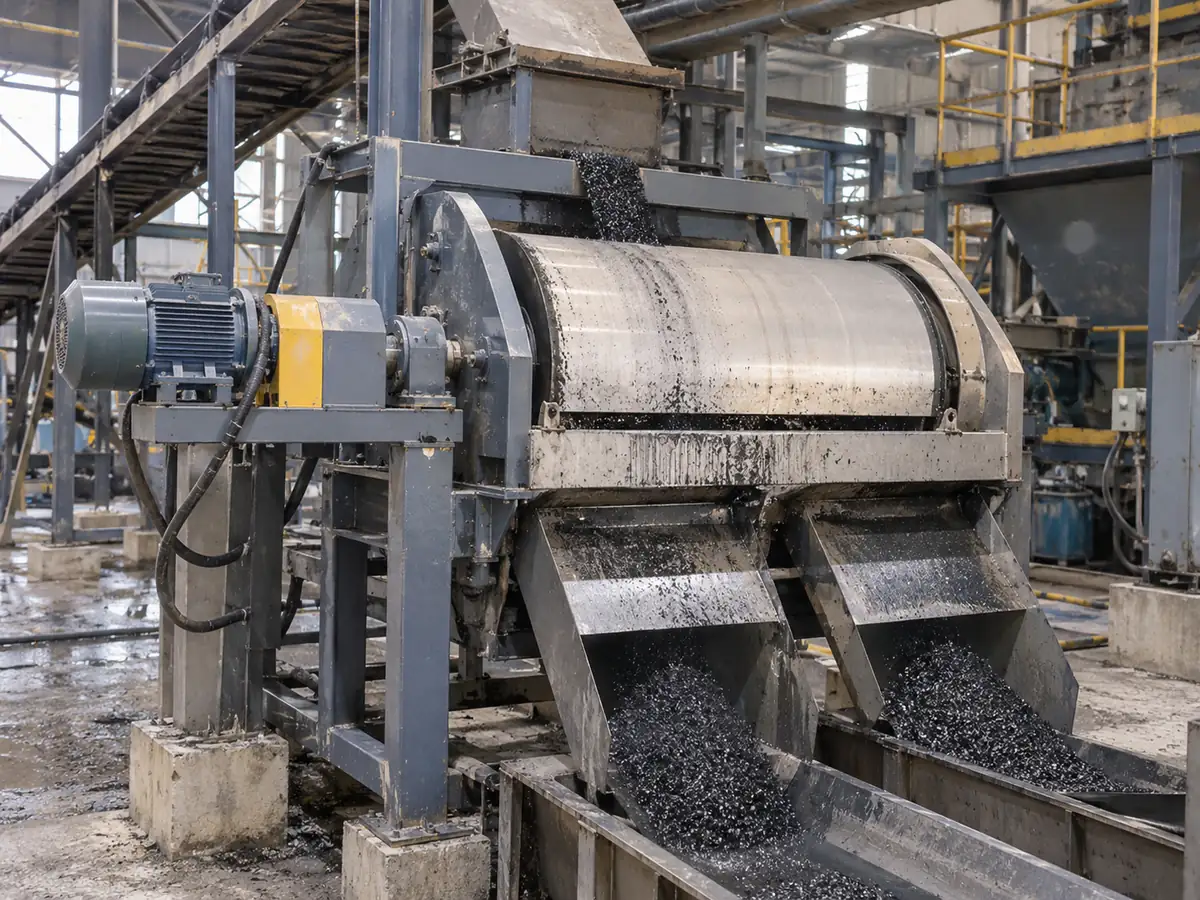
For a drum application, feed presentation, magnetic capture and discharge trajectories must work as one system.

1. Feed Presentation

Material enters the magnetic separation area through a suitable feed arrangement designed for stable separation.

2. Magnetic Capture

Responsive particles experience magnetic force through the real working distance.

3. Different Trajectories

Magnetic and less-responsive particles follow different paths around the drum.

4. Separate Discharge

The splitter and discharge geometry divide the actual particle trajectories into separate products.

For detailed drum construction and configuration, see the Magnetic Drum Separator page.

Conceptual magnetic drum separator illustrating mineral feed and separated discharge

Liberation

Why Liberation Size Can Matter More Than a Higher Magnetic Field

Quick answer: magnetic separation acts on particles. If ilmenite is still locked with gangue, a stronger magnetic circuit cannot physically separate mineral phases that have not been liberated.

Fully Liberated Particle

A separate titanium-bearing particle has a better basis for selective response and a cleaner product split.

Locked Particle

Ilmenite attached to gangue can report as a composite particle, reducing either recovery or product quality depending on where it goes.

Ultrafine Particle

At very fine sizes, slime, fluid effects, entrainment and unstable presentation can become as important as nominal magnetic strength.

Feed Condition

Dry or Wet Magnetic Separation for Titanium Ore?

Short answer: use the existing material state and beneficiation circuit as the starting point. Dry separation depends strongly on moisture, feed presentation and particle behavior; wet separation depends on slurry concentration, flow, classification and tank/discharge conditions.

Dry Route

Review moisture, flowability, burden depth, feed distribution, dust, abrasion and the available working distance. A dry magnetic drum is only useful when the real feed can be presented consistently to the active zone.

Wet Route

Review solids concentration, particle size, volumetric flow, classification, tank geometry and magnetic discharge. A dedicated wet drum should be configured as part of the slurry circuit rather than treated as a dry drum placed in water.

Process Performance

What Controls Titanium Ore Magnetic Separation Performance?

Separation performance depends not only on the magnetic separator itself, but also on the ore characteristics and feed conditions.

Mineral Magnetic ResponseDetermines whether the proposed magnetic route is physically realistic for the target fraction.
LiberationLocked mineral cannot be selectively separated simply by increasing the magnetic specification.
Particle SizeChanges magnetic-force balance, trajectory and how consistently the feed can be presented.
Feed Layer / Slurry ConditionChanges working distance, particle interaction and the stability of the separation zone.
Field Strength & GradientInfluence magnetic force on responsive particles, but they do not independently guarantee recovery.
Residence Time & Discharge GeometryInfluence where captured and less-responsive fractions finally report.

Magnetic Specification

How to Specify Magnetic Performance for Ilmenite Separation

Quick answer: Gauss is only one factor in magnetic separator selection and does not determine separation performance alone. Other factors such as working distance, magnetic gradient, mineral response and material conditions also affect the final result.
Field StrengthMagnetic flux density at a stated measurement point.
Field GradientHow rapidly the field changes through the separation zone.
Working DistanceThe real gap between the target particle and magnetic source.
Mineral ResponseThe actual behavior of the target mineral assemblage.
Particle MotionExposure time, feed trajectory and discharge path.

Plant Integration

Fit the Separator Into the Existing Titanium Beneficiation Line

To recommend the right magnetic separator, we need more than the capacity requirement. Please provide the upstream equipment, downstream handling requirements and installation conditions.

Upstream EquipmentCrusher, screen, mill, classifier, spiral, conveyor or other equipment immediately before the magnetic stage.
Feed InterfaceFeed direction, elevation, chute or pipe size, distribution and normal/peak condition.
Product DischargeRequired magnetic and non-magnetic outlet locations, drop height and downstream product handling.
Downstream EquipmentFlotation, electrostatic separation, dewatering, concentrate handling or other following process stage.
Mechanical / ControlsFootprint, support, maintenance access, lifting route, drive, speed control and project-specific interfaces.

Why Corvelan

Why Choose Corvelan Magnetic Separators for Titanium Ore Applications

For your titanium ore project, we check the ore, equipment design, test method and plant connections together before recommending a separator.

Material TestingUse representative ore, concentrate or tailings to evaluate the decision that cannot be resolved responsibly from a catalog specification alone.
Equipment ManufacturingConfigure confirmed dry or dedicated wet magnetic drum construction, magnetic system and mechanical interfaces around the approved duty.
Inspection & AcceptanceKeep drawing checks, magnetic measurements and material performance evidence separate so each result supports the correct decision.
Application-First SelectionStart with the material, target fraction and flowsheet position rather than a catalog model.
Material Testing RouteUse representative testing when magnetic response or process performance is uncertain.
Custom InterfacesConfigure feed, discharge, splitter, access and mounting around the approved plant layout.
Defined AcceptanceUse an acceptance method that matches what the project actually needs to verify.
When a Different Separator Is NeededDo not present a conventional drum as a universal answer when the ore points to another separation route.
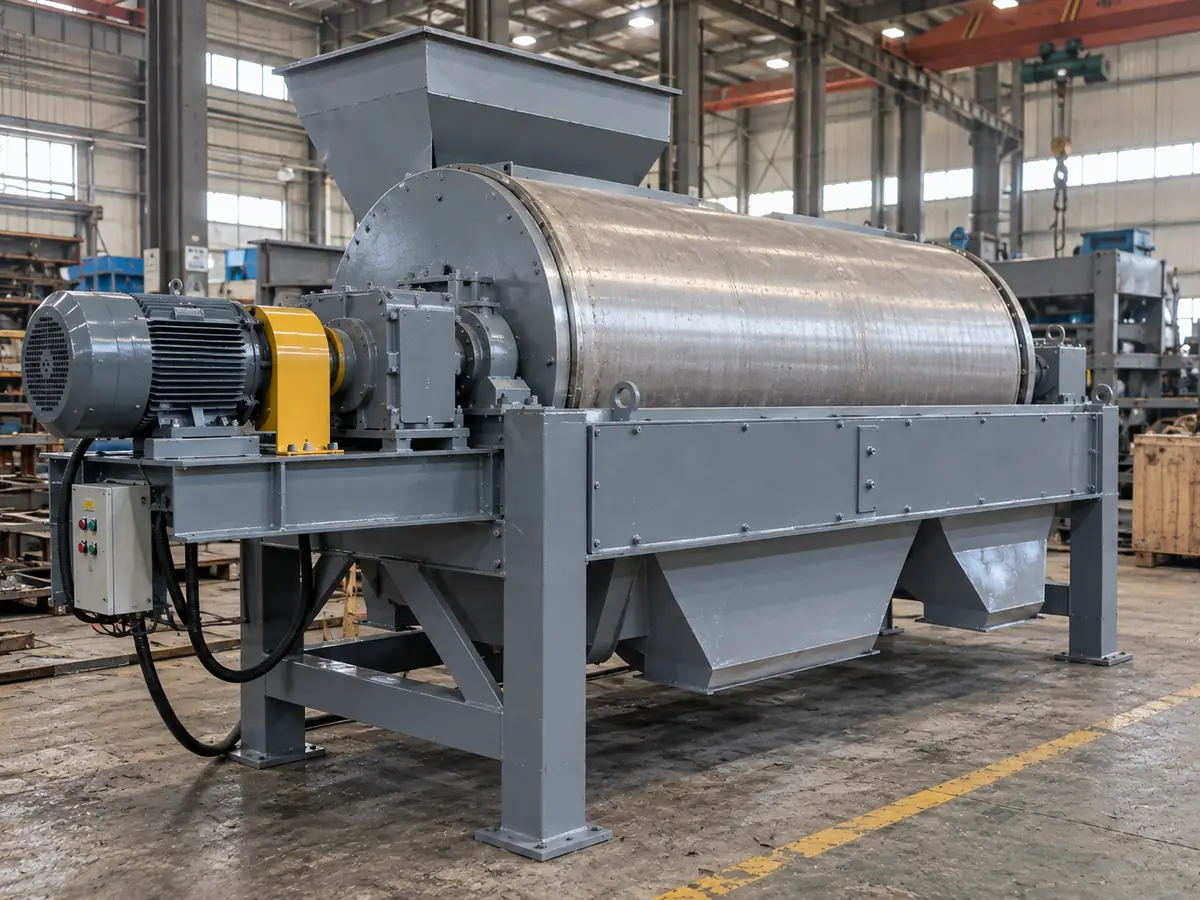
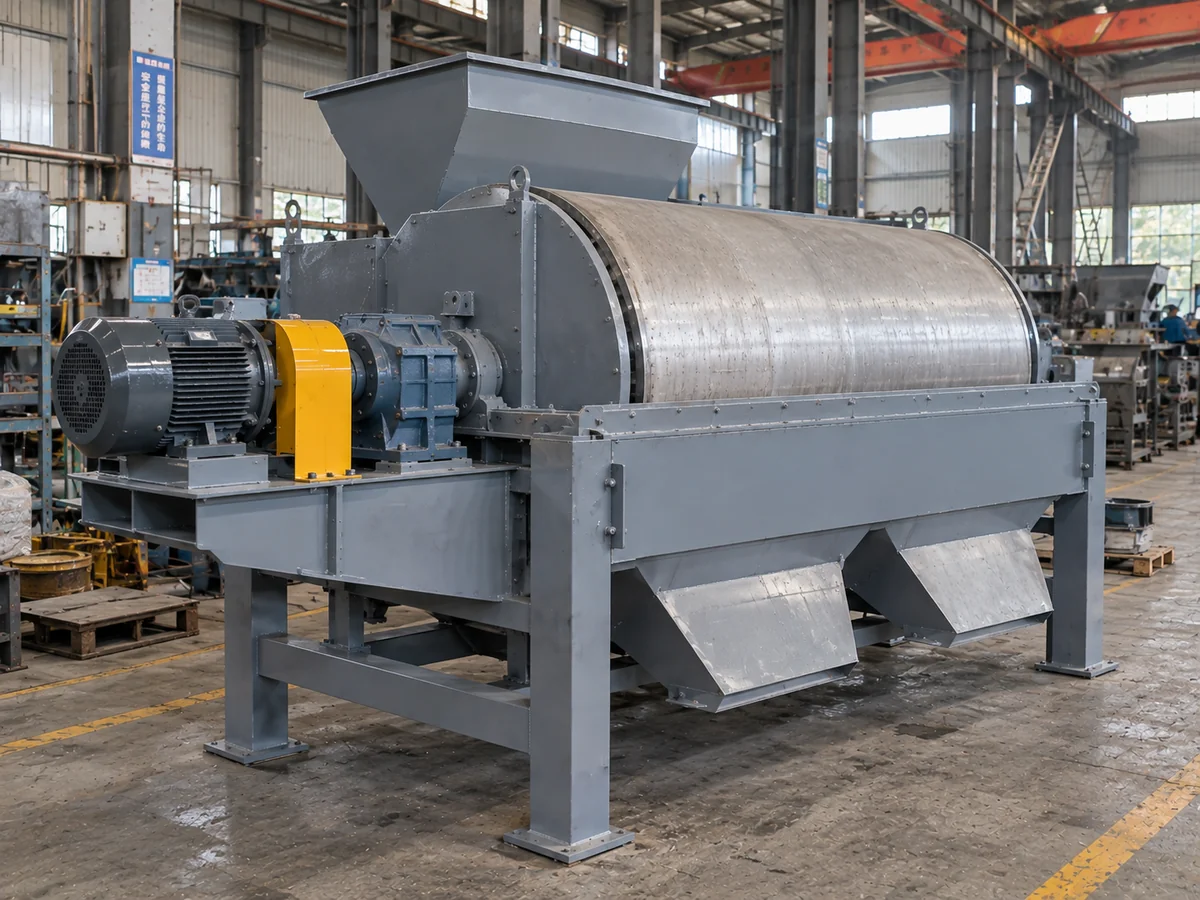
Conceptual completed magnetic separator configuration for project engineering review

RFQ Checklist

Send These 9 Details to Select the Right Titanium Ore Magnetic Separator

You do not need to select the drum diameter, magnet grade or headline Gauss value before contacting us. Send the material and application information needed to recommend the right magnetic separator.

1. Ore Type / SourceHard rock, placer, concentrate, heavy mineral sand or tailings.
2. Assay / MineralogyTiO₂, total iron, XRF/XRD or other mineralogical information if available.
3. Target Mineral / ContaminantMagnetite, titanomagnetite, ilmenite, tramp iron or another defined fraction.
4. Particle SizeFeed PSD and any known liberation information.
5. Feed ConditionDry moisture condition or slurry concentration/flow information.
6. CapacityNormal and peak feed rate tied to the stated material condition.
7. Existing FlowsheetUpstream and downstream equipment around the proposed magnetic stage.
8. Installation DrawingAvailable space, elevation, inlet/outlet positions and maintenance constraints.
9. Required ResultRemoval, recovery, grade, residual, product loss or another clearly defined acceptance target.

FAQ

Titanium Ore Magnetic Separator FAQ

What magnetic separator is used for ilmenite?

There is no single universal ilmenite separator. The correct route depends on mineral assemblage, magnetic response, particle size, liberation, dry or wet feed condition and the required product split. Strongly magnetic fractions can often be removed first, while direct ilmenite recovery may require representative testing and evaluation of a higher-intensity or higher-gradient separation class.

Can a permanent magnetic drum separate ilmenite?

Sometimes, but not by assumption. A permanent drum can be appropriate for strongly magnetic fraction removal and selected mineral-recovery duties. Direct ilmenite recovery should be checked against the real ore, liberation, particle size, working distance and magnetic response before a conventional drum is approved.

Is ilmenite magnetic?

Ilmenite is magnetic enough to be treated as a weaker or paramagnetic mineral in many beneficiation decisions, but it responds much less strongly than magnetite. Practical response varies with composition, intergrowth, particle size and liberation, so the actual ore should control separator selection.

Can magnetic separation recover rutile?

Rutile is not normally the mineral directly captured by conventional magnetic separation. In rutile-bearing feeds, magnetic separation is more commonly used to remove or stage accompanying magnetic minerals so the non-magnetic or less-magnetic fraction can be treated by the next beneficiation step.

Should magnetite be removed before ilmenite recovery?

In many titanium-bearing ores, removing a strongly magnetic magnetite or titanomagnetite fraction first can simplify downstream treatment of the titanium-bearing fraction. The exact sequence still depends on mineralogy, liberation and the required concentrate and tailings products.

Is dry or wet magnetic separation better for titanium ore?

Neither route is universally better. Dry separation depends heavily on moisture, feed presentation, burden depth and particle behavior. Wet separation depends on slurry concentration, flow, classification, tank geometry and magnetic discharge. Start from the existing beneficiation circuit and real feed condition.

Does higher Gauss mean higher ilmenite recovery?

No. Gauss describes magnetic flux density at a defined measurement point. Recovery also depends on field gradient, working distance, mineral response, liberation, particle size, feed presentation, residence time, discharge geometry and the test method.

Why does liberation size matter in titanium ore magnetic separation?

Magnetic separation acts on particles, not theoretical mineral phases. If ilmenite remains locked with gangue, a composite particle may report to the wrong product or reduce concentrate quality. Grinding and classification may therefore matter more than simply increasing magnetic strength.

What information is needed to select a titanium ore magnetic separator?

Provide the ore type and source, assay or mineralogy if available, target mineral or contaminant, particle-size distribution, feed condition, normal and peak capacity, existing flowsheet, installation drawing or available space, and the result you need the separation stage to achieve.

Can Corvelan test my titanium ore before equipment selection?

Corvelan offers magnetic separation material testing when the real material response or process result cannot be judged responsibly from a catalog specification alone. The representative sample, test question, acceptance metric and operating conditions should be defined before the result is used for the next equipment decision.

Titanium Ore Separation Review

Send Your Ore Analysis, Flowsheet and Capacity

We will help evaluate your titanium ore application, recommend suitable magnetic separator options and confirm the information needed for quotation.

Request Titanium Ore Separation Review

Get An Instant Quotation Now