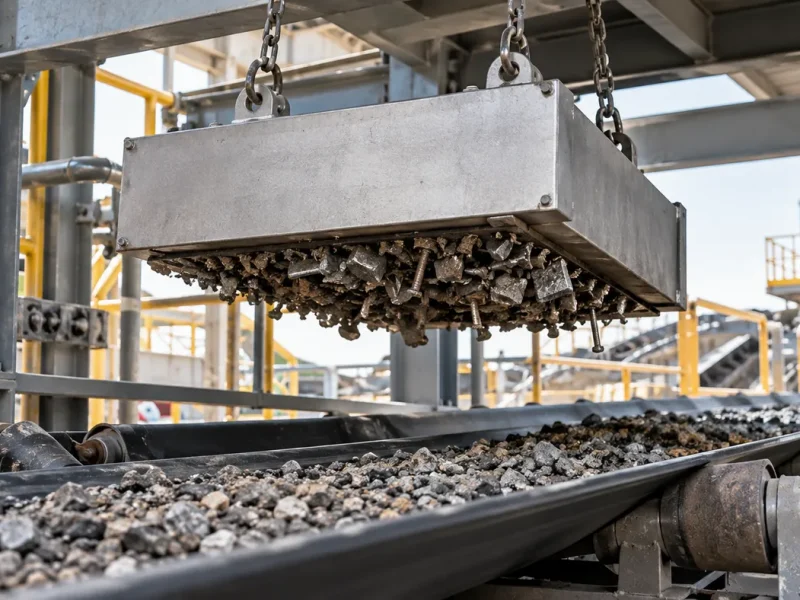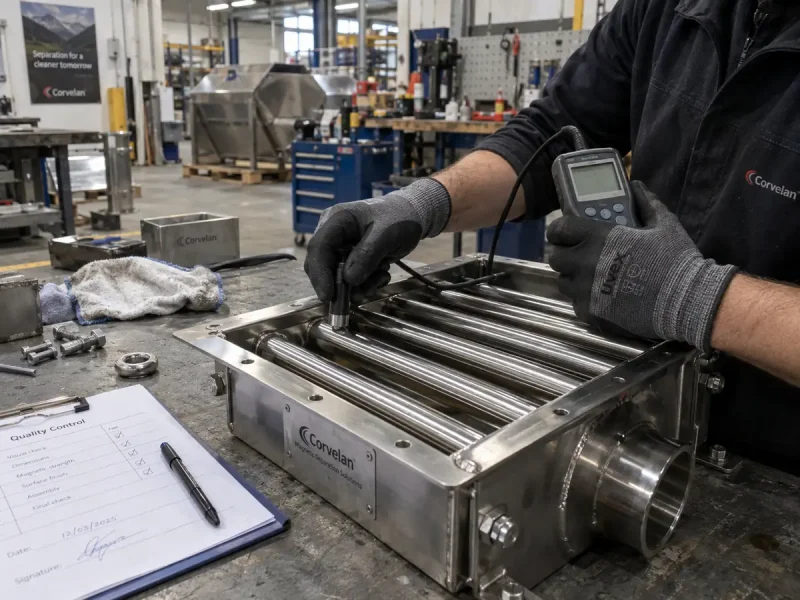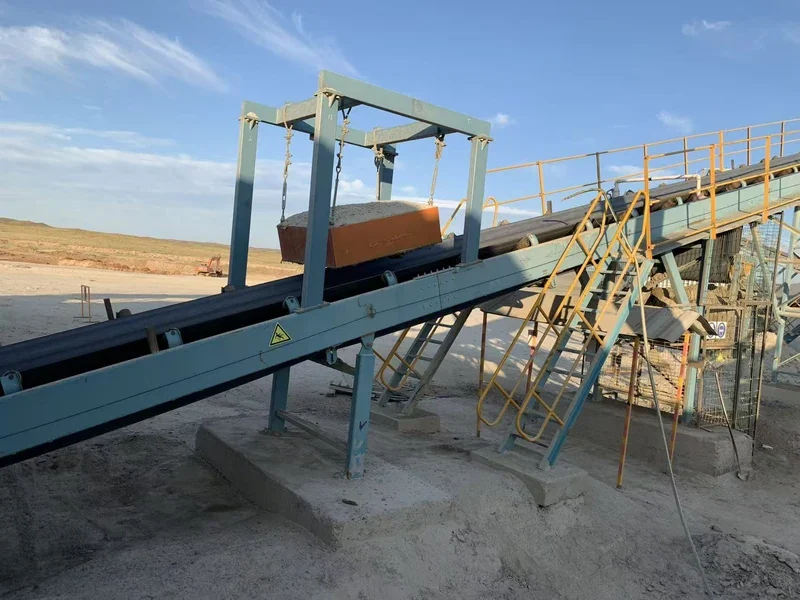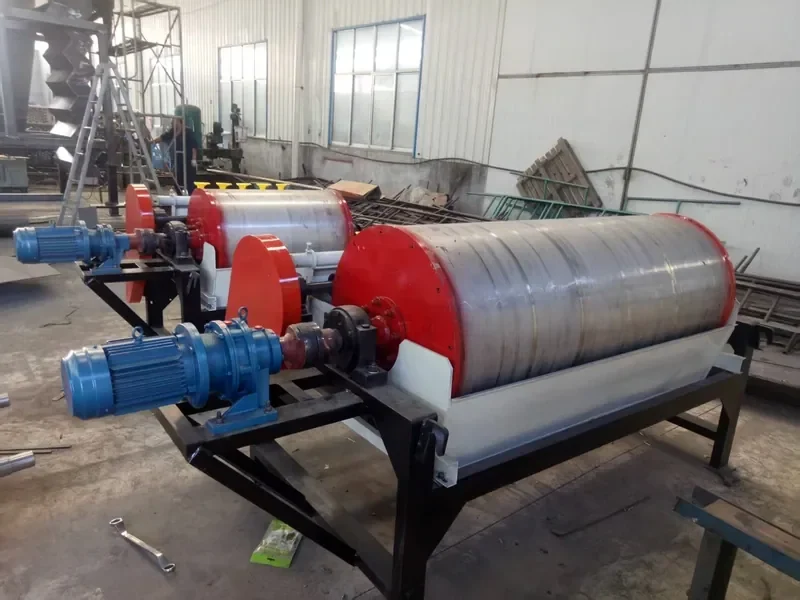
Quick answer: Gauss and pull force are not interchangeable measurements. Gauss tells you the magnetic flux density at a defined point; pull force tells you the breakaway force for a defined ferrous test piece under a defined setup. Use Gauss when you need to compare flux density at the same defined location and distance. Use pull force when you need to compare breakaway force using the same test piece, gap, location, and pull direction. Use a process test when the decision concerns actual capture, recovery, purity, or residual contamination. If you are checking whether an installed separator has changed over time, repeat the same baseline method before concluding that the magnetic system itself has weakened.
A magnetic separator can be described with a high Gauss value, a high pull-force value, or both. The problem begins when those numbers are treated as if they sit on one universal “magnetic strength” scale.
They do not. The useful comparison is the one that answers the decision you actually need to make under controlled conditions. That means defining what is being measured, where it is measured, how it is measured, and what decision the result is supposed to support.
For supplier comparisons, our position is simple: a larger number should not win unless the measurement basis is both equivalent and relevant to the installed duty.

Gauss vs Pull Force: What Does Each Number Actually Measure?
Gauss is a unit used for magnetic flux density. NIST identifies Gauss as a unit of magnetic flux density, with 1 G corresponding to 10⁻⁴ T. A Gauss reading therefore describes the magnetic field at the probe position; it is not a direct measurement of mechanical holding or breakaway force.
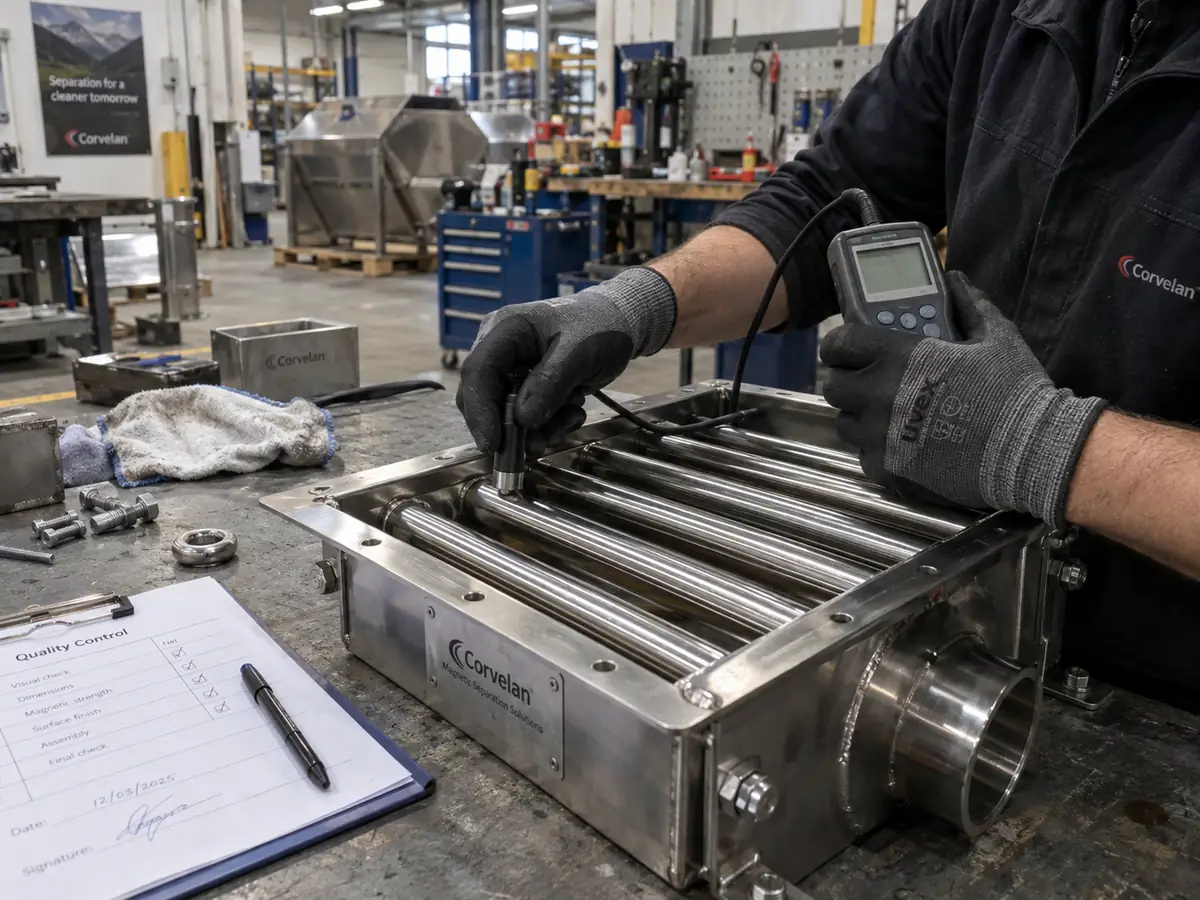
Pull force is a force measurement. In a magnetic-separator pull test, a defined ferrous test piece is attracted to the magnetic field and a force gauge records the force required to pull the piece away under a defined test setup.
The difference matters because changing the test object, gap, position, orientation, or measurement method can change the result without changing the underlying separator hardware.
Same separator, different Gauss reading: Move the probe to another position, rotate it, or measure at an offset instead of direct contact, and the reading can change even though the magnetic assembly has not changed. To judge the result, ask where the probe was placed, how it was oriented, and at what distance the reading was taken.
Same separator, different pull-force result: Change the steel test piece, contact area, spacer thickness, test location, or pull direction, and the measured breakaway force can change without any change to the separator. A pull-force number without the test-piece definition and gap is therefore incomplete comparison data.
| Measurement | What it tells you | Typical variables that must be defined | What it does not prove by itself |
|---|---|---|---|
| Gauss | Magnetic flux density at a defined point | Meter/probe, probe orientation, exact location, pole reference, distance/gap, operating condition | Holding force, capture efficiency, recovery, purity |
| Pull force | Breakaway/attractive force on a defined test piece | Force gauge, test-piece material/geometry, spacer/gap, location, pull direction, repetition method | Complete field distribution, capture efficiency, recovery, purity |
| Process test under defined material and operating conditions | Outcome under defined material and operating conditions | Feed/material, contaminant, flow, geometry, working distance, sampling, pass/fail metric | A universal magnetic property that transfers unchanged to another process |
Can You Compare Gauss and Pull Force Directly?
No; normalize the decision and test method first. A Gauss value and a pull-force value measure different physical quantities, so their numerical magnitudes should not be ranked against each other.
A statement such as “12,000 Gauss is equivalent to 8 kg of pull” is incomplete unless a specific geometry, ferrous test object, distance, magnetic circuit, and validated method are defined. Even then, the relationship describes that defined setup; it is not a universal conversion for magnetic separators.
The practical rule is simple: if the two quotations measure different things, do not compare the headline numbers. First decide which measurement answers your purchasing or acceptance question.
Before you compare: A larger Gauss number does not automatically outrank a pull-force result, and a larger pull-force result does not automatically prove better separation. First make sure the two suppliers are measuring the same thing under equivalent conditions.

| Supplier data presented | Can you rank it directly? | What to do next |
|---|---|---|
| Gauss vs pull force | No | Choose one decision question and one relevant method |
| Gauss vs Gauss, but measurement points differ | No | Request readings at equivalent documented positions |
| Pull force vs pull force, but test pieces or gaps differ | No | Retest or request results under one defined setup |
| Same method and equivalent conditions | Potentially, for that defined test question | Check whether the test also represents the installed duty |
| Static magnetic test vs claimed process recovery/purity | No | Require a process test under agreed material and operating conditions |
This prevents a common procurement error: selecting the quotation with the biggest number before checking whether the numbers describe the same thing.
Which Test Should You Use for the Decision You Need to Make?
Use the test that measures the thing your acceptance question asks. In practical terms, choose the test that measures the result you actually need to check. We recommend choosing the method from the decision first, not simply because a supplier happens to publish that number.
| Decision you need to make | Most relevant evidence | Why | What it cannot establish alone |
|---|---|---|---|
| Compare magnetic flux density at a defined point | Gauss reading under one defined method | Directly measures flux density at that location | Holding force or process result |
| Compare breakaway/holding behavior under a controlled setup | Pull-force test | Gives a repeatable force result when apparatus and method are controlled | Complete field distribution or process result |
| Trend the same separator over time | Repeated Gauss or pull test using the same baseline method | Detects change relative to a reproducible baseline | Root cause or process performance without further checks |
| Verify capture, recovery, purity, or residual contamination | Process/material test under defined conditions | Tests the outcome that matters in operation | Transferability to materially different feed or operating conditions |
| Meet a sector-specific acceptance requirement | The method required by the applicable standard or contract | Keeps verification aligned with the governing scope | General applicability outside that scope |
Start With Your Actual Question
Comparing two suppliers: Normalize the measurement method first. Different measurements are not rankable; the same measurement under different conditions is not comparable yet.
Accepting new equipment: Define the measurement point, test setup, acceptance basis, and required record before the test starts.
Checking an installed separator: Repeat the original baseline method before deciding the magnet has weakened. A new probe position, test piece, gap, or operator method can create an apparent change.
Checking actual separation performance: Move from a component-strength number to a representative material/process test when the question is capture, recovery, purity, or residual contamination.
Comparing a defined magnetic field point
Use Gauss when the question is specifically about magnetic flux density at a known point. This is useful only when the probe type, orientation, location, pole reference, and distance are defined well enough to reproduce the reading.
If one supplier reports a peak directly at a pole edge and another reports a value at a different surface location or offset, the units match but the comparison basis does not.

Comparing breakaway or holding force under one method
Use pull force when the question is how much force is required to separate a specified ferrous test piece under a specified setup. Published pull-test procedures define the test piece, gap or spacer, location, pull direction, and repeat method because these variables materially affect the reading.
For supplier comparison, the apparatus is part of the result. A pull-force number without the apparatus and method is incomplete.

Trending the same installed separator over time
Either method can support trending if the baseline is repeatable and the same method is used later. The purpose here is not to prove an absolute universal magnetic strength; it is to detect whether the measured condition has changed relative to a known baseline.
If the test location, probe, test piece, spacer, or operator method changes, an apparent “loss of strength” may be a test-method change rather than a real separator change.
If the reading changed: First confirm that the meter or probe, measurement point, probe orientation, test piece, spacer or gap, pull direction, and relevant physical condition are the same as the baseline. Dirt, retained ferrous material, a changed cover or liner, temperature where relevant, or a different energization state can also change the test condition.
If the magnetic baseline is stable but separation performance is worse: Do not immediately blame the magnetic assembly. Check whether material depth, throughput or velocity, contaminant size, contaminant exposure, moisture or agglomeration, feed distribution, or working distance has changed.
Next step: Only after the baseline method and process conditions are checked should you treat a changed reading as evidence that the magnetic condition itself may have changed.
Proving capture, recovery, or purity in actual material
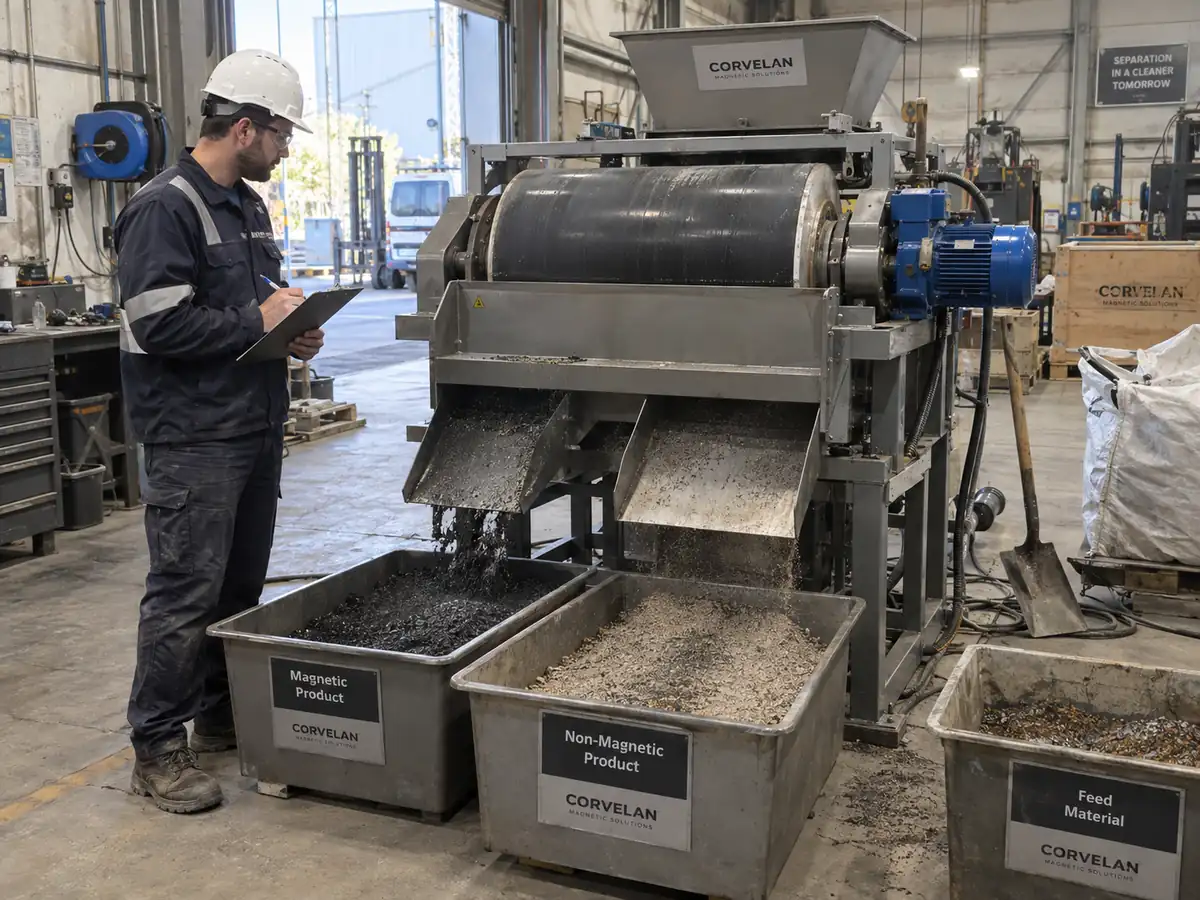
Move to a process test with material that represents the planned production condition when the decision concerns the production result. Material properties, contaminant size and magnetic response, flow rate or velocity, burden depth, working distance, separator geometry, and sampling method can all affect the outcome.
A static magnetic measurement can be useful evidence about the magnetic component, but it does not prove a process-performance claim on its own.
When Are Two Gauss Readings Actually Comparable?
Same unit is not enough; match method, position and distance. Two Gauss readings are comparable only when the measurement method, measurement point, and relevant operating conditions are sufficiently equivalent.
At minimum, check the following fields before ranking supplier values:
- Instrument and probe type: Record the meter and probe configuration used for the measurement.
- Probe orientation: The probe must be oriented consistently relative to the field being measured.
- Exact measurement location: Define the point on the magnetic face or relative to the magnetic pole rather than reporting only “surface Gauss.”
- Distance or gap: State whether the value is at contact/surface or at a defined offset.
- Surface and installation condition: Define relevant covers, sleeves, liners, or other barriers if they are part of the measurement condition.
- Operating state: If temperature, energization state, or another controlled condition is relevant to the specific equipment, record it rather than assuming every reading was taken under the same state.
- Reporting rule: State whether the reported figure is a peak, an average, a mapped point, or another defined value.
The key mistake is assuming that the same unit guarantees an apples-to-apples comparison. It does not. A “higher Gauss” claim has little procurement value if you cannot reproduce the point and method that produced it.
If the supplier cannot define the measurement position and method, treat the headline number as incomplete data rather than evidence that one separator is stronger.
Same unit does not mean the same test. One supplier may measure directly at the magnetic surface and report a peak position, while another measures at an offset or at a different defined location. Both results can legitimately be reported in Gauss, but they do not answer the same comparison question.
How to judge it: If you cannot place the probe back at the stated location and reproduce the measurement condition, the value is not yet normalized enough for supplier ranking.

When Are Two Pull-Force Results Actually Comparable?
Pull force is comparable only under the same defined apparatus and method. Two pull-force results are comparable only when the test apparatus and procedure are controlled. The test piece, air gap, location, and pull direction can change the measured force enough to invalidate a supplier ranking.
Before comparing pull-force values, define:
- Force gauge: The gauge type and its relevant calibration/verification status where required.
- Ferrous test piece: Material, size, shape, and attachment arrangement.
- Spacer or air gap: State whether the test is in contact or uses a defined non-ferrous spacer.
- Test location: Record the exact position and, where relevant, pole location.
- Pull direction: Pull consistently relative to the magnetic face; published procedures commonly specify a perpendicular pull for breakaway testing.
- Surface condition: Dirt, retained ferrous material, wear, or an unintended gap can change the result.
- Repetition method: Repeat the measurement using the same setup so a single operator-dependent result is not treated as the complete test record.
Safety note: Pull tests around strong magnets and ferrous test pieces can create pinch and sudden-release hazards. Follow the equipment manufacturer’s procedure and your site isolation/guarding rules; this article is not a machine test procedure or risk assessment.

This is especially important when one quotation publishes only a force value in kilograms-force, pounds-force, or newtons. Converting the force unit does not fix a different test piece, different air gap, or different test location.
Why Two Changes at Once Can Mislead You
A larger steel test piece combined with a smaller air gap can increase the measured pull force. If both conditions change together, a higher result cannot be attributed to a stronger separator alone.
The reverse can also mislead you: a smaller test piece combined with a larger spacer can reduce the result even when the magnetic assembly itself has not changed.
Comparison rule: If the test piece and gap change at the same time, restore one defined setup before ranking the results.
Why Working Distance Can Change the Comparison
Compare Gauss or pull-force readings where the contaminant travels, not only at the magnetic face. A belt, liner, wall, product layer, spacer or air gap changes the test position, so record the same reference point and conditions for each offer. For the full method to define the distance stack and compare installation geometry, read the Magnetic Separator Working Distance guide.

What Gauss or Pull Force Cannot Prove About Separator Performance
Neither static test alone proves real separation performance. Neither Gauss nor pull force alone proves capture efficiency, recovery, purity, or residual contamination in a moving process.
These static tests can tell you something useful about a magnetic component under a defined condition. The process result, however, also depends on how the target material and contaminant interact with the separator during operation.
Match the evidence to the claim:
| Claim being made | What to use | Why |
|---|---|---|
| “Flux density at this point is X” | Defined Gauss measurement | The claim is a point measurement |
| “Breakaway force under this setup is X” | Defined pull-force test | The claim is a force measurement under a specified apparatus |
| “The magnetic condition has changed since baseline” | Repeat the same controlled baseline test | Trending requires method consistency |
| “The separator captures this contaminant under this duty” | Process test using material that represents the planned production condition and defined operating/sampling conditions | The claim concerns process behavior |
| “The process achieves a specified recovery/purity/residual level” | Defined process trial or commissioning acceptance with sampling | The claim requires a measurable production outcome |

Published technical guidance notes that separation performance is influenced by variables beyond magnetic strength, including flow, particle properties, geometry, and bulk density. Standardized pull-test pieces can improve repeatability, but they do not automatically reproduce the shape or behavior of the actual tramp material being captured.
That distinction matters during purchasing. A technically complete component test can still be the wrong evidence for a process guarantee.
Material and contaminant condition
Particle size, shape, magnetic response, moisture or material state can change how easily a contaminant is exposed to and captured by the field. A test piece chosen for repeatability is not automatically a physical substitute for the real contaminant.

Flow, burden, and velocity
A moving product stream creates competing forces and residence-time limits that do not exist in a static surface measurement. If the commercial claim concerns the operating process, define the operating range rather than extrapolating from a bench or surface number.
Geometry and working distance
The path of the product and contaminant relative to the magnetic element matters. A strong local surface value may be less relevant if the critical contaminant path is farther away.
What Happens When Several Conditions Change Together?
| Combined condition | What changes | What to do |
|---|---|---|
| Fine or weakly responsive contaminant + deep burden + higher flow velocity | The target can be harder to expose to the magnetic field for sufficient time. | Do not infer capture from a surface magnetic number; validate representative material under planned flow conditions. |
| Coarser strongly attracted ferrous piece + shallow burden + favorable presentation | Capture can be easier under the same headline magnetic measurement. | Do not use this easier case to guarantee harder contaminants or deeper process conditions. |
| Stable Gauss or pull-force baseline + worsening process result | The magnetic component may not be the variable that changed. | Check burden, flow, material state, contaminant condition, feed presentation, and working distance before concluding magnet loss. |
Counterexample — same number, different process result: Two separators can show the same defined magnetic reading while operating under different process conditions. A shallow, well-presented material layer and a deeper or faster-moving burden do not create the same separation challenge.
The measurement did not become wrong; the question changed. A valid component-level number may still be the wrong evidence for a process-performance decision.
Testing the actual production result
When the decision is process performance, define the test around the process claim: material, contaminant, operating condition, sampling method, metric, and pass/fail basis. That keeps the test aligned with the result you are buying instead of asking one magnetic-strength number to prove more than it measures.
What Should You Ask a Supplier to Put on the Test Report?
Request the method context with the number; otherwise the number is not auditable. In practical terms, ask for the test conditions with the number. If the result will be used to compare suppliers, approve a design, or establish a baseline for later checks, the report should contain enough information to reproduce the test.

Compare these supplier details:
| Project input / report field | Why it changes the comparison | What it is used for |
|---|---|---|
| Equipment or component identity | Prevents a result from being detached from the tested item | Traceability |
| Measured quantity and units | Distinguishes Gauss from force and other metrics | Basic comparison validity |
| Instrument / gauge identification | Shows what measurement system produced the result | Reproducibility |
| Calibration or verification status, where required | Supports confidence when the applicable method or contract requires controlled instrumentation | Acceptance traceability |
| Probe type or ferrous test-piece definition | These can materially change the reading | Method normalization |
| Exact location / pole reference | Magnetic values vary with position | Repeat testing |
| Gap, spacer, or distance | Working distance affects relevance and measured force | Installed-condition comparison |
| Orientation / pull direction | Method geometry affects the result | Repeatability |
| Surface / relevant test condition | Dirt, barriers, temperature, energization state, or other applicable conditions can affect interpretation | Condition control |
| Repeat count and raw/individual readings | Shows repeatability instead of hiding all variation in one headline number | Auditability |
| Reporting rule | Distinguishes peak, average, mapped value, or another defined result | Data interpretation |
| Baseline or agreed pass/fail basis | A number has little approval value without knowing what it is being judged against | Procurement / commissioning decision |

Not Every Project Needs the Same Evidence Package
- Quotation comparison: focus on measured quantity, method, point or location, gap, probe or test piece, and reporting rule.
- Installed baseline or maintenance trending: add equipment identity, repeat location, baseline date, instrument identification, and individual readings so later checks can reproduce the baseline.
- Process-performance acceptance: the magnetic test report is not enough by itself; also define representative material, operating condition, sampling method, acceptance metric, and pass/fail basis.
Do not assume every supplier provides every document as a standard deliverable. Put the required evidence into the RFQ, technical agreement, inspection plan, or acceptance document before relying on the result.
For a process-performance guarantee, the magnetic test report and the process test plan answer different questions. Agree both when both are needed for approval.
When a Standard Changes the Test Method
A sector-specific standard can override a generic preference for Gauss or pull force within its defined scope.
HACCP International’s 0909MAGSEP 2-2021 is a voluntary standard for final magnetic separation devices used to remove ferromagnetic and weakly ferromagnetic particles from food product streams. HACCP International’s public update material also discusses requirements related to the magnet-strength test method and test instrumentation within that food-safety scope.

That does not make the standard a universal rule for mining separators, wet drums, recycling magnets, conveyor tramp-iron systems, or every industrial magnetic separator. For those applications, first identify the contract, sector requirement, customer specification, or verification objective that actually governs the test.
Before applying a standard, confirm three things: whether your industry and process are inside its scope, whether the contract or customer specification requires it, and whether the test is being used for component verification or process acceptance.
When a standard is contractually applicable, use the current official edition and purchased text for mandatory clauses. Do not rely on a general comparison article to replace the governing document.
Frequently Asked Questions
Is higher Gauss always better?
No. A higher Gauss reading means higher measured flux density at the stated point and condition. It does not automatically prove better holding force or better separation in the actual process. First confirm that the measurement points and methods are equivalent, then check whether that point is relevant to the installed application.
Is higher pull force always better?
No. A higher pull-force result is meaningful only for the defined test piece, gap, location, direction, and method. A different test object or smaller gap can increase the reading without proving better process performance.
Can Gauss be converted to kilograms or newtons of pull force?
There is no universal magnetic-separator conversion. Force depends on the magnetic field together with the test-object material, geometry, contact area, gap, and magnetic-circuit conditions. A relationship calculated for one defined setup should not be reused as a general conversion for another separator.
Can I compare two suppliers if both quote Gauss?
Only if the readings were taken under equivalent documented conditions. Check the probe, orientation, exact location, pole reference, distance/gap, relevant operating state, and reporting rule before ranking the values.
Can I compare two suppliers if both quote pull force?
Only if the apparatus and method are equivalent. Check the force gauge, test-piece material/size/shape, spacer or gap, test location, pull direction, surface condition, and repetition method.
Which test proves actual separation performance?
A representative process or material test is the stronger evidence when the claim concerns capture, recovery, purity, or residual contamination. Define the material, contaminant, operating condition, sampling method, metric, and pass/fail basis so the test measures the outcome you are actually buying.
Why Did My Gauss or Pull-Force Reading Change Even Though the Separator Was Not Replaced?
First check whether the test point, probe or force gauge, probe orientation, test piece, spacer or gap, pull direction, surface condition, and relevant operating condition match the previous baseline. A changed reading can come from a changed test condition. Only after those checks should you investigate whether the magnetic condition itself has changed.
What if the Gauss or Pull-Force Result Is Stable but Separation Performance Gets Worse?
Check changes in material condition, contaminant size or exposure, burden depth, flow rate or velocity, feed presentation, working distance, and separator geometry before concluding that the magnet is the cause. If the commercial decision concerns the process result, use a representative material or process test under defined operating and sampling conditions.