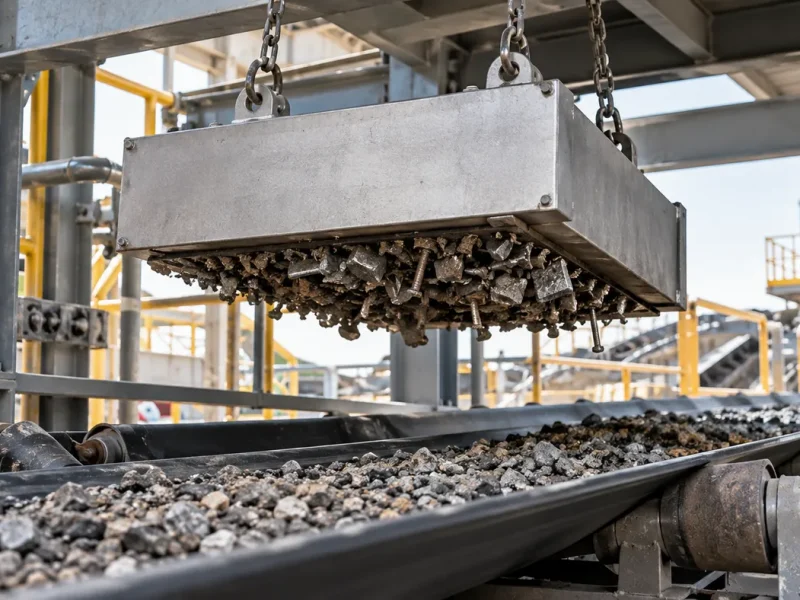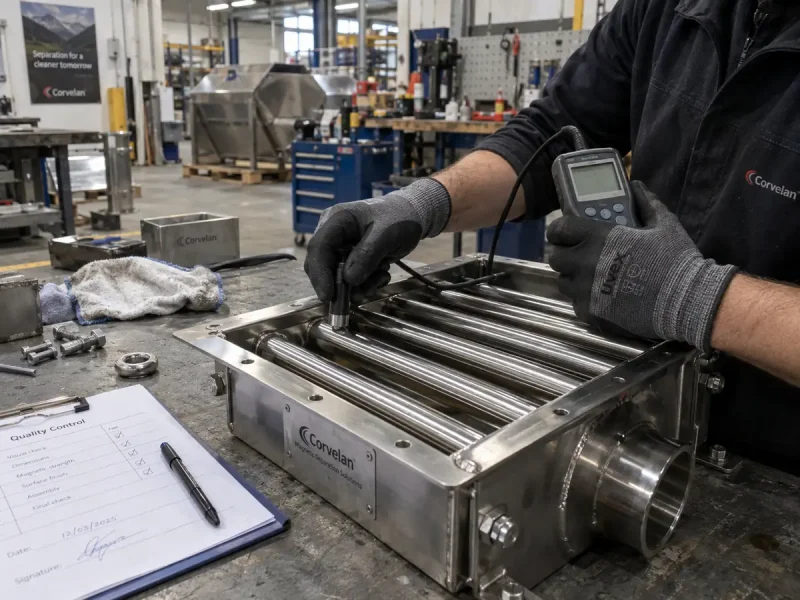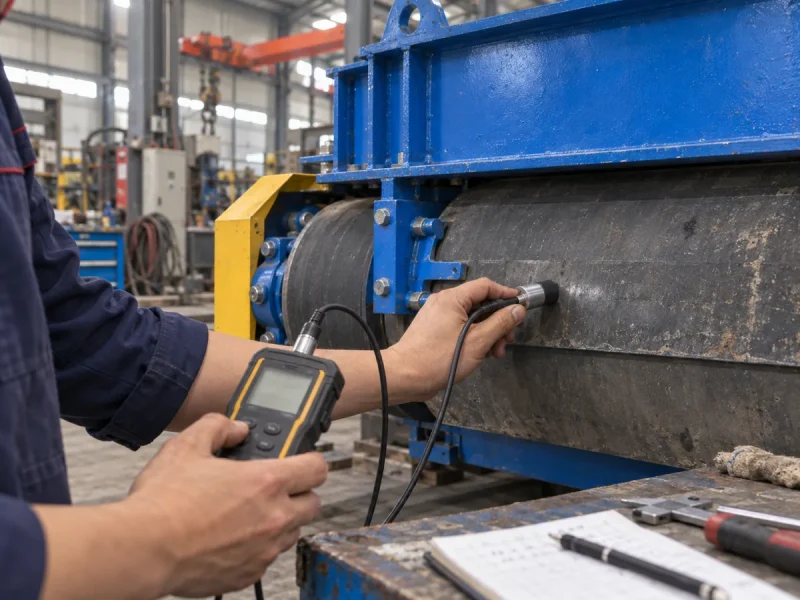
This guide covers industrial magnetic filters and magnetic separators used in dry powder, granule, slurry, and liquid process lines. It does not cover household boiler or central-heating magnetic filters. In this guide, ferrous contamination means mainly iron- or steel-based particles that are strongly attracted to the magnetic collection surface.
Magnetic Filter Cleaning: The Short Answer
Clean an industrial magnetic filter according to its construction, not with one universal procedure. Set the cleaning interval from how quickly ferrous contamination builds up in your own process. If loading suddenly changes, product begins to cake, captured metal becomes unusually difficult to remove, or leakage appears after reassembly, investigate the cause instead of simply cleaning more often.
For industrial magnetic filters, three rules prevent most cleaning mistakes:
- Match the cleaning method to the filter design. A fixed magnetic surface, an extractor-sleeve design, and an automatic or clean-in-place system do not use the same cleaning sequence.
- Set the cleaning frequency from observed loading under comparable conditions. There is no useful universal “clean every X hours” rule for every process. Start with closer checks, record what the filter catches, and adjust the interval from stable operating data.
- Treat an abnormal change as process information. More or less captured metal can reflect throughput, incoming material, upstream wear, maintenance, reassembly, or another process change—not only the cleaning schedule.
Start With Your Situation
Use the symptom or task you have now to enter the guide at the most useful point.
| Your situation | Start here |
|---|---|
| I am not sure how this filter is supposed to be cleaned. | Identify the cleaning design. |
| We seem to be cleaning much more often than before. | Check the loading trend first. |
| The magnetic surfaces look more heavily covered. | Separate ferrous loading from product caking. |
| The amount or type of captured metal suddenly changed. | Check throughput, material, maintenance and equipment condition. |
| Cleaning stops production too often. | Check whether manual cleaning still fits. |
| Leakage or another problem appeared immediately after cleaning. | Check reassembly and restart condition. |
The exact safe-access, isolation, depressurization, disassembly, cleaning-agent and restart procedure must come from the equipment manual and your site procedure. In the United States, OSHA 29 CFR 1910.147 covers servicing and maintenance where unexpected startup or release of stored energy could injure workers.
How to Clean a Magnetic Filter by Design
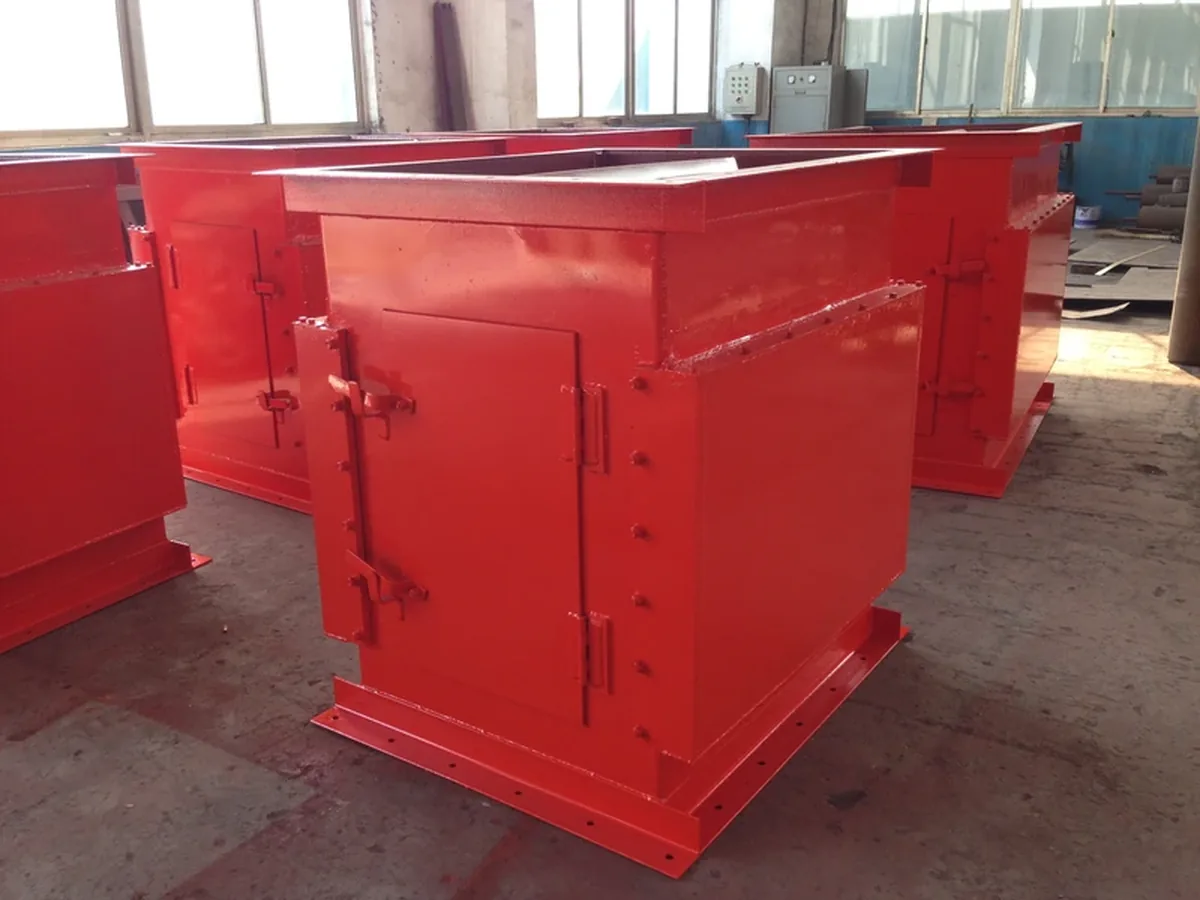
Match the cleaning method to the filter construction before touching the captured metal. First identify how the magnetic element is built and how retained metal is intended to be released. The table below is a decision guide, not a substitute for the equipment manual.
| Filter construction | What you may observe | General cleaning principle | Main check before acting |
|---|---|---|---|
| Fixed or directly exposed magnetic surface | Ferrous particles remain attracted directly to the magnetic collection surface | Use only the manual removal method allowed for that design | Confirm permitted tools, cleaning agent, surface-protection limits and safe access |
| Extractor sleeve / removable magnetic core | An inner magnetic element can move away from an outer collection tube or sleeve | Move the magnetic core away so retained ferrous material can release from the outer collection surface | Confirm the drawing/manual actually shows this mechanism and collect debris away from the product stream |
| Drawer or grate with an easy-clean mechanism | The assembly withdraws to a cleaning position and the magnetic part moves separately | Use the designed release position so collected metal drops into a controlled container | Confirm full travel, guards/interlocks, clearance and discharge location |
| Semi-automatic or automatic cleaning | Pneumatic or electric movement performs part or all of the release cycle | Follow the programmed and manual service sequence for that model | Confirm energy-isolation requirements, actuator state, controls and discharge path |
| CIP/SIP-capable hygienic filter | The housing and product-contact areas are designed for an in-place sanitation sequence | Follow the validated sanitation and magnetic-element procedure for that equipment | Confirm whether ferrous release is a separate step from clean-in-place or sterilize-in-place sanitation |
Manufacturer manuals for industrial magnetic filters commonly show a sequence built around stopping product flow, withdrawing the magnetic unit, releasing captured metal from extractor tubes where that construction is used, cleaning the components, reassembling them and then restarting. That is useful as a principle, but it should not be copied mechanically onto a different filter design.
How to Tell Similar Cleaning Designs Apart
Material and Process Conditions Change the Cleaning Problem
The same magnetic filter can behave very differently with free-flowing powder, sticky product, abrasive feed, liquid or a hygienic process. Separate ferrous loading from ordinary product build-up before deciding that the answer is simply to clean more often.
| Material or process condition | What you may see | Main cleaning concern | What to investigate |
|---|---|---|---|
| Dry, free-flowing powder | Ferrous fines collect mainly around the active magnetic surface | Remove captured metal without releasing it back into the product path | Loading trend, throughput, particle character and contamination source |
| Moist or sticky powder | Product and captured metal form mixed build-up | Product caking may be mistaken for magnetic loading | Moisture, flowability, bridging and actual captured metal |
| Abrasive material | Wear marks may develop on tubes or sleeves over time | Cleaning should not hide physical wear or damage | Tube/sleeve condition, abrasion, impact points and upstream wear sources |
| Liquid or slurry | Residue remains around the housing, tubes or seals | Drainage, pressure state and sealing matter during access and restart | Retained product, seals, leakage and the model-specific procedure |
| Hygienic process | Product residue may matter as much as captured metal | Magnetic cleaning and sanitation may be separate requirements | Validated CIP/SIP procedure where applicable, drainage, seals and product-contact surfaces |
Dry, Free-Flowing Material: When Loading Is Easier to Interpret
When the product is relatively dry, free-flowing and not caking, ordinary product is less likely to create a thick sticky layer around the magnetic elements. Surface build-up is therefore often easier to relate to actual captured contamination. The important boundary is throughput: even with dry material, a higher captured mass per hour can simply reflect more material passing through the line. Compare runs only after checking whether production rate was reasonably similar.
Sticky Product: Is It Ferrous Loading or Product Caking?
Sticky, moist, fatty or very cohesive product can make the magnetic surface look much more heavily covered even when the amount of captured metal has not changed much. This creates two different situations that need different actions.
| Observation | More likely interpretation to test | How to tell | Next action |
|---|---|---|---|
| Surface coverage increases and captured ferrous mass also increases | Contamination loading may genuinely have increased | Compare throughput, raw material, upstream wear, maintenance and particle character | Investigate the contamination source and temporarily use closer inspections if needed |
| Surface coverage increases but captured ferrous mass stays similar | Product caking, moisture or poor flowability may be increasing | Compare moisture/product condition, bridging and the non-metal portion of the build-up | Address flowability or caking instead of only shortening the magnetic-cleaning interval |
A magnetic surface that looks more heavily covered does not automatically mean that more metal is being captured.
Abrasive Feed: Filter Wear or an Upstream Wear Source?
If the filter surface itself develops new scratches, pits, dents or local abrasion, inspect that component and compare the condition with the service limits for the equipment. If the magnetic surface shows no corresponding new damage but captured debris changes to flakes, chips, wire-like pieces or larger fragments, investigate upstream wear or recent maintenance as well. Particle shape is a useful clue, but it does not by itself prove where the metal came from.
Liquid or Slurry: Separate Loading Problems from Sealing Problems
If loading was normal before cleaning but leakage appears immediately after restart, first inspect seals, mating surfaces, clamps and reassembly rather than changing the cleaning interval. Residue around tubes or housings should also be separated into retained process material and captured ferrous contamination. In a pressurized line, stopped flow does not prove that stored pressure is zero.
Safety Changes with the Installation
A gravity-fed grate and a pressurized or pneumatically actuated filter may require very different isolation procedures. Stopped product flow does not prove that the equipment is safe to open. Control electrical, pneumatic, hydraulic, pressure, gravity, or other stored-energy sources according to the equipment manual and the site’s authorized procedure before opening or servicing the filter.
Magnetic Filter Cleaning Frequency: How to Set It
Set cleaning frequency from how fast contamination accumulates under your real operating conditions. The goal is to clean before loading becomes unacceptable for the process, without creating unnecessary stops. The acceptable limit is application-specific; this article does not assign a universal mass, coverage percentage or time interval.
A practical way to establish an interval is:
- Start with a short inspection interval. This is especially important on a new line, after maintenance, after a raw-material change, after a rate change, or when you do not yet have a stable loading history.
- Record what the filter captured and how much material passed through the process. Use collected mass where practical, a repeatable loading observation where weighing is not practical, particle character, runtime or batch count, and throughput/material processed.
- Compare several reasonably comparable runs. If loading remains stable and comfortably below the process limit, cautiously lengthen the interval. If loading is heavy or increasing, shorten it temporarily while you investigate why.
- Re-baseline after change. A previously stable schedule should not be treated as permanent after a process, material, equipment, production-rate or upstream-maintenance change.
Choose a loading metric that matches the way the process operates. Captured ferrous mass per operating hour can be useful when throughput is reasonably stable. If throughput changes significantly, compare captured contamination with the amount of material processed instead.
Choose the Right Loading Metric
| Process condition | Useful trend metric | Why |
|---|---|---|
| Continuous line with reasonably stable throughput | g/h or another mass-per-time measure | Runtime is a reasonable comparison basis when production rate is similar |
| Continuous line with changing throughput | g/t or another captured-mass-per-material-processed measure | Separates contamination trend from production-rate change |
| Batch process | g/batch or captured mass per known batch mass | Matches the natural operating unit |
| Captured material cannot be weighed consistently | Repeatable coverage observation plus same-position photos | Less precise than mass, but useful for trending when the observation method is consistent |
| A site procedure defines a maximum interval | Follow the approved interval limit; use loading trend as additional information | Safety, sanitation or quality controls may override an economic cleaning interval |
How to Adjust the Cleaning Interval
| What you observe | What it suggests | What to do |
|---|---|---|
| Loading stays low and similar across comparable runs | The current interval may be conservative | Carefully extend the interval and keep checking the trend |
| Loading is consistently heavy | The interval may be too long, or the contamination load may be high | Shorten the interval temporarily and investigate the contamination source |
| Loading suddenly rises | Something may have changed upstream, in the material, or in production rate | Normalize for throughput where needed and investigate before treating it as only a scheduling problem |
| Product build-up increases but captured metal does not | Flowability may be the main problem | Check moisture, caking and bridging instead of only increasing cleaning frequency |
| Raw material, throughput or upstream equipment changes | The previous loading history may no longer represent the process | Establish a new baseline under the changed condition |
Example: Use Loading Rate Only Under Comparable Conditions
A filter collects 24 g of ferrous material after 8 operating hours: 24 ÷ 8 = 3 g/h.
On a later run it collects 52 g after 8 hours: 52 ÷ 8 = 6.5 g/h.
If the runs had similar throughput, that step increase would be worth investigating.
Why Throughput Can Change the Interpretation
Now add production rate to the same illustrative example. If Run A processed 2 t/h for 8 hours, it handled 16 t, so 24 g ÷ 16 t = 1.5 g/t. If Run B processed 4 t/h for 8 hours, it handled 32 t, so 52 g ÷ 32 t ≈ 1.6 g/t.
Hourly loading rose from 3 g/h to 6.5 g/h, but loading per tonne changed only slightly. In this example, higher production explains most of the hourly increase. The numbers are illustrative only; they are not Corvelan test data and are not universal contamination limits.
How Do You Know the Cleaning Interval Is Too Long?
The interval may be too long when captured metal heavily covers the collection surface, material flow begins to restrict, contamination becomes compacted or difficult to release, or the filter repeatedly reaches an unacceptable loading condition before the scheduled clean. There is no universal coverage percentage or number of hours that applies to every magnetic filter; the limit depends on the filter design, process risk, material and site requirements.
Could the Cleaning Interval Be Unnecessarily Short?
Possibly. If several comparable runs show consistently low loading, no unusual process change is present, and no safety, sanitation or quality procedure requires the current interval, the schedule may be conservative. Extend it cautiously and continue checking the trend rather than making a large change at once.
What Does a Stable Cleaning Pattern Look Like?
| Stable pattern | Signal worth investigating |
|---|---|
| Similar loading under comparable throughput and material | A sudden step increase or decrease |
| Similar particle type and shape | New flakes, chips, wire-like pieces or another new form |
| Similar product build-up | Rapid caking or bridging change |
| Cleaning mechanism moves and releases normally | Increasing resistance or incomplete release |
| Reassembly and restart produce no new leakage | Leakage appears immediately after cleaning |
| Cleaning interval remains predictable | The required interval suddenly becomes much shorter |
Stable does not mean identical. The goal is a repeatable range under reasonably comparable conditions, not the same number every time.
When the Usual Cleaning Rule Changes
One operating condition rarely tells the whole story. The combinations below are common situations where a simple “clean more often” rule can lead to the wrong conclusion.
| Combined condition | What changes in the interpretation | Next action |
|---|---|---|
| Dry feed + stable throughput + stable low loading | The current interval may be more conservative than necessary | Cautiously extend it and continue trending |
| Captured g/h rises + throughput also rises | Hourly capture alone cannot show whether contamination concentration worsened | Normalize by material processed before concluding loading increased |
| Surface coverage rises + captured metal stays similar + product is sticky | Caking may be increasing rather than ferrous loading | Check moisture, flowability and bridging before shortening the interval |
| Throughput is similar + captured mass rises + new flakes appear after maintenance | A new upstream wear or maintenance source becomes more plausible | Investigate the source while keeping closer inspections |
| Captured metal falls + downstream contamination becomes worse | Less captured metal is not automatically good news | Check reassembly, magnetic-element position, bypass/contact and operating condition |
| Frequent cleaning + difficult access + continuous production | The cleaning architecture may be the bottleneck, not only the interval | Compare another cleaning arrangement against the real material and line constraints |
Magnetic Filter Cleaning Problems: Symptom, Cause, and Next Check
Use the symptom to decide whether the next action is cleaning, inspection, or a process investigation. Before changing the cleaning schedule, check the conditions in a consistent order.
Before Changing the Cleaning Schedule, Check in This Order
- Compare operating conditions. Check throughput or batch size, raw-material lot, moisture or product condition, pressure where relevant, and any recent rate change.
- Compare the captured material. Look at mass or repeatable loading level, particle size and form, and whether new flakes, chips, dust or wire-like pieces appeared.
- Separate product build-up from ferrous loading. A thicker layer around the magnetic elements may be sticky product rather than a larger metal load.
- Check the filter after the last clean. Confirm reassembly, operating position, seals, closures, visible wear and normal movement of the release mechanism.
- Only then change the interval or cleaning arrangement. This reduces the chance of treating a process or equipment problem as a scheduling problem.
| Symptom | Likely explanation | How to confirm | Next action |
|---|---|---|---|
| Filter reloads much faster than before | New upstream wear, incoming-material contamination, process-rate change, maintenance debris, or another new source | Compare normalized loading where needed, debris shape/type and recent process, maintenance and material changes | Investigate the source while temporarily using closer inspections |
| Filter captures much less metal than before | Cleaner incoming material or lower throughput, but also possible changed material, incorrect reassembly, magnetic element out of position, or changed product contact/bypass condition | Compare throughput, raw material, downstream contamination/result, assembly and operating position | If downstream performance also improves, the feed may truly be cleaner; if downstream performance worsens, inspect capture, assembly and flow condition |
| Ferrous material is very difficult to release | Cleaning method does not match the construction; magnetic core was not moved to the correct release position; compacted product is holding debris | Verify the cleaning mechanism and check for product build-up | Use the model-approved release sequence; do not force or strike components unless explicitly permitted |
| Product bridges or cakes around the magnetic elements | Cohesive, fatty, moist or poorly flowing material is accumulating around the grid/rods | Compare product build-up separately from captured metal | Address flow/cleanability conditions; more frequent metal removal alone may not solve bridging |
| Tube or sleeve is dented, worn, pitted or scratched | Mechanical damage, abrasion, impact or unsuitable cleaning practice | Inspect the affected surface and compare with equipment service limits | Stop using damaging cleaning methods and follow the model-specific inspection/repair decision |
| Leakage appears after cleaning or reassembly | Seal contamination/damage, incorrect seating, loose clamp/fastener, damaged mating surface or incorrect reassembly | Inspect what was opened, moved, removed and resealed during the cleaning event | Correct the reassembly/sealing issue before returning to normal operation |
| Capture seems weaker than before | Changed flow/contact condition, product build-up, wrong operating position, bypass, or another process change; the observation alone does not prove magnet degradation | Compare operating condition, product path, assembly position and downstream result | Restore known operating conditions and investigate before assigning the cause to the magnet itself |
| Released debris can fall back into the product stream | Cleaning position or collection method does not contain the released contamination | Observe the discharge path during an approved clean | Change the collection/cleaning setup so released metal is controlled outside the product path |
A Change in Captured Metal Is a Process Signal
A filter that captures more metal can still be doing its job, and a filter that captures less metal is not automatically performing better. Interpret the change with throughput, downstream result, particle character and recent process events.
| What changed | First interpretation to test |
|---|---|
| Captured mass increases while throughput is similar | Contamination loading may have increased |
| Captured mass increases while throughput also increases | Normalize by material processed before concluding contamination concentration worsened |
| Surface coverage increases while metal mass is similar | Product caking may be increasing |
| New flakes or chips appear | Investigate upstream wear, maintenance or another new source |
| Captured mass decreases and downstream result improves | Incoming contamination may genuinely be lower |
| Captured mass decreases but downstream result worsens | Check capture, assembly, bypass/contact and flow condition |
Cleaning Mistakes to Avoid
| Mistake | Why it matters |
|---|---|
| Opening a powered or pressurized unit because product flow has stopped | Stored energy or pressure may still remain |
| Scraping, striking or using abrasive tools on magnetic tubes without an approved procedure | The cleaning action can damage the collection surface and create another equipment problem |
| Cleaning more often without investigating abnormal loading | The real source may be upstream or related to a changed process condition |
| Treating product caking as the same thing as ferrous loading | Flowability problems may need a different correction |
| Allowing released metal to fall back into the product path | The cleaning action can re-contaminate the process |
| Comparing g/h between runs with very different throughput | A higher hourly capture rate may simply mean more material passed through the filter |
When Manual Cleaning Becomes the Bottleneck
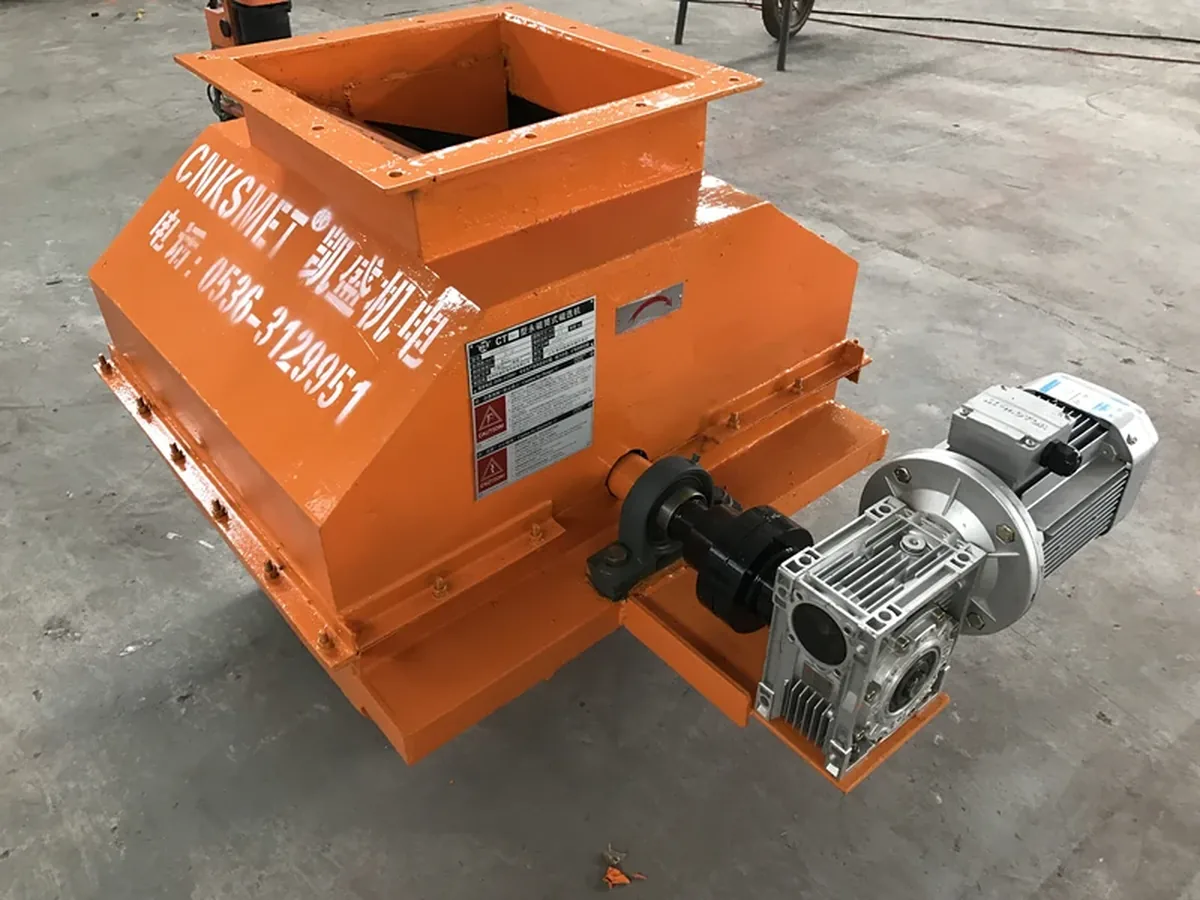
Manual cleaning is not automatically the wrong choice. If contamination is low, access is easy and a planned stop is short, a simple manual mechanism can be operationally reasonable. The decision changes when cleaning becomes frequent, difficult, inconsistent or disruptive.
| Operating condition | Manual cleaning may still fit when… | Compare easier/automatic cleaning when… |
|---|---|---|
| Cleaning frequency | Cleans are occasional and predictable | Cleans are frequent enough to dominate routine operator work |
| Access | The unit is safely reachable with adequate withdrawal/handling clearance | Access is restricted, awkward or creates repeated handling risk |
| Production continuity | A planned cleaning stop has little effect on output | Every cleaning stop creates a meaningful process interruption |
| Contamination discharge | Released metal can be collected cleanly and consistently | Manual release creates spill, re-entry or containment problems |
| Material behavior | Product releases cleanly from the filter surfaces | Sticky/cohesive product makes manual cleanup long or inconsistent |
| Operator consistency | Different operators can follow the same procedure with repeatable results | Cleaning quality depends strongly on operator technique or repeated manual handling |
When Several Operating Constraints Occur Together
| Combined condition | Practical interpretation |
|---|---|
| Frequent cleaning + easy access + batch operation | Manual cleaning may still be practical because cleaning can be fitted into natural production stops |
| Infrequent cleaning + very difficult access | Low frequency does not automatically make manual cleaning convenient; access can still justify comparing another arrangement |
| Frequent cleaning + restricted access + continuous production | Cleaning architecture deserves closer review because frequency, access and production interruption reinforce each other |
| Automatic mechanism + sticky/caking product | Automation may reduce handling but will not automatically solve a product-flow or caking problem |
| Hygienic process + low ferrous loading | Low magnetic loading does not remove sanitation requirements |
| Easy-clean mechanism + inconsistent operator execution | Easier metal release does not solve an uncontrolled cleaning procedure by itself |
Do not select automatic cleaning from frequency alone. A different mechanism still has to fit the product, line layout, utilities, sanitation needs, safe-access requirements and the way captured metal will be discharged.
Estimate the Manual Cleaning Burden
Weekly cleaning-related line stop = cleaning events per week × line-stop minutes per event
These calculations do not prove that automatic cleaning is cheaper. They simply make the current manual burden visible so manual, easy-clean and automated arrangements can be compared on the same basis. Do not combine operator time and production-stop time into one cost number unless your own costing method defines how each should be valued.
Magnetic Filter Cleaning Log: What to Record
A short, consistent log is more useful than a long form that operators stop completing. Use the same observation method each time so changes can be compared.
| Date / shift | Runtime / batches | Material processed / throughput | Captured ferrous load | Particle character | Material / lot | Process / maintenance change | Filter condition | Action taken |
|---|---|---|---|---|---|---|---|---|
| Record | Hours or batch count since last clean | Tonnes, kilograms, batches, flow rate or another repeatable production measure | Mass where practical, or a repeatable loading observation | Fine dust, flakes, chips, wire-like pieces or another change | Material identity or lot reference | Rate, raw material, upstream maintenance or another change | Build-up, wear, tube/sleeve, seal or leakage observation | Cleaned, inspected, interval changed or investigation opened |
Photos taken from a consistent position can strengthen the trend record, but they should not replace a measurable check where the process requires one. A repeatable estimate is more useful for trending than a precise-looking number collected inconsistently.
Keep several comparable normal records, not only abnormal ones. An unusual cleaning event is much easier to interpret when it can be compared with a recent stable baseline.
Post-Clean Inspection and Restart Checks
If a new problem appears immediately after cleaning, first inspect what was opened, moved, removed, resealed or repositioned during that cleaning event.
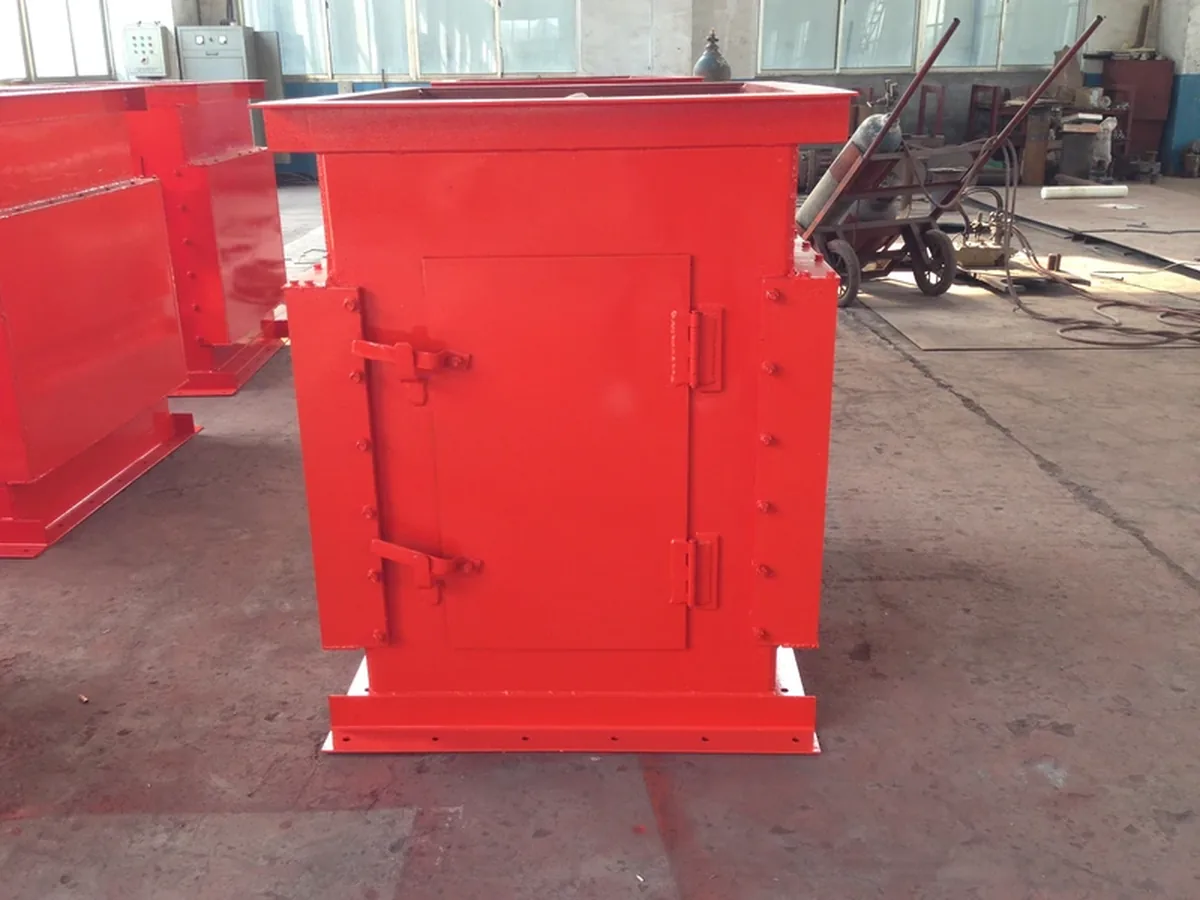
Before returning the line to normal production, confirm the equipment is ready for a controlled restart under the site/model procedure. Typical checks include:
- magnetic elements and extractor parts are fully returned to the operating position;
- clamps, fasteners, covers and guards are correctly secured;
- seals are clean, correctly seated and undamaged;
- no cleaning tools, loose debris or released metal remain in the housing or product path;
- any drains, discharge chutes or collection containers are returned to the correct state;
- isolation is removed only by the authorized procedure;
- the first controlled restart shows no leakage, abnormal movement, blockage or other obvious fault.
If the system is pressure-bearing, sanitary, hazardous-area rated, or automatically actuated, the approved equipment and site procedures take priority over this general checklist.
When Cleaning Is Not the Real Fix
Cleaning restores a loaded collection surface; it does not remove the source that created the metal.
If the same problem returns immediately after a correct clean: investigate flow/caking, an upstream contamination source, equipment damage, reassembly, or whether the cleaning architecture fits the process.
Repeated cleaning is the wrong root-cause response when the real problem is:
- accelerating upstream wear or a damaged process component;
- contaminated incoming raw material;
- a process/layout change that increased metal load;
- damaged magnetic tubes, sleeves, housings, seals or actuators;
- a product-flow problem such as severe caking or bridging;
- an unsuitable cleaning architecture for the required access, sanitation or production continuity.
This is why a cleaning record should be treated as process information, not only as a maintenance checkbox.
What to Prepare Before Reviewing a Cleaning Problem
If You Are Troubleshooting an Existing Filter
- current filter construction and cleaning mechanism;
- normal cleaning interval and the abnormal interval or symptom you are seeing now;
- material identity, lot and dry/sticky/slurry/liquid condition;
- throughput, batch size or material processed;
- typical captured loading and the abnormal loading;
- photos and description of the captured material;
- recent process, raw-material or upstream-maintenance changes;
- leakage, wear, reassembly or operating-position observations.
If You Are Comparing Another Cleaning Arrangement
- material state and contamination type;
- current cleaning frequency and operator time per clean;
- allowable line-stop time and whether operation is continuous or batch;
- access and withdrawal clearance around the installation;
- sanitation, washdown or cleaning-agent requirements;
- available pneumatic/electrical utilities where relevant;
- how captured metal can be discharged and contained;
- line size/opening, flow orientation, pressure and temperature where relevant.
For product-family context, see our High-Intensity Magnetic Filter and Pipeline Magnetic Separator pages, or browse Magnetic Separation Equipment.
Reviewing another cleaning arrangement? Send the material condition, cleaning frequency, allowable line-stop time, access limits, sanitation requirements and available utilities.
Discuss Your Application
Magnetic Filter Cleaning FAQ
Is there a standard magnetic filter cleaning frequency?
No single interval fits every industrial process. Set the interval from actual ferrous loading, process risk and operating experience, then re-check it when the material, throughput, equipment or upstream condition changes. If throughput varies substantially, compare loading with material processed rather than relying on g/h alone.
Can I just wipe magnetic rods with a cloth?
Only if that method is permitted for the specific construction and cleaning procedure. Extractor-sleeve designs are often intended to release contamination by withdrawing the magnetic core; automatic and CIP-capable filters use different sequences. Avoid abrasive or damaging methods unless the manufacturer explicitly permits them.
Why did the amount of captured metal suddenly change?
Treat either an increase or a decrease as a diagnostic signal. First compare throughput or material processed, then particle character, raw-material changes, upstream maintenance, reassembly and downstream result. More captured metal does not automatically mean the filter is failing, and less captured metal is not automatically an improvement.
Should I clean more often if product is caking around the rods?
Not automatically. Separate ferrous loading from product build-up first. If surface coverage rises but captured metal stays similar, sticky or poorly flowing material may be the main problem. Check moisture, flowability and bridging as well as the captured metal.
What should I inspect during cleaning?
In addition to removing captured material, look for damaged or worn tubes/sleeves, product build-up, seal condition, correct movement and operating position of the cleaning mechanism, and anything that changed since the last normal clean. Follow the model-specific inspection points in the equipment manual.
When should I consider an easier or automatic cleaning design?
Compare alternatives when cleaning frequency combines with difficult access, downtime, contamination containment, sanitation burden or inconsistent manual execution. Frequency alone is not enough; the alternative still has to fit the product and process.
How do I know if the magnetic filter cleaning interval is too long?
The interval may be too long if captured metal heavily covers the collection surface, product flow starts to restrict, contamination becomes compacted or difficult to remove, or the filter reaches an unacceptable loading condition before the scheduled clean. The acceptable limit is process-specific, so use these observations to refine your own interval rather than applying a universal number.
Safety and Technical References
- OSHA, 29 CFR 1910.147, Control of Hazardous Energy (Lockout/Tagout).
- Goudsmit Magnetics industrial magnetic-filter and Cleanflow user manuals describing manual extraction/cleaning sequences.
- Dings Magnetics grate-magnet information describing tube-in-tube easy-clean and automatic-cleaning concepts.
These references support general industrial principles only. They do not verify Corvelan-specific specifications, cleaning intervals or performance.