Find equipment by installation point and separation task.
All magnetic separators →Start with the material or production line you need to protect.
All applications →Compare technologies, check parameters and prepare your RFQ.
All guides →See the factory, quality checks and answers before you request a quotation.
RCYD(C) Series · Permanent Magnet · Automatic Iron Discharge
Corvelan RCYD(C) self-cleaning cross-belt magnetic separators remove tramp iron and steel from materials moving on a conveyor belt. The permanent magnet pulls the metal out of the material, while the cross belt carries it away automatically. This makes the RCYD(C) series suitable for continuous ferrous-metal removal where manual magnet cleaning would interrupt production.

RCYD(C) Series at a Glance
The RCYD(C) family covers belt widths from 500 to 2000 mm with ten catalog models. Each model has its own suspension height, material depth, magnetic field rating, drive power, weight and overall size. You can compare these values in the model table below.
Quick Fit
Applications & Target Metal
RCYD(C) cross-belt separators continuously remove tramp iron and steel from loose materials moving on belt conveyors. Typical targets include bolts, nails, wire and steel fragments. These are ferrous, or ferromagnetic, contaminants that can damage downstream equipment or contaminate the material stream.
Working Principle
The magnet pulls iron and steel out of the material on the conveyor. Inside the separator, the magnetic system creates the working field needed to attract the metal. The self-cleaning belt automatically moves the captured metal away from the material flow.
Bulk material passes below the suspended separator on the main conveyor.
The permanent magnetic system pulls ferrous metal up from the material on the conveyor.
The self-cleaning belt moves captured ferrous metal across the separator body.
As the belt leaves the effective magnetic zone, captured metal drops into the planned discharge area.

These features are used across the RCYD(C) series. Exact component details can vary by model.
RCYD(C) Model Range
Start with your conveyor belt width. Then check the suspension height, material depth, conveyor speed and the iron or steel you need to remove. The table below shows the RCYD(C) series data.
| Model | Belt Width (mm) | Suspension Height (mm) | Material Depth (mm) | Magnetic Field Rating (mT) | Drive Power (kW) | Max. Belt Speed (m/s) | Operation | Weight (kg) |
|---|---|---|---|---|---|---|---|---|
| RCYD(C)-5 | 500 | 150 | ≤100 | ≥60 | 1.5 | ≤2.5 | Continuous | 750 |
| RCYD(C)-6 | 600 / 650 | 180 | ≤130 | ≥60 | 1.5 | ≤2.5 | Continuous | 920 |
| RCYD(C)-6.5 | 650 | 200 | ≤150 | ≥70 | 1.5 | ≤2.5 | Continuous | 1200 |
| RCYD(C)-8 | 800 | 250 | ≤200 | ≥70 | 2.2 | ≤2.5 | Continuous | 1400 |
| RCYD(C)-10 | 1000 | 300 | ≤250 | ≥70 | 3.0 | ≤2.5 | Continuous | 2120 |
| RCYD(C)-12 | 1200 | 350 | ≤300 | ≥70 | 4.0 | ≤2.5 | Continuous | 3350 |
| RCYD(C)-14 | 1400 | 400 | ≤350 | ≥70 | 4.0 | ≤2.5 | Continuous | 4450 |
| RCYD(C)-16 | 1600 | 450 | ≤400 | ≥70 | 5.5 | ≤2.5 | Continuous | 6200 |
| RCYD(C)-18 | 1800 | 500 | ≤450 | ≥80 | 5.5 | ≤2.5 | Continuous | 8100 |
| RCYD(C)-20 | 2000 | 550 | ≤500 | ≥80 | 7.5 | ≤2.5 | Continuous | 9700 |
Note: The magnetic field rating is only one factor affecting iron removal performance. Actual separation results also depend on metal size, material depth, conveyor speed and installation conditions.
Dimensions A–E come from the RCYD(C) family outline drawing. Use them to check whether the separator can fit above your conveyor. We confirm the final outline and mounting drawing before you build or modify the support structure.
| Model | A (mm) | B (mm) | C (mm) | D (mm) | E (mm) |
|---|---|---|---|---|---|
| RCYD(C)-5 | 1900 | 935 | 735 | 753 | 950 |
| RCYD(C)-6 | 2050 | 1030 | 780 | 840 | 1100 |
| RCYD(C)-6.5 | 2165 | 1080 | 780 | 888 | 1200 |
| RCYD(C)-8 | 2350 | 1280 | 796 | 1088 | 1300 |
| RCYD(C)-10 | 2660 | 1550 | 920 | 1335 | 1400 |
| RCYD(C)-12 | 2860 | 1720 | 1010 | 1515 | 1550 |
| RCYD(C)-14 | 3225 | 1980 | 1050 | 1755 | 1800 |
| RCYD(C)-16 | 3350 | 2160 | 1180 | 1850 | 1950 |
| RCYD(C)-18 | 3580 | 2450 | 1210 | 2130 | 2200 |
| RCYD(C)-20 | 3600 | 2700 | 1300 | 2410 | 2400 |
Model Selection
We start with your conveyor width. Then we check whether that model can handle your material depth, belt speed, magnet distance and installation space. Belt width alone is not enough to choose the final model.
Your conveyor belt width helps identify the suitable RCYD(C) model range.
We check how deep the material is and how far the hardest-to-reach metal will be from the magnet. The distance between the magnet and the metal affects separation performance.
We check the operating speed against the RCYD(C) table and the time available for the magnet to pick up the metal.
Tell us what metal you need to remove, its typical size and shape, how often it appears and where it sits in the material.
We check your conveyor layout and available space to ensure the separator can be installed and maintained properly.
If you have specific separation requirements, share them with us so we can recommend the suitable configuration.
Separation Factors
Do not compare separators by Gauss or mT alone. Real iron-removal performance also depends on the distance to the metal and how the material moves under the separator.
Burden depth means how deep the material is on the conveyor. Deeper material puts buried metal farther from the magnet.
A faster conveyor gives the magnet less time to attract and lift the metal.
A large flat steel piece, a bolt, wire and a small irregular fragment can respond differently to the same magnetic field.
Moisture, lump size, bulk density and how the material moves can affect how easily the magnet reaches the metal.
Steel beams, chutes and other ferrous parts near the separator can affect the magnetic area and available installation space.
The self-cleaning belt needs clear space to carry the captured metal away and drop it outside the main material stream.
Separator Choice
Both types can remove ferrous metal above a conveyor, but they create the magnetic field in different ways. The RCYD(C) series uses a permanent NdFeB magnetic system. An electromagnetic separator uses an energized coil and needs electrical power to create its magnetic field.
| Question | Permanent Cross-Belt Magnet | Electromagnetic Cross-Belt Separator |
|---|---|---|
| Magnetic field source | Permanent magnet | Electrically energized coil |
| Power for the magnetic field | Not required | Required during operation |
| When power is switched off | The permanent magnetic field remains | The coil field switches off when de-energized |
| Self-cleaning belt | The discharge belt drive still needs power | A self-cleaning belt drive also needs power when included |
| Suitable application | When a permanent system meets the working distance, material depth and tramp-metal duty | When the working distance, duty or site requirements make an electromagnetic design a better fit |
Do not choose between the two types from Gauss alone. We compare your conveyor width, material depth, working distance, target metal, belt speed, available space and operating requirements before recommending the separator type.
Real Installation Reference
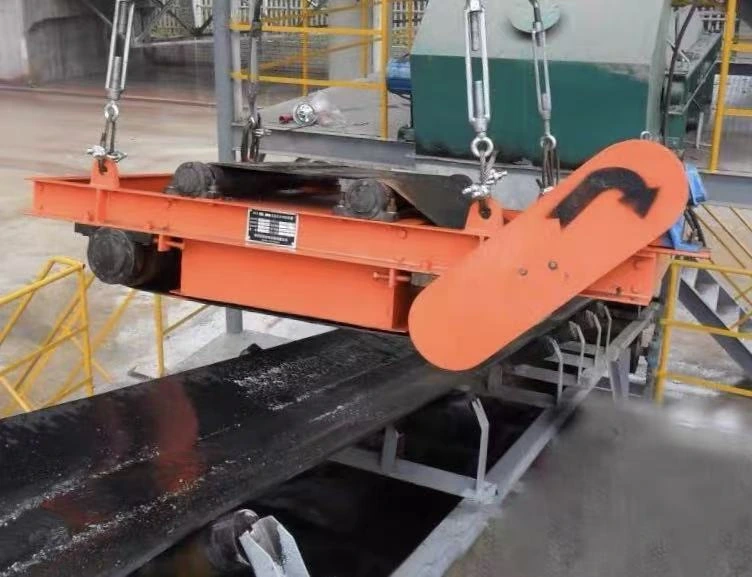
The RCYD(C) series can be arranged above horizontal or inclined conveyors. In a cross-belt setup, the self-cleaning belt runs across the main conveyor and carries captured iron or steel to the side for discharge.

We use this information to check the mounting layout and the space needed around the selected RCYD(C) model.
Selection Support
Conveyor width is the first step, but other operating conditions also affect model selection. We check the catalog model against your conveyor, material and installation space before quotation.
We compare belt width, catalog suspension height, material depth and the A–E outline dimensions with the space available on your conveyor.
We check headroom, suspension points, nearby steelwork, side-discharge space and service access around the separator.
If you need a measurable result, we define the test piece, material depth, conveyor speed, magnet distance, number of passes and pass/fail rule before the test.
Cleaning · Maintenance · Safety
The separator removes captured iron and steel automatically, but the belt drive and moving parts still need routine inspection.
Inspect belt wear, tension and tracking. Check the crowned drive pulley and correct any abnormal tracking before belt damage develops.
Inspect the reducer/drive, rollers, bearing housings, fasteners and guards according to the selected unit and site maintenance procedure.
Keep the ferrous discharge path clear and check suspension hardware, support steel and service clearance.
Separation Factors Test
If you need a measurable result, we first agree on how the test will be carried out. This includes the test piece, material depth, conveyor speed, magnet distance, material condition, number of passes and the pass/fail rule.
Agree on the metal type, size, shape and where it will be placed in the material.
Record material depth, conveyor speed, magnet distance and material condition during the test.
Agree on how the result will be checked before the test starts.
Real Product Views
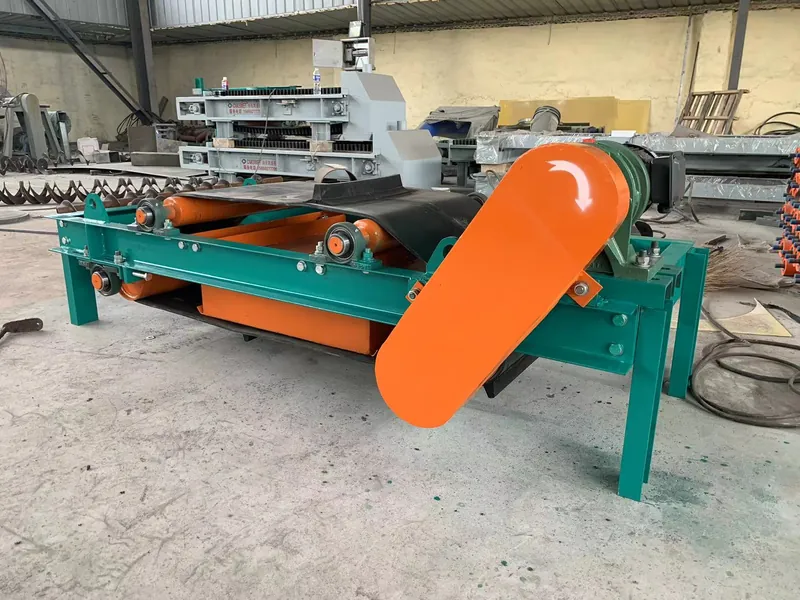
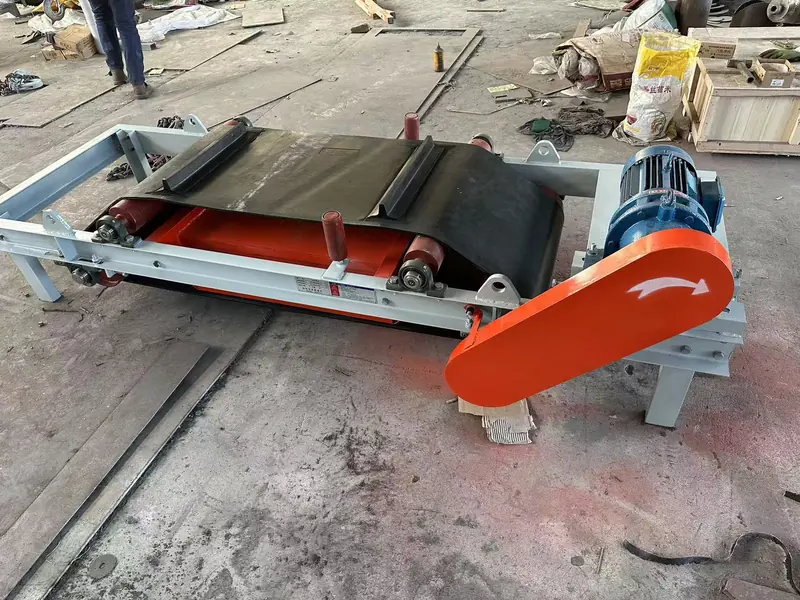
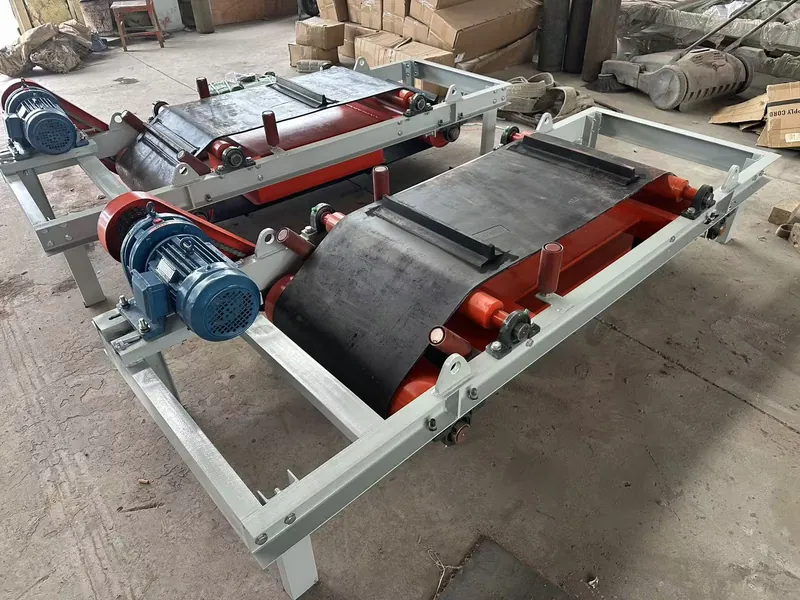
The RCYD(C) series changes in size as conveyor width increases. Frame size, drive position and overall dimensions can also vary by model. These real product views show the main construction style used across the series.

Before quotation or fabrication, we check the selected model, equipment drawing and installation layout with you.
What You Can Review
We use the RCYD(C) model data together with your conveyor information. The page gives you the main catalog range, dimensions and real equipment references before you send an enquiry.
Compare all ten catalog models by belt width, suspension height, material depth, magnetic field rating, drive power, speed and weight.
Use the A–E outline dimensions and conveyor installation example to check space, suspension and discharge direction.
If your project needs a measurable acceptance result, define the test piece, operating conditions and pass/fail rule before the test starts.
Related Magnetic Separation Pages
If the RCYD(C) cross-belt separator is not the only option you are considering, these Corvelan pages can help you compare other magnetic separation methods by application and material type.
See how suspended magnets fit above belt conveyors for tramp iron removal and downstream equipment protection.
View conveyor magnet applications →Compare continuous drum separation when material can be presented directly to a magnetic drum at a feed, transfer or discharge point.
Compare magnetic drum separation →Review conveyor-based tramp iron removal and magnetic separation considerations for coal handling.
See coal separation applications →Compare magnetic separation methods for ferrous recovery from mixed scrap and recycling streams.
See scrap metal separation →See how magnetic equipment can recover liberated steel wire after tire shredding and size reduction.
See tire wire recovery →FAQ
The RCYD(C) series covers conveyor belt widths from 500 to 2000 mm across ten catalog models.
RCYD(C)-10 is the first model we would check for a 1000 mm conveyor belt. Its catalog data lists a 300 mm suspension height and material depth up to 250 mm. We still check the actual material depth, target metal, belt speed and installation before confirming the model.
No. The permanent magnetic system does not require electrical excitation. Electrical power is required for the driven self-cleaning discharge belt.
Suspension height tells you how high the separator is designed to sit above the conveyor area for that model. The actual distance to the iron inside the material also matters, so we still check the real installation before confirming the model.
No. mT or Gauss measures magnetic flux density. It is not the same as pull force or separation efficiency. Magnet distance, material depth, metal size and shape, belt speed and material condition all affect the result.
Yes. The RCYD(C) series data includes both horizontal and inclined installation layouts. We confirm the final mounting layout against the selected model and your conveyor drawing.
No, not with the same magnetic principle. This permanent cross-belt separator is designed mainly for iron, steel and other ferromagnetic metal. Aluminum and copper need a different separation method.
Send your material, the iron or steel you need to remove, conveyor belt width, material depth, belt speed and a photo or drawing of the installation area. Throughput, particle size, moisture, available headroom, side-discharge space and any required test result are also useful when available.
Yes. Send your conveyor drawing or clear site photos together with belt width, material depth, belt speed and the target metal. We use this to check the starting RCYD(C) model, suspension space and side-discharge clearance before quotation.

Model Selection & Quotation
Send the information you already have. We use your conveyor width to find the first RCYD(C) model to check, then review the material and installation details before quotation.
Throughput, particle or lump size, moisture, bulk density, headroom, suspension points, side-discharge space, nearby steelwork, site power, environmental conditions and any required test result.
What happens next: We check your conveyor data, choose the RCYD(C) model to start with and tell you if we need any other information. Then we confirm the equipment details for quotation.