Quick Answer: Wet vs Dry Magnetic Separation
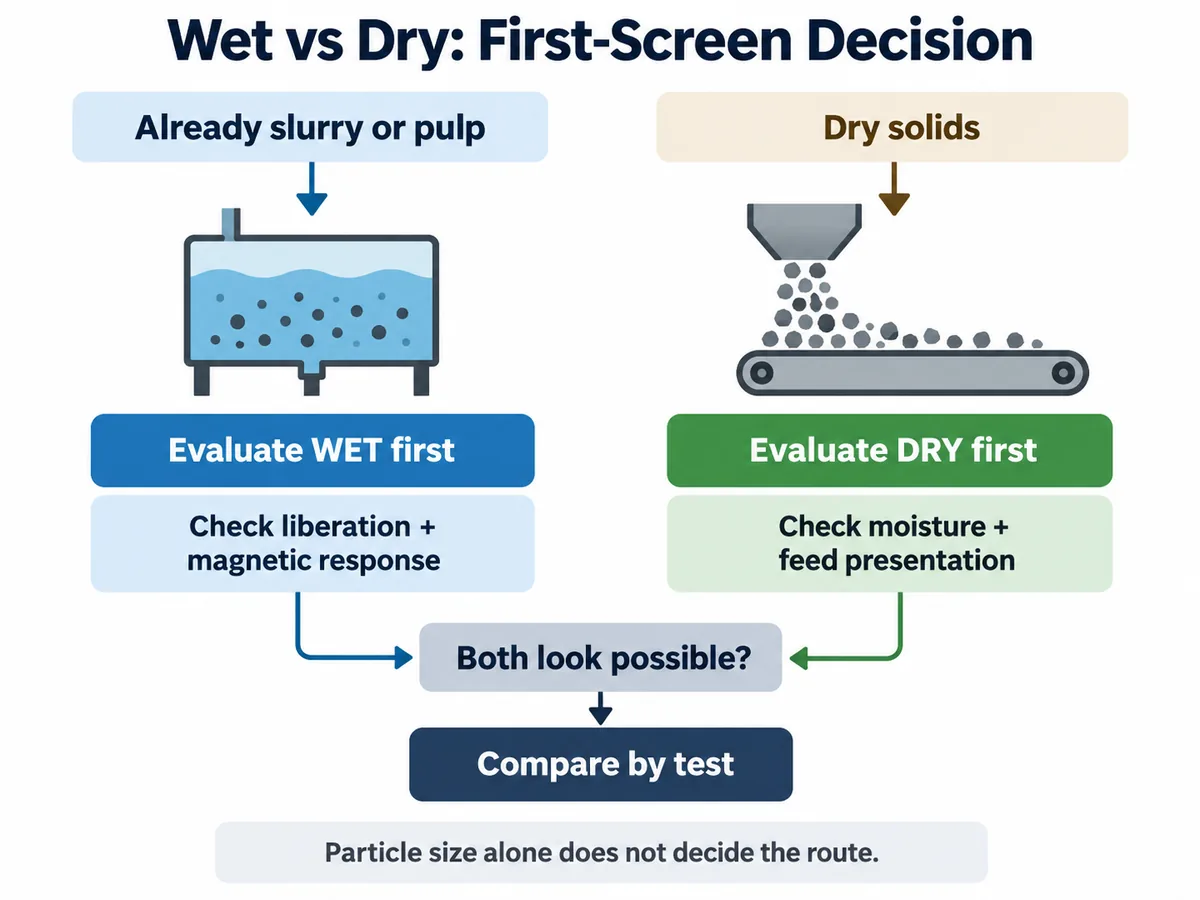
Start with wet magnetic separation when the material is already handled as a controlled slurry, when fine-particle dispersion is important, or when the separator is part of a wet grinding and classification circuit. Start with dry magnetic separation when the material must remain dry, water handling should be avoided, or the job is dry pre-concentration before grinding.
Do not make the final decision from particle size alone. Liberation, magnetic response, feed presentation, moisture, circuit position and the required product can change the answer. Reviews of magnetic concentration likewise describe mineralogy, particle-size distribution and physicochemical properties as interacting selection factors rather than one universal cut-off.
What “Wet” and “Dry” Actually Mean
Wet magnetic separation means the particles enter the separation zone in a liquid slurry or suspension. Dry magnetic separation means the particles enter as dry or nominally dry solids without a process slurry. The wet/dry choice therefore describes the processing medium and particle presentation; it does not by itself define the magnetic intensity, gradient, recovery or total operating cost.
Keep these decisions separate: wet does not automatically mean high intensity; dry does not automatically mean low intensity; wet does not automatically mean higher recovery; dry does not automatically mean lower total cost; fine does not automatically mean wet; coarse does not automatically mean dry.
This distinction matters because the magnetic force is only one part of the separation. Liquid drag, gravity, inertia, air movement, particle-to-particle contact and how the feed enters the active magnetic zone can all change the path of a particle. Research on dry magnetic separation also shows that fine-particle behavior can be affected by moisture, humidity and inter-particle forces, while controlled air flow can improve dry fine-particle dispersion in some designs.
Start Here in 30 Seconds
Evaluate wet first.
Then check liberation, magnetic response and slurry condition.
Evaluate dry first.
Then check fines, moisture, agglomeration, dust and feed stability.
Evaluate dry first.
Confirm that enough valuable mineral is liberated to reject mass without unacceptable loss.
Evaluate wet first.
Do not assume that wet processing automatically gives the required grade or recovery.
The route is not decided yet.
First confirm the magnetic mechanism, field/gradient requirement and particle presentation.
The route is not decided yet.
Check whether the worst expected feed can still form a stable dry layer.
Test both.
Use the same representative material and the same project acceptance target.
Do not change route first.
Check what changed in particle size, liberation, moisture/slurry condition, mineralogy or feed rate.
Use this as a first screen only. The sections below show the conditions that can reverse the first answer and the checks that help identify which case matches your material.
What Are You Trying to Decide?
- I only need to understand wet vs dry.
Start with the definitions above, then read the seven conditions below. - I am choosing a route for a new process.
Use the seven conditions, then check the combined scenarios. - My current separator is underperforming.
Go to “Already Have a Separator?” before deciding to change route. - Two proposals recommend different routes.
Compare them on the same feed, target and process boundary. - Both wet and dry appear technically possible.
Use the matched-test section to compare the operating window and whole-process burden.
7 Conditions That Can Change the Choice
First choose the route that best fits the current process state. Then try to disprove that first answer. Each condition below can change the conclusion, change what you observe, or change the next test you should run.
1. Current Feed State
How to recognize it: A controlled slurry has liquid intentionally built into the process: the material is pumped or hydraulically transported, solids concentration or flow can be controlled, and the upstream or downstream circuit is already wet. Surface-wet solids are different: they are still conveyed as solids, water is incidental, and the material may coat chutes, bridge or stick without behaving like a pumpable slurry.
What changes: A true slurry gives wet separation a strong process-integration advantage. A nominally dry stream gives dry separation the first advantage only when the stream remains stable enough to feed the separator consistently.
Why: Converting a wet circuit to dry can add dewatering and drying. Converting dry solids into slurry can add dilution, pumping, water recovery and final dewatering. Those extra steps can be more important than the separator itself.
Do not confuse it with: “The material contains water” is not the same as “the process is wet.” Moist, sticky solids can be a difficult dry feed without being a designed slurry.
What to check: Is water intentionally part of the process? Is the stream pumped or conveyed? Does it remain free flowing at the highest expected moisture? Is dewatering already present downstream?
What to do next: Start with the route that matches the real process state, but test the worst expected moisture or slurry condition rather than only the average condition.

2. Liberation
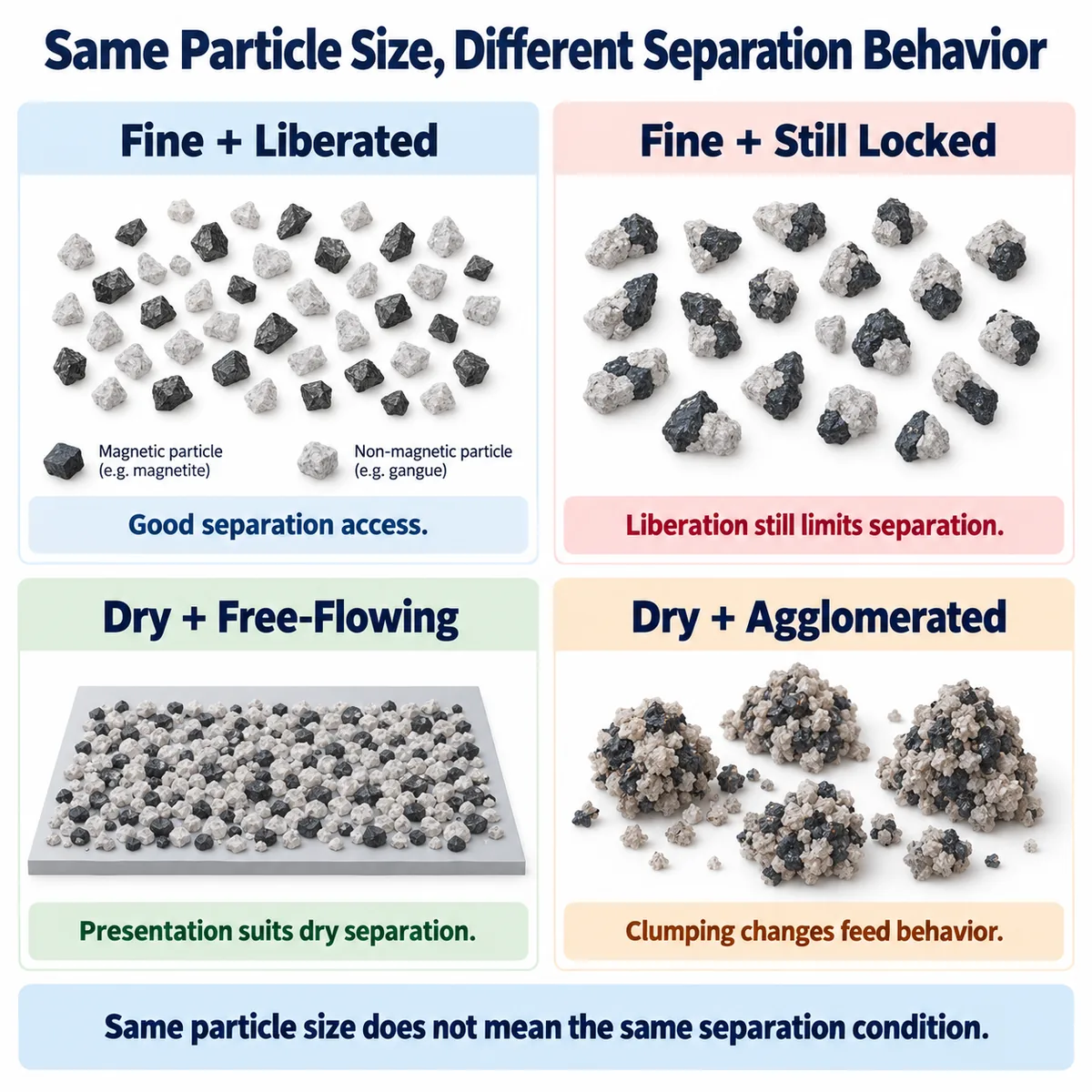
How to recognize it: Particle size tells you how large the particles are. Liberation tells you whether the magnetic target and the unwanted material are physically separated into different particles. Fine material can still contain locked composite particles, while some coarser material can already be sufficiently liberated for a useful pre-concentration step.
What changes: Fine and well-liberated material makes particle presentation and magnetic response the next major questions. Fine but poorly liberated material can remain difficult in either wet or dry separation. Coarser but sufficiently liberated material may still support useful dry pre-concentration.
Why: A magnetic separator cannot cleanly split two minerals that remain physically joined in the same particle. Increasing magnetic force or changing wet/dry route may simply move the locked particle into a different product.
Do not confuse it with: “Ground fine” does not mean “liberated.” A low separation result can be a liberation problem rather than a separator-route problem.
What to check: Use mineralogical/liberation data when available. Size-by-size assay and matched separation tests can also show whether separation changes strongly with size. If no liberation information exists, do not assume it from the nominal top size alone.
What to do next: If liberation is the main constraint, define the size or process condition needed for liberation before approving wet or dry equipment.
3. Particle Size and Feed Presentation
How to recognize it: Two feeds can have similar measured particle-size distributions yet behave very differently. One fine dry feed may spread as a stable, thin layer; another may agglomerate. Fines can also coat larger particles instead of moving as separate particles.
What changes: Fine, free-flowing material may still be technically testable in a dry route. Fine, agglomerated material is more likely to show unstable dry presentation. In a wet route, dispersion may improve, but slurry density and particle transport still have to be controlled.
Why: Separation depends on how individual particles enter and move through the magnetic zone, not only on the sieve result. Inter-particle forces become increasingly important as particles become finer, which is one reason dry fine-particle separation needs careful feed control.
Do not confuse it with: Particle-size distribution is a size measurement. Feed presentation is the real layer, dispersion and movement presented to the separator.
What to check: Look for agglomeration, coating, bridging, uneven bed depth, surging feeder discharge and whether the same PSD behaves differently after storage or weather changes.
What to do next: Test the feed in the condition that the production separator will actually see. Do not base the route only on a laboratory sieve analysis.
4. Magnetic Response
How to recognize it: Strongly magnetic material can often be captured with a different magnetic mechanism than weakly magnetic material. However, low capture in a test does not by itself prove that the target is weakly magnetic.
What changes: A weakly magnetic target can require higher field/gradient capability, closer particle-to-field interaction or a different separator family. A strongly magnetic target may not need that complexity even when the material is fine.
Why: Magnetic susceptibility is one input to the force acting on the particle, but liberation, distance from the active magnetic zone, layer loading and particle transport also affect whether the target is captured. Reviews of magnetic separation distinguish low- and high-intensity duties by magnetic response and application rather than by wet/dry route alone.
Do not confuse it with: Low capture is not automatically “the magnet is too weak.” The target may be locked, poorly presented, outside the useful capture zone or overloaded by the feed condition.
What to check: Confirm mineral identity or magnetic response where possible, then check liberation, feed presentation, feed rate/layer condition and the magnetic mechanism used in the test.
What to do next: Only after these checks should field/gradient requirement and equipment family be narrowed.
5. Moisture, Clay and Agglomeration
How to recognize it: The same measured moisture does not guarantee the same dry-feed behavior. A low-clay feed may remain free flowing while another feed with more fines or clay may coat surfaces, bridge or form clusters at a similar moisture level.
What changes: Dry separation becomes less stable when feed presentation changes with moisture, clay or storage condition. A wet route may become more practical if converting the material into a controlled slurry removes an unstable dry-feed problem, but that benefit must be weighed against water and dewatering duties.
Why: Moisture can change friction, adhesion and agglomeration. The separator may then see clusters and an uneven feed layer rather than the nominal particle-size distribution.
Do not confuse it with: Average moisture is not a complete flowability specification. Two materials with the same moisture reading can behave differently because their fines, clay and surface conditions differ.
What to check: Look for chute coating, bridging, feeder surging, uneven layer depth, fines sticking to larger particles, and performance changes after rain, storage or a change of feed source.
What to do next: Test the most difficult realistic moisture/fines condition. If dry presentation becomes unstable, compare the burden of drying/conditioning with the burden of creating and handling a controlled wet circuit.
6. Circuit Position
How to recognize it: Ask what the separator is supposed to do at that point in the process: reject mass before grinding, recover a magnetic mineral after liberation, or make a final cleaning/upgrading step.
What changes: Before grinding, the value of separation may come from rejecting enough waste while keeping valuable-mineral loss acceptable. After liberation grinding, the process may already be a slurry and the purpose may shift toward recovery or grade. At final cleaning, small losses or residual contamination can become more important than early mass rejection.
Why: The job of the separator changes with circuit position. Pre-concentration is designed to remove material early and can reduce downstream load when the valuable mineral is sufficiently liberated.
Do not confuse it with: A route that works at one point in a flowsheet is not automatically the best route at another point.
What to check: Define upstream state, downstream state, whether grinding is already required, and the actual job of the separation step.
What to do next: Judge the route by the KPI that matters at that circuit position instead of asking which route is simply “better.”
7. Acceptance Target and Feed Variability
How to recognize it: Different projects use different definitions of success. One process may need mass rejection, another magnetic-mineral recovery, another final product purity, and another protection from unwanted ferrous contamination.
What changes: The same test result can look good or poor depending on the real target. A route that works on an average sample can also fail if worst-case moisture, fines, mineralogy or feed rate pushes it outside a stable operating window.
| Real objective | Do not judge only by | Also evaluate |
|---|---|---|
| Reject waste before grinding | Concentrate grade | Mass rejected and valuable-material loss |
| Recover a magnetic mineral | Magnetic product mass | Grade and recovery against the feed |
| Improve product purity | Amount captured | Final product specification |
| Protect downstream equipment | Recovery-style metrics | Residual unwanted ferrous material and protection requirement |
| Reduce downstream load | Separator result alone | Actual reduction in material sent to the next process |
Why: Wet-versus-dry selection is only meaningful when both routes are tested against the same project objective and the expected variation in the feed.
Do not confuse it with: A high isolated grade, recovery or mass-rejection number is not automatically the best process result if it was obtained under a different feed condition or against a different objective.
What to check: Define the acceptance metric, how it is measured, and the feed envelope the process is expected to handle.
What to do next: Use the same acceptance basis for both wet and dry tests and repeat the condition most likely to challenge the route.
When Conditions Stack: Common Wet-vs-Dry Decisions
Single-variable rules are useful for screening, but real projects often combine two or three conditions. The combinations below are the ones most likely to produce the wrong answer if only one variable is considered.
| Combined condition | Simple answer that can mislead | What actually decides the route |
|---|---|---|
| Fine + dry + strongly magnetic | “Fine means wet” | Whether dry presentation remains stable enough to use the strong magnetic response |
| Fine + dry + weakly magnetic | “Just use a stronger magnet” | Magnetic response, liberation, dispersion and the required magnetic mechanism together |
| Coarse + poorly liberated | “Coarse means dry” | Whether separation is meaningful before further liberation |
| Fine + slurry + strongly magnetic | “Wet high intensity” | Wet may fit, but high intensity may be unnecessary |
| Fine + slurry + weakly magnetic | “Wet solves it” | Wet presentation plus the correct high-intensity/high-gradient mechanism |
| Water scarce + sticky fines | “Dry is obvious” | Dry conditioning/drying/dust burden versus wet-loop burden |
| Dry pre-concentration + locked valuable mineral | “Reject waste early” | Whether valuable-mineral loss is acceptable at the available liberation |
| Final product must be dry + upstream already wet | “Use a dry separator” | Whether converting to dry mid-process adds more burden than existing dewatering |
Fine + Dry + Strongly Magnetic
Situation: The feed is fine and dry, but the target has a strong magnetic response.
What you may see: The dry feed remains free flowing, forms a uniform layer and shows repeatable capture at normal feed rate.
Why the simple rule fails: Fine particle size increases dry-presentation difficulty, but strong magnetic response can still make a dry route worth testing when agglomeration and moisture are controlled. Fine size alone therefore does not prove that a wet circuit is required. Research on dry high-gradient separation also shows that improving fine-particle dispersion can materially change dry performance in a specific separator design.
What to confirm: Feed-layer uniformity, moisture, agglomeration, dust handling, normal production feed rate and repeatability.
Next step: Run a controlled dry test before adding the cost and handling steps of a wet circuit.
Fine + Dry + Weakly Magnetic
Situation: Three challenges occur together: small particles, weaker magnetic response and dry particle interactions.
What you may see: Capture changes strongly with feed layer, moisture, agglomeration or operating setting, giving a narrow stable window.
Why the simple rule fails: Raising field alone may not solve a presentation problem, and changing to wet alone may not solve a magnetic-mechanism problem.
Do not confuse it with: A dry test that captures little material does not prove that dry is impossible until liberation, dispersion and the magnetic mechanism have also been checked.
What to confirm: Magnetic response, liberation, PSD, moisture, agglomeration, layer/presentation and the separator mechanism used in the test.
Next step: If stable dry presentation and the required magnetic force/gradient cannot be achieved together, evaluate a wet high-intensity/high-gradient route on the same representative material.
Coarse + Poorly Liberated
Situation: The feed is coarse enough to appear suitable for dry pre-concentration, but valuable and unwanted minerals remain locked together.
What you may see: Magnetic and non-magnetic products both contain composite particles, so improving one product can increase loss in the other.
Why the simple rule fails: The limiting problem is not wet versus dry. It is that the separator is being asked to separate materials that are still physically joined.
What to confirm: Liberation at the proposed pre-concentration size and the amount of valuable material lost with rejected mass.
Next step: Decide whether more liberation is required before selecting the separation route. If coarse pre-concentration is still tested, use valuable-mineral loss as a key acceptance metric.
Water Scarce + Sticky Fines
Situation: The site strongly prefers a dry process, but the feed contains fines, clay or variable moisture that makes dry presentation unstable.
What you may see: Bridging, surface coating, feeder surging, uneven bed depth or performance that changes with storage/weather conditions.
Why the simple rule fails: “No water” favors dry separation, but a dry route may still need drying, conditioning, screening and dust control before the separator can work consistently.
What to confirm: The worst realistic dry-feed behavior and the process steps required to stabilize it.
Next step: Compare the total burden of dry conditioning/drying/dust control with the water, pumping and dewatering burden of a controlled wet route. Do not compare separator water use alone.
Final Product Must Be Dry + Upstream Already Wet
Situation: The final product must be dry, but the separator sits after wet grinding, classification or slurry transport.
What you may see: Choosing a dry separator would require dewatering/drying before separation even though the downstream process already includes thickening, filtering or final drying.
Why the simple rule fails: Final product state is not the same as separator feed state. A wet route can still fit the whole flowsheet when wet handling already exists.
What to confirm: Where water is introduced, where dewatering already occurs, and whether an extra wet-to-dry conversion is actually avoided by using dry separation.
Next step: Compare the complete flowsheet rather than choosing dry separation only because the finished product must be dry.
Already Have a Separator? Diagnose Before Changing Route
Poor performance does not automatically mean that the wet/dry route is wrong. If a separator used to work, works on some batches, or changes sharply with operating conditions, first determine what changed.
- Check the material. Compare particle-size distribution, mineralogy, liberation, moisture, fines/clay and feed source with the condition that previously worked.
- Check feed presentation. For dry equipment, look at feed rate, layer depth, bridging and agglomeration. For wet equipment, look at slurry solids, flow and dispersion.
- Check the operating condition. Confirm feed/flow settings, working gap or active zone where relevant, cleanliness/buildup and whether the process is operating inside the conditions used for the original test.
- Only then reconsider the route. If the material and operating condition are verified but the process still cannot meet the defined target, compare a wet/dry route change using representative test work.
Dry Separator Worked Before, but Performance Now Varies
Do not begin by assuming that the magnetic system has changed. First compare material source, moisture, fine fraction, storage/weather condition, feeder discharge and throughput. If performance follows one of those changes, correct or include that condition in the new test before changing to wet separation.
Wet Separator Recovery Is Lower Than Expected
Do not respond only by increasing magnetic setting. Check whether the target is actually weakly magnetic, whether liberation has changed, whether slurry condition and feed rate match the test basis, and whether mineralogy or the operating window has shifted. A route change is justified only after the limiting mechanism is identified.
Compare the Whole Process, Not Just the Separator
Wet and dry routes create different support duties. The right comparison includes the steps required to make each separator feed stable and to deliver the required downstream product.
| Process issue | Wet route may require | Dry route may require | When it can change the decision |
|---|---|---|---|
| Feed preparation | Dilution or slurry conditioning | Drying, classification or dry conditioning | Incoming material is variable or unstable |
| Transport | Pumps, piping and slurry control | Conveyors, feeders and enclosed transfer | Plant layout or existing process strongly favors one state |
| Environmental control | Water recovery and wet handling | Dust collection and enclosure | Site water or dust constraints dominate |
| Product handling | Thickening, filtering or drying where needed | Dry product handling | Final product state is fixed |
| Feed control | Slurry solids and flow stability | Layer depth, flowability and feed uniformity | Throughput or feed condition varies significantly |
| Maintenance burden | Slurry wear and wet-contact components | Buildup, dust and dry-feed contact surfaces | Material is abrasive, sticky or difficult to contain |
Compare the process steps needed to make each route stable—not only the separator. “Dry uses no process water” and “wet handles fines better” are not complete economic or engineering comparisons by themselves.
Which Magnetic Separation Mechanism and Equipment Family Fits?
After narrowing the wet/dry route, the next question is the magnetic mechanism. We do not select an equipment family from wet/dry state alone.
| Process condition | Magnetic question | Equipment family to evaluate |
|---|---|---|
| Controlled slurry + strongly magnetic target | Is conventional wet magnetic capture sufficient for the duty? | Wet Drum Magnetic Separator |
| Controlled slurry + weakly magnetic target | Is high-intensity/high-gradient wet separation required? | Wet High Intensity Magnetic Separator |
| Dry + free-flowing + stronger magnetic response | Can the feed maintain a controlled dry layer at production conditions? | Dry Drum Magnetic Separator |
| Dry + finer or weaker-response duty | Can dry presentation and the required magnetic mechanism both be achieved reliably? | Magnetic Roller Separator or another relevant dry route after test work |
For a broader view of available equipment families, see our Magnetic Separation Equipment category. If the actual job is conveyor tramp-ferrous protection rather than mineral beneficiation or material upgrading, use a protection-equipment selection path instead of applying this wet-versus-dry framework.
How to Test Wet and Dry Separation Fairly
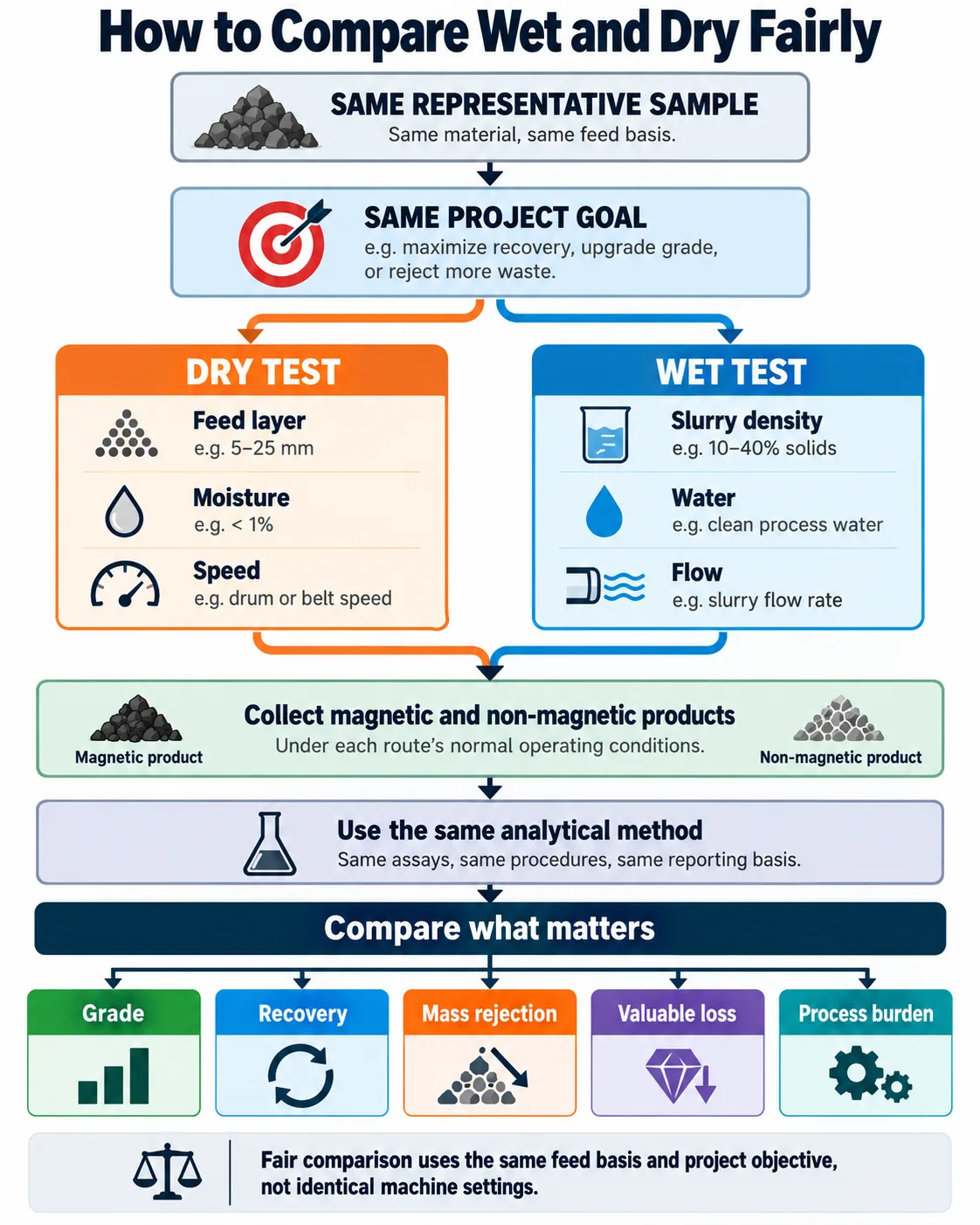
A fair comparison does not mean forcing wet and dry machines to use identical operating settings. It means testing comparable material against the same project objective and documenting the conditions that are specific to each route.
Keep These Comparable
- representative sample source and sampling basis;
- sample preparation history where practical;
- particle-size distribution used for the comparison;
- analytical method;
- project objective and acceptance metric.
Record Route-Specific Conditions
- dry-feed moisture or wet-feed slurry solids/flow;
- feed presentation, layer depth or slurry condition;
- actual feed rate and variation;
- magnetic setting used for that separator;
- working gap, matrix or active zone where relevant;
- drying/conditioning/dust steps for the dry route;
- dilution/pumping/dewatering steps for the wet route.
Sample both the magnetic and non-magnetic products. Repeat the condition most likely to challenge the route, such as higher moisture, more fines, mineralogical variation or a higher normal feed rate. The objective is to find the route that meets the same project target with a controllable operating window and an acceptable whole-process burden.
Minimum Test Record
| Record | What to capture | Why it matters |
|---|---|---|
| Sample identity | Representative lot, sampling point and preparation history | Prevents two different feeds from being treated as one comparison |
| Particle-size distribution | Measured distribution for the actual test feed | Size and fines affect presentation and liberation interpretation |
| Liberation | Known, unknown or measured; record the basis | Separates a liberation problem from a route problem |
| Moisture / slurry condition | Dry moisture or wet solids/flow condition | Defines the physical feed state presented to the separator |
| Feed rate | Actual rate and expected variation | Shows whether the result depends on an unrealistically light test condition |
| Magnetic setting | Machine setting used for each test | Makes the test reproducible without pretending different equipment uses identical settings |
| Working zone | Gap, matrix/active zone or equivalent geometry where relevant | Records the particle-to-field condition |
| Feed presentation | Dry layer/distribution or wet slurry presentation | Shows whether the feed reached the magnetic zone consistently |
| Product mass balance | Magnetic and non-magnetic product masses | Reveals mass rejection and loss rather than one product alone |
| Product analysis | Both products using the same analytical method | Allows grade/recovery or contamination calculations on a common basis |
| Repeatability | Repeat difficult or variable conditions | Shows whether the operating window is stable enough for the project |
Comparing Two Wet-or-Dry Proposals on the Same Basis
If two suppliers recommend different routes, compare the assumptions behind their results before comparing headline numbers.
| Ask both suppliers | Why it matters |
|---|---|
| Was the same representative feed used? | Different material can create a false route comparison. |
| Was PSD and sample preparation documented? | Preparation can change liberation and particle presentation. |
| Was the project target identical? | Grade, recovery, mass rejection and contaminant removal answer different questions. |
| Were moisture/slurry conditions recorded? | Feed state can materially change particle behavior. |
| Is the throughput basis stated? | A light laboratory feed does not by itself define production duty. |
| Were both product streams weighed and analyzed? | Both sides are needed for a useful mass balance. |
| Are drying, dewatering, pumping and dust-control steps included? | Separator-only comparisons can hide major process burdens. |
| Are performance commitments tied to a defined feed and operating envelope? | A number without the conditions behind it is difficult to verify or accept. |
A useful proposal is not simply the one with the highest isolated test number. It clearly defines the feed, operating conditions, project objective and acceptance boundary behind the result.
What to Send Corvelan
Initial Route Screening
You do not need a complete test program before contacting us. For an initial route discussion, send:
- material name and main process objective;
- approximate particle-size range or available PSD;
- current dry, moist or slurry condition;
- target magnetic mineral or unwanted contaminant, if known;
- expected throughput range;
- the result you need from the separation step.
With these basics, we can narrow the wet/dry route and the equipment family that deserves further evaluation without turning incomplete information into a guaranteed model or performance number.
Equipment Selection and Test Planning
When the duty is sensitive, the feed is variable, or both routes remain possible, the next useful inputs are:
- representative material sample;
- measured PSD;
- liberation or mineralogy information where available;
- dry-moisture range or slurry operating range;
- feed variability and normal/maximum throughput;
- upstream and downstream process steps;
- water, dust, dewatering and final-product-state constraints;
- the acceptance metric and how it will be measured.
Send Your Material Conditions
If you are not sure whether your material should remain dry or enter a wet circuit, send us the information you already have. We can first narrow the route and relevant equipment family. Where the result depends on the material or operating window, representative test work should define the final selection and performance basis.
FAQ
Is wet magnetic separation always better for fine particles?
No. Wet processing often becomes attractive as fines increase because liquid can help particle dispersion, but liberation, magnetic response, slurry condition and the required product still control the result. Some fine dry duties remain technically viable when feed presentation can be controlled.
Can fine particles be separated with a dry magnetic separator?
Yes, in some duties. Feasibility depends on magnetic response, particle interactions, feed dispersion, moisture and separator design. Fine particle size alone does not automatically require wet processing.
Is wet vs dry magnetic separation the same as low-intensity vs high-intensity separation?
No. Wet/dry describes the processing medium and feed presentation. Low/high intensity or high-gradient describes the magnetic mechanism needed for the target material. Both decisions must be made; one does not replace the other.
What if the material is both fine and weakly magnetic?
Do not choose from particle size alone. Confirm liberation and magnetic response, then determine whether the fine feed can be presented consistently in dry separation and whether the required magnetic gradient can be achieved. If those requirements conflict, compare a wet high-intensity/high-gradient route on the same representative material.
What if the feed is moist but not actually slurry?
Treat it as a feed-presentation question first. Check whether the highest expected moisture and fines still allow a stable dry layer. If the material bridges, coats or agglomerates, compare dry conditioning/drying with the burden of converting the stream into a controlled slurry.
Why can the same dry separator work on one batch but poorly on another?
The separator may be seeing a different feed even when the material name is unchanged. Changes in PSD, liberation, moisture, fines/clay, mineralogy, feed rate or storage condition can change particle presentation and capture. Compare those conditions before assuming the route or magnetic system is wrong.
How should wet and dry test results be compared?
Use representative material, the same project objective and the same analytical basis. Record route-specific feed and operating conditions, analyze both products, include route-specific drying/dewatering/dust burdens, and repeat the condition most likely to challenge the process. Fair comparison means a common project basis, not identical machine settings.
Technical References
- Physical Concentration of Heavy Minerals: A Brief Review on Low and High Intensity Magnetic Separation Process Techniques, JOM, published 2023.
- Dry Permanent Magnetic Separator: Present Status and Future Prospects, Minerals, 2022.
- Significant Improvement in Dry High-Gradient Magnetic Separation Efficiency via Radial Airflow: From Theory to Practice, Separation and Purification Technology, 2026.