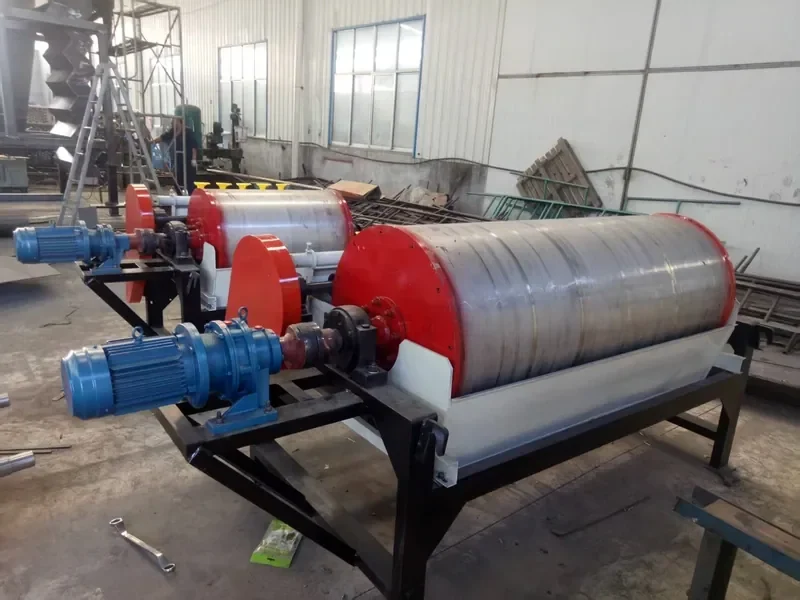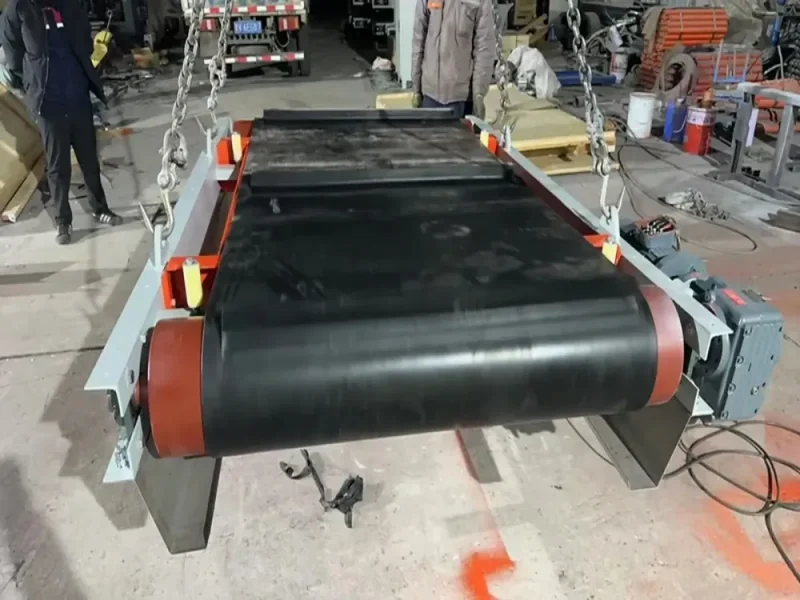
Quick answer: Surface Gauss tells you the magnetic flux density at a local measurement point. It does not tell you, by itself, how far a separator can capture iron. For a meaningful comparison, define the distance from the magnetic face to the contaminant position, including any air gap, belt, chute wall, liner, wear layer and material depth. Then compare supplier data on the same measurement basis.
At Corvelan, we recommend treating surface Gauss as a useful local specification, not as a stand-alone reach rating. If your target contamination is separated from the magnetic face, the more useful question is: what magnetic or test condition exists where the contaminant actually passes?
Which Working-Distance Question Are You Trying to Answer?
Start with the decision you need to make, then choose the measurement that can answer it.
| Your question | Check first |
|---|---|
| What does this Gauss value mean? | Where it was measured and what that location represents. |
| How do I compare two quotations? | Align metric, reference plane, distance, test location and method. |
| Why is my installed separator missing some iron? | Rebuild the actual face-to-target distance before assuming the magnet is weak. |
| How do I verify a production result? | Use process evidence separately from static Gauss or pull-force data. |
Why Surface Gauss Cannot Tell You Working Distance
Treat surface Gauss as a local defined measurement, not a stand-alone reach/capture rating. A higher surface Gauss reading does not by itself prove stronger separation at the target contaminant position.
Gauss is a unit of magnetic flux density. A surface reading describes the magnetic condition where the probe is placed. Once the contaminant is farther away, the relevant location has changed. If two suppliers measure at different positions, their quoted values may describe different conditions even when both use Gauss.

This is why a published Gauss value needs measurement context. Some magnetic-grid specifications, for example, identify their Gauss value as a reading taken on the tube surface. That is useful because it tells you where the number applies.
For a contaminant farther from the magnetic face, you need information that represents that defined distance and position. Magnetic-separator testing also distinguishes between attracting tramp iron from a specified distance and holding it after it reaches the magnetic element. These functions are related, but they are not the same measurement question.
| What you are given | What it can tell you | What it cannot prove by itself |
|---|---|---|
| Surface Gauss | Local magnetic flux density at a defined surface point | Field condition at a remote contaminant position or process capture |
| Gauss at a stated distance | Magnetic flux density at a defined point away from the magnetic face | Process capture unless geometry, material and operating conditions are also addressed |
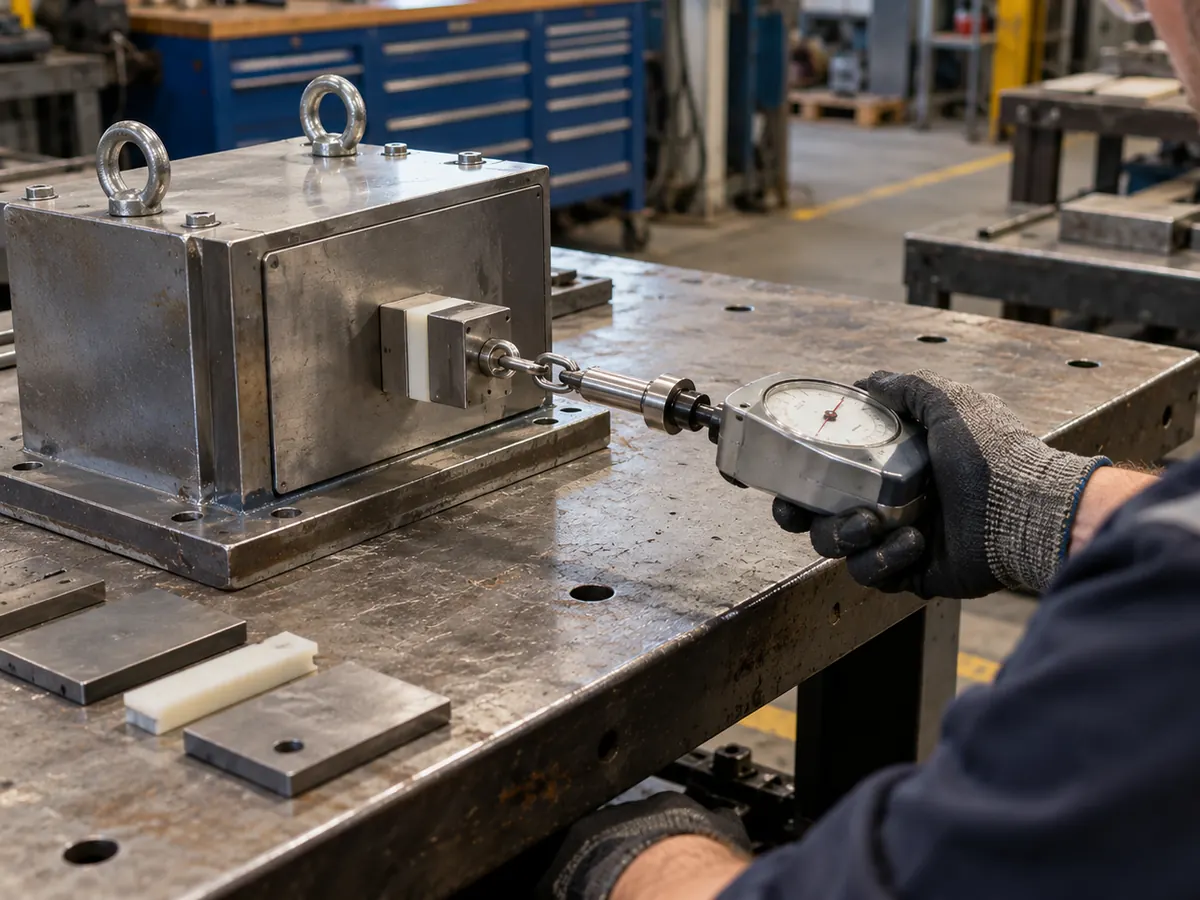
| Pull-force test | Force on a defined ferrous test piece under a defined setup | Equivalent Gauss, behavior of every contaminant, or full process performance |
| Process test with normal production material | Separation outcome under defined material and operating conditions | Performance outside the tested condition range |
What to check: First decide what question the magnetic number needs to answer. If you are checking the same magnetic element repeatedly at the same defined point, a surface Gauss reading can be a useful local baseline. If the contaminant passes away from the magnetic face, the comparison needs information tied to that actual distance and position. If the real question is whether material will be removed under production flow, neither a surface reading nor an isolated at-distance reading should be treated as the process result by itself. The measurement should follow the decision: local condition → local measurement; remote target → defined at-distance evidence; production result → representative process evidence.
How to Define the Working Distance That Actually Matters
Working distance is the actual separation from magnetic face to target contaminant, not merely nominal mounting clearance. Use a defined magnetic face or reference plane so that the number means the same thing on drawings, quotations and test records.
Start with a clear magnetic reference surface. Without a common zero point, phrases such as “50 mm from the magnet” or “200 mm suspension height” can be ambiguous. The quotation, drawing or test record should state where the distance starts.
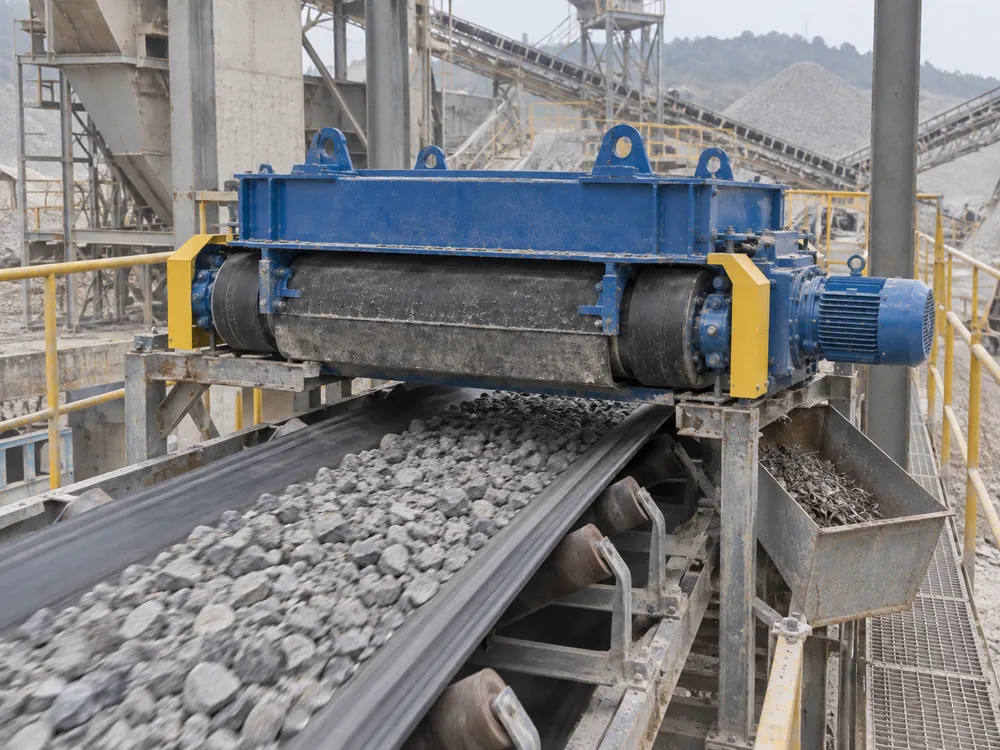
Start from the Same Magnetic Reference
Use the magnetic face, or another clearly defined reference plane, as the starting point. If suppliers use different reference surfaces, translate their dimensions to the same basis before comparing values.
The purpose is not to force every separator into one geometry. It is to make sure a drawing dimension is not mistaken for the distance that matters to the contaminant.
Include Every Layer Between the Magnet and the Contaminant
Anything physically between the magnetic face and the contaminant can add to the separation distance. Depending on the installation, this may include:
- structural clearance or air gap;
- conveyor belt thickness;
- a nonmagnetic chute wall or sleeve;
- liner or wear plate;
- protective cover;
- other nonmagnetic process barriers.
If a barrier material is magnetic, or its magnetic properties are not known, treat its material and geometry as a separate design variable rather than simply adding its thickness as a nonmagnetic gap.
These layers do not tell you whether the separator will succeed. They tell you where the relevant magnetic or test condition needs to be checked.
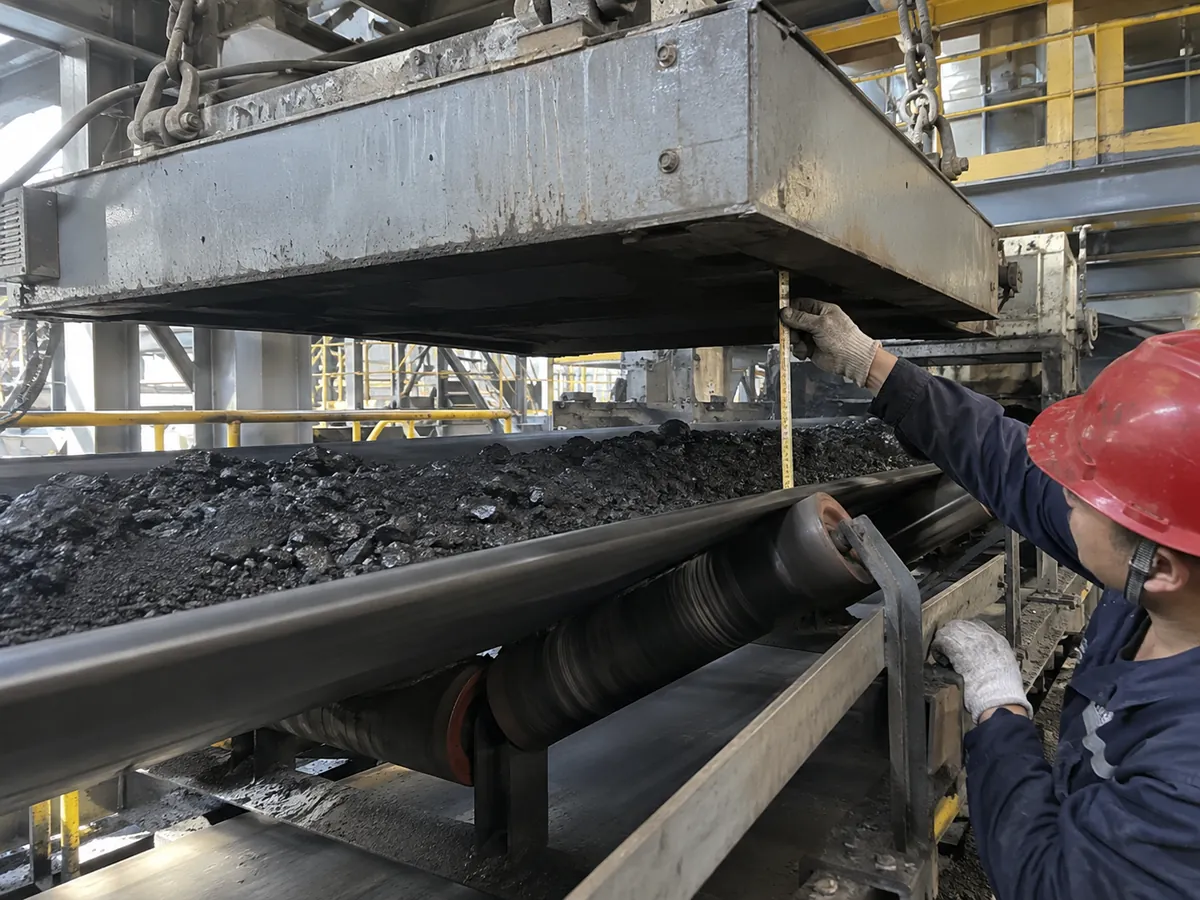
Include Material Depth and the Real Contaminant Position
The contaminant may not be at the surface of the conveyed or flowing material. On a conveyor, tramp iron can be near the top, middle or bottom of the burden. If that position varies, use a working-distance range rather than pretending one nominal gap represents every particle.
A simple section sketch is usually enough to organize the inputs:
| Distance component | What to record | Why it matters |
|---|---|---|
| Magnetic reference | Defined magnetic face or reference plane | Establishes the zero point |
| Fixed clearance | Air or structural gap | Adds constant separation |
| Belt, chute or liner | Thickness and relevant geometry | Adds material between magnet and target |
| Material depth | Normal and maximum relevant depth | Changes the contaminant position |
| Target position | Expected position or range | Defines where at-distance data is needed |
| Variation | Sag, wear, changing burden or movement | Shows whether one distance is enough |
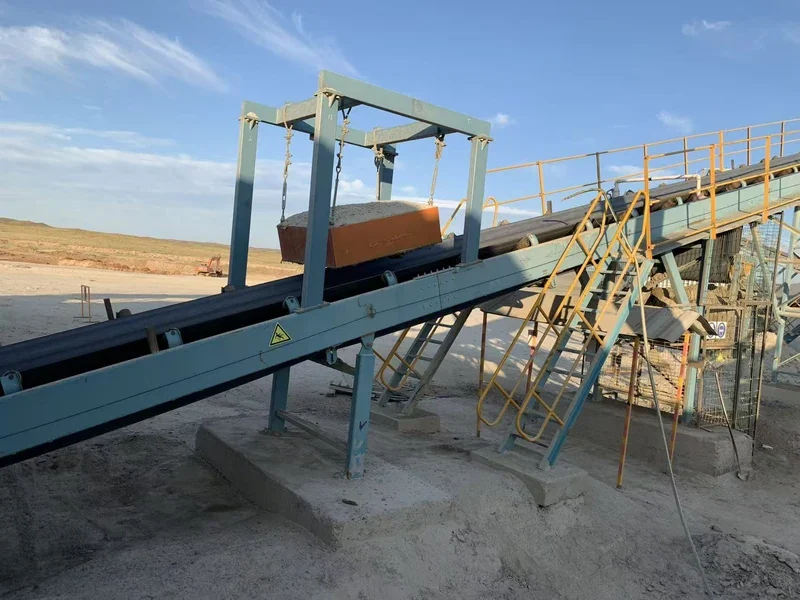
Do not use mounting clearance as a shortcut for working distance. For a separator above a conveyor, magnet-to-belt clearance can still omit belt thickness and the contaminant depth inside the burden. Draw the full path from the magnetic face to the target position first.
Use a Range When the Target Position Changes
Use one distance only when the target position is controlled closely enough for that point to represent the application. If material depth changes materially, state the minimum and maximum target position, or define the design position that the comparison must address.
Working distance tells you where to evaluate the magnetic condition. It is not a universal formula for predicting capture.
When Several Distance Conditions Change at the Same Time
Working distance can change even when separator mounting height does not. Burden depth, barrier thickness and contaminant position can change together, moving the real target farther from the magnetic face.
| Condition | What changes | What to do |
|---|---|---|
| Burden is shallow and stable | One target position may represent the duty. | Use one clearly defined distance. |
| Burden depth varies | The deepest target may be much farther away. | Use a working-distance range or design position. |
| Belt, liner or wear layer changes | The face-to-target path changes. | Rebuild the distance stack. |
| Deep burden + target near the belt | Mounting clearance becomes a poor proxy for target distance. | Compare evidence at the deepest relevant position. |
These conditions often occur together. Define the target position or target-position range instead of assuming one visible mounting dimension represents the application.
How to Compare Magnetic Separator Quotations on the Same Basis
Two magnetic numbers are comparable only when metric, distance, location, method and relevant geometry/conditions are aligned. Do not rank magnetic separators from the Gauss number alone; also align the reference plane and the relevant test object or probe.
This matters even when both quotations use the word “Gauss.” The same unit does not guarantee the same measurement basis.
Compare the Same Type of Measurement
Do not treat these as interchangeable:
- surface Gauss;
- Gauss at a defined distance;
- pull force on a defined test piece;
- process capture, recovery or contaminant-removal result.
Each answers a different question. A pull-force test, for example, measures force on a specific test piece under a defined setup. It should not be converted into a Gauss claim or a universal capture result.
Compare the Same Distance and Reference Point
If one supplier reports a surface value and another reports a value away from the magnetic face, the two numbers are not a valid direct comparison.
If both report Gauss at distance, confirm that the distance starts from the same type of reference surface and represents the same functional location in the separation zone.
Compare the Same Test Location and Method
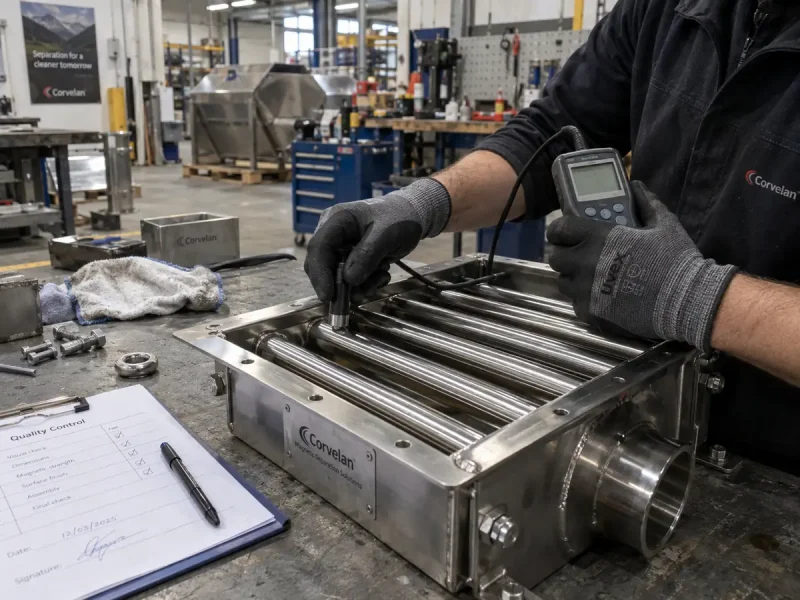
Magnetic strength can vary across a separator face. A useful comparison therefore needs a defined location and repeatable method. Equipment should be compared at functionally equivalent points, with the test apparatus and exact test location recorded.
For a field measurement, record the probe position and orientation required by the chosen method. For a pull test, record the test piece, spacer or distance, pull direction, force gauge and test location. If you use repeated readings, keep the setup consistent.
Stop the Comparison When Key Conditions Are Missing
Use this check before accepting a “higher number” argument:
| Supplier detail | Ready to compare | Ask for clarification | Not directly comparable |
|---|---|---|---|
| Metric | Same metric | Metric name is unclear | Different metrics presented as equivalent |
| Reference plane | Same defined reference | Reference not stated | Different references cannot be translated |
| Distance | Same stated distance | Distance missing | Different distances with no normalized data |
| Functional location | Equivalent point or zone | Location vague | Different zones answer different questions |
| Test object or probe | Same or clearly defined | Details incomplete | Different test piece or procedure used as a direct ranking |
| Method | Same repeatable method | Method partly described | Methods materially differ |
| Geometry and condition | Relevant geometry is aligned | Important condition missing | Different context makes the comparison technically different |
Compare these supplier details: Ask each supplier to state the metric, magnetic reference plane, measurement distance, test point, test object or probe, method, and the equipment or process condition represented by the value. If those fields cannot be aligned, treat the figures as not directly comparable.
That is more useful than “highest number wins,” because the correct next step may be to request missing information rather than approve the larger number.
Why the Same Nominal Gap Can Mean Different Things
The same nominal gap can describe different real separation conditions because geometry, burden and separation-zone physics change what the relevant measurement must represent. This is why the same dimension can need a different measurement basis on different separator types.
Use the working-distance principle across equipment types, but do not force one measurement convention onto every separator.
| Application | What the gap usually represents | What to check | Mistake to avoid |
|---|---|---|---|
| Contact or near-contact magnetic element | Product passes close to the magnetic surface | Local reading, actual product path and process objective | Assuming a local surface value proves full process performance |
| Suspended or non-contact separator | Target may be separated by air gap, belt, liner and material depth | Actual contaminant distance or range and relevant at-distance evidence | Treating magnet-to-belt clearance as contaminant distance |
| Wet or high-gradient separation zone | Separation depends on magnetic conditions within a defined process zone | Equipment-family-specific field, gradient or process-test basis | Using one arbitrary Gauss number as the full selection basis |
Contact or Near-Contact Magnetic Elements
You are in this case when the product is intentionally presented close to the magnetic element and there is little or no bulk-material depth separating the target from that element.
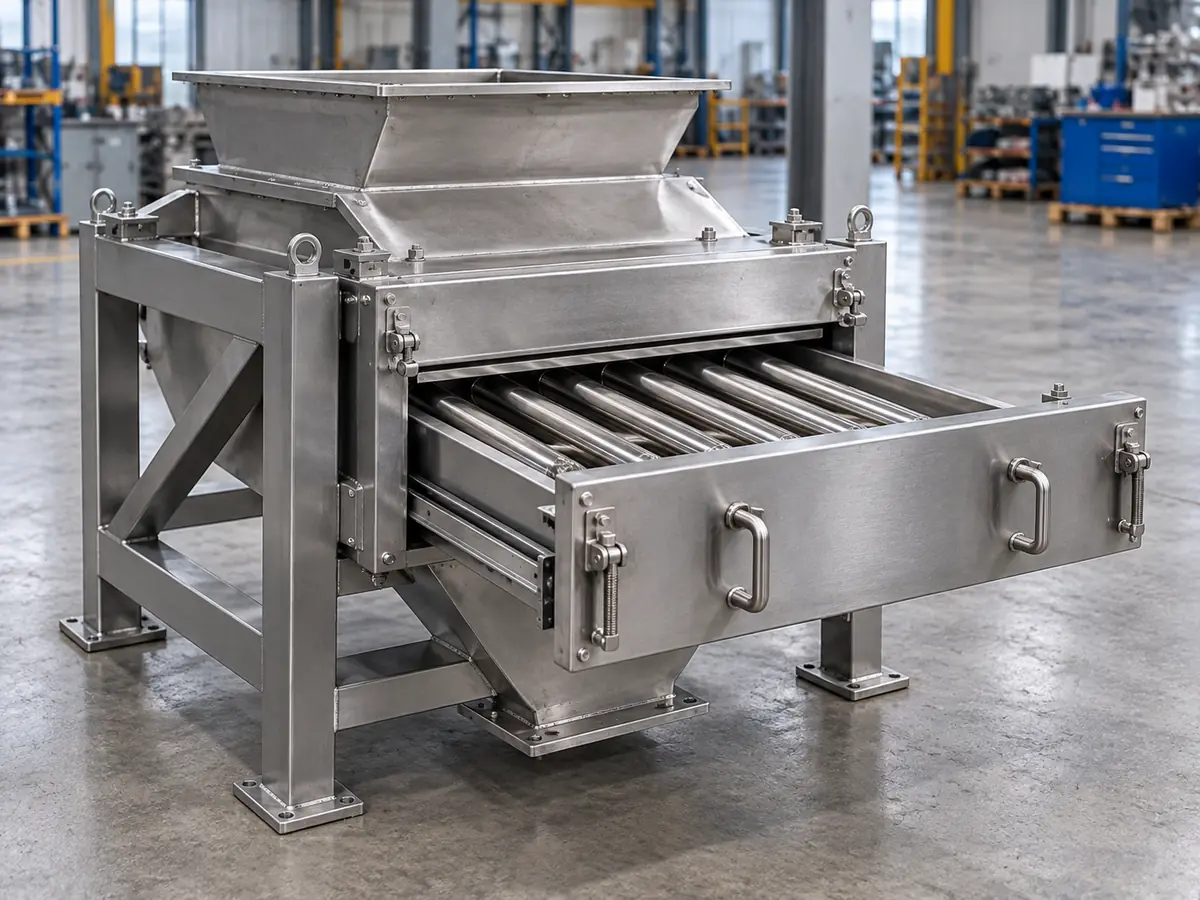
For a grid, tube, plate or similar arrangement where the product path is designed to pass close to the magnetic element, a surface reading can describe the local field near that element. Its relevance still depends on the actual product path and the stated measurement reference.
It still does not prove the process result. Contaminant material, particle size and shape, product flow, exposure, cleaning condition and other application variables can change what the separator actually captures.
Suspended Separators Above Conveyors
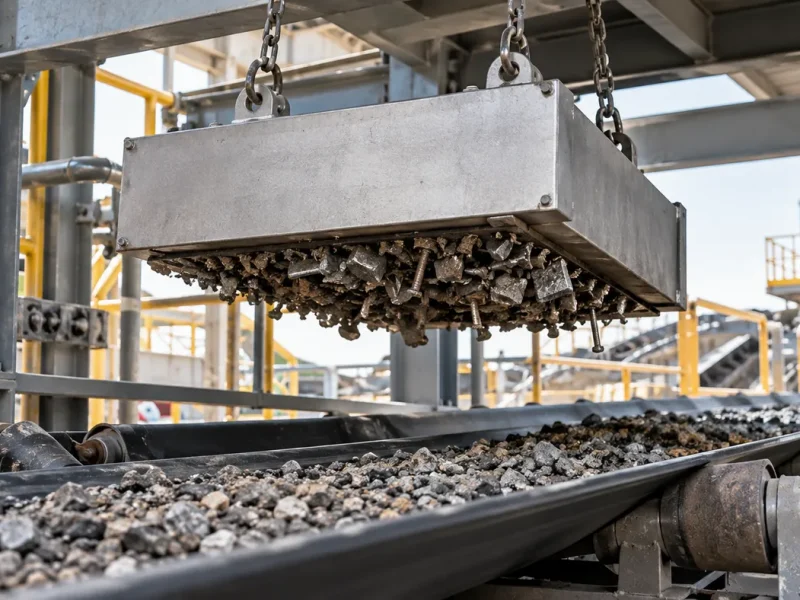
You are in this case when the magnet works without direct contact with the product and the contaminant may sit somewhere inside a moving burden below the magnetic face.
For a suspended separator, the target may be materially farther from the magnetic face than the mounting dimension suggests. The real distance can include air clearance, belt thickness, liner or cover, material depth and the contaminant position inside the burden.
If you need to remove contamination from near the bottom of the burden, data taken only at the magnet surface or at the top of the material does not answer the same question.
Wet and High-Gradient Applications
You are in this case when particles are being separated inside a slurry or a defined high-gradient separation zone rather than being pulled from a dry conveyor burden.
Some wet-drum and high-gradient applications need a different magnetic description. In these cases, magnetic-field distribution within the separation zone can matter, and high-gradient magnetic separation involves both field magnitude and field gradient at the particle position.
This does not mean every magnetic separator must be selected from a field-gradient calculation. It means a one-point surface Gauss figure should not be generalized beyond the equipment family and separation mechanism it describes.

The Same Working Distance Does Not Mean the Same Separation Result
Working distance removes one source of ambiguity, but it does not make two applications identical. At the same face-to-target distance, target response, size, shape, material presentation and motion can still differ.
| Same working distance | What may still differ |
|---|---|
| Same target location | Magnetic response, size, shape and orientation |
| Same target location | Material surrounding the contaminant and how freely it can move |
| Same target location | Motion through the separation zone and required process result |
Key distinction: Working distance normalizes location. It does not normalize the entire separation process.
If an Installed Separator Misses Iron, Check the Distance Stack Before Blaming the Magnet
If removal becomes inconsistent, first ask what changed between the magnetic face and the contaminant position. Do not assume the magnetic system is weak before checking the real operating geometry.
| What you observe | Check first | Next action |
|---|---|---|
| Easy pieces are removed, but deeper pieces remain | Maximum burden depth and contaminant position | Rebuild the face-to-target distance. |
| Results worsen as the material bed becomes deeper | Normal and peak material depth | Define a working-distance range. |
| Static magnetic check looks normal but production result is poor | Feed presentation, target position and operating condition | Use a representative process check. |
| Results changed after belt, liner or wear-component replacement | New thickness and geometry | Update the working-distance basis. |
These observations do not prove the cause; they show which variable to isolate first. If target position and operating conditions have not changed, investigate magnetic-system condition and other equipment variables separately.
What to Ask for Before You Approve a Separator
A magnetic number becomes procurement-usable only when its measurement object, location, distance, method, condition and comparison/acceptance basis are documented. Before approving a magnetic-strength claim, make sure the measurement basis and its purpose are clear; a repeatable number can still be the wrong evidence if it does not answer the project question.
First decide what you need to verify:
- Local magnetic baseline — Has the same magnet changed when measured at the same point and with the same method?
- Like-for-like equipment comparison — Which separator provides the required field or pull-test result under matched conditions?
- Process result — Does the separator achieve the agreed separation objective with normal production material and defined operating conditions?
These questions need different evidence.
Ask Suppliers to State the Measurement Basis
When a Gauss or pull-force value is part of the quotation, ask for the information needed to interpret it:
- what the value is intended to verify;
- whether the metric is surface Gauss, Gauss at distance, pull force or a process result;
- magnetic reference plane;
- measurement distance;
- exact test point or functional zone;
- test object or probe details;
- test-piece material, size and shape when pull testing is used;
- spacer thickness or defined separation distance when applicable;
- pull direction or probe orientation when relevant to the method;
- instrument and method;
- repeated-reading or sampling approach;
- material and operating condition when process performance is being evaluated;
- the comparison or result the project requires.
This list defines the information needed for a meaningful comparison; it is not a test procedure. Any physical field or pull test should follow the equipment manufacturer’s instructions and the site’s isolation, guarding, access and safety rules.

Keep Equipment Checks Separate from Process Results
A static magnetic measurement can verify a defined equipment metric. It does not automatically verify the separation result under real material flow.
| What you need to know | Evidence that fits the question | Limit of that evidence |
|---|---|---|
| Is the local magnetic reading consistent with the defined specification? | Repeatable Gauss measurement at the defined point and method | Local equipment metric only |
| Are two separators comparable on magnetic field or pull test? | Matched point, distance, object, method and relevant geometry | Like-for-like equipment comparison only |
| Will the process meet an agreed capture, recovery or contamination objective? | Process trial or commissioning check using normal production material and agreed operating conditions | Applies only to the tested or agreed conditions |
If the purchase decision depends on process capture or recovery, define that process result separately rather than using a surface magnetic value as a substitute.
Recheck the Measurement Basis When the Installation Changes
An old baseline remains comparable only if the relevant condition is still the same. Changes to separator height, belt construction, liner thickness, burden depth or target position can leave the magnetic equipment unchanged while changing the application distance.
Before comparing a new reading with an old record, confirm the same reference plane, distance, location, method and installation geometry. If they differ, rebuild the distance stack before interpreting the change as magnet degradation or improvement.
Put Missing Information Back into the RFQ
If a quotation gives only a Gauss value, do not approve or reject it from that number alone. Ask where it was measured, at what distance, at what functional point, with what method, and what the value is intended to demonstrate.
For a non-contact application, also provide the working-distance inputs: magnetic-face reference, fixed barriers, material depth, contaminant position, and the operating condition that matters to the comparison.
Before you approve: A useful technical record identifies the measurement object, location, distance, method and condition. If the project requires a process result, define the process check separately instead of extending a static magnet reading beyond its scope.
When Surface Gauss Is Still Useful
Surface Gauss remains useful as a defined local specification or repeatable baseline; it is not enough by itself to prove reach, capture or recovery.
Typical uses include:
- comparing repeated readings at the same defined point on the same equipment;
- checking a local specification when the measurement method is defined;
- locating or comparing strong-field regions under a controlled method;
- documenting a baseline for later inspection.
The practical rule is to match the evidence to the question:
- Use surface Gauss when you need a repeatable local magnetic baseline at a defined point.
- Use Gauss at a defined distance when the magnetic condition away from the face is the question.
- Use a controlled pull-force test when you need a repeatable force comparison on a defined test piece and setup.
- Use a representative process check when the decision depends on capture, recovery or contaminant removal under operating conditions.
These methods answer different engineering questions. For a focused comparison of Gauss readings and pull-force measurements, read the Gauss vs Pull Force guide.
FAQ
Does higher Gauss always mean a better magnetic separator?
No. A higher reading can mean a stronger local flux-density value at the measurement point, but separator performance also depends on where the target contaminant is, the magnetic geometry, the contaminant response and the process condition. Compare the measurement basis before comparing the number.
How far can a magnetic separator attract iron?
There is no universal distance that can be derived from surface Gauss alone. The answer depends on the magnetic circuit, the target contaminant, the actual distance from the magnetic face and the application conditions. Define the target position first, then request relevant at-distance or test evidence.
What is the correct magnetic separator working distance?
It is the application-specific distance from the defined magnetic face to the target contaminant position. Include any structural gap, belt, chute wall, liner, wear layer, material depth and position variation that lies between them.
Should I ask suppliers for Gauss at distance instead of surface Gauss?
If the target is separated from the magnetic face, Gauss at a defined distance can be more useful than an isolated surface number. It still needs a defined reference point, location, geometry and method, and it does not replace process evidence when process performance is the required result.
Is pull force better than Gauss for comparing separators?
It answers a different question. Pull force measures force on a defined ferrous test piece under a defined setup. It can be useful for controlled comparison, but only when the test piece, distance, location, pull direction and method are consistent. Do not treat pull force and Gauss as interchangeable ratings.
Does conveyor belt thickness affect working distance?
Yes, when the belt lies between the magnetic face and the target contaminant. In a suspended conveyor installation, belt thickness can be one component of the total target distance, together with clearance and the contaminant depth inside the burden.
Can two separators have the same working distance but still require different evidence?
Yes. Working distance normalizes target location, but material response, size, shape, presentation, motion and the required process result can still differ. Align those conditions before treating the applications as comparable.
Why can a separator pass a Gauss check but still miss iron in production?
Because a Gauss check confirms a magnetic condition at a defined point, not the whole production process. If the target is farther away, buried deeper or presented differently under flow, check the real distance stack and operating condition before blaming the magnetic system.

What to Send Corvelan for a Meaningful Comparison
If you want to compare magnetic separator options for your line, send us a simple section sketch plus the project details that change the working distance and measurement basis:
- material and normal operating condition;
- normal and maximum material depth;
- target contaminant description and expected position;
- magnetic-face or mounting reference available on your drawing;
- belt, chute, liner, wear layer or other barriers between the magnet and material;
- available installation space;
- the magnetic value or test basis already specified in your RFQ, if any;
- whether you are comparing an equipment metric or a required process result.
We will use these inputs to keep the discussion tied to the actual separation position and to avoid comparing magnetic numbers that describe different conditions.