To choose a magnetic separator for kaolin, start with a wet high-gradient trial when your feed is already a slurry and the color problem comes from fine, weakly magnetic particles that have been freed from the clay. Test dry high-intensity separation first if the line must stay dry and the powder feeds evenly. If the problem is steel wear or strongly magnetic grit, catch it upstream before it reaches the fine purification stage.
Set the test target before comparing machines. A paper-coating pigment may need a specific brightness and particle-size distribution. A ceramic body may need to fire to a certain color with very few dark specks. A useful trial shows what the separator can remove, what stays in the clay, and how much saleable product you get at your required rate.
How Do You Choose a Magnetic Separator for Kaolin?
Choose the first trial from the impurity you need to remove, the condition of the feed, and the product specification. Use the sample and target from the point where the separator will run. Raw ore and classified slurry from the same mine may need very different equipment.
Set the product target
Write down the property that can cause your customer to reject the clay. For a low-iron grade, use the required Fe₂O₃ limit and the agreed reporting basis. For a color-sensitive grade, ask the buyer which brightness, whiteness, fired color, or speck test they use. When a buyer controls both chemistry and appearance, keep both acceptance criteria with the product yield target.
Pick the first trial
| What you see at the proposed feed point | First trial | Result that changes the route |
|---|---|---|
| Steel flakes, scale, or a strongly magnetic fraction | A guard magnet for coarse steel or a low-intensity stage matched to the feed | Test a second stage if fine weakly magnetic material still drives rejection. |
| Degritted slurry with fine, weakly magnetic particles | Wet matrix-type high-gradient magnetic separation (HGMS) | If the slurry distributes evenly and the target particles respond on a wet plate, compare the two designs at the same dry solids rate. |
| Classified, free-flowing dry feed | Dry high-intensity roll for a suitable size cut, or a dry matrix filter for fine powder | If moisture causes clumps or the reject carries too much usable clay, compare improved dry handling with a wet circuit. |
| High total iron with little response in a controlled magnetic trial | Check the mineral phases and where the iron sits | Test further liberation if iron is trapped in composite particles. If the iron remains with the clay structure, review ore selection, blending, or a different product grade. |
Which Iron and Titanium Impurities Can You Remove?
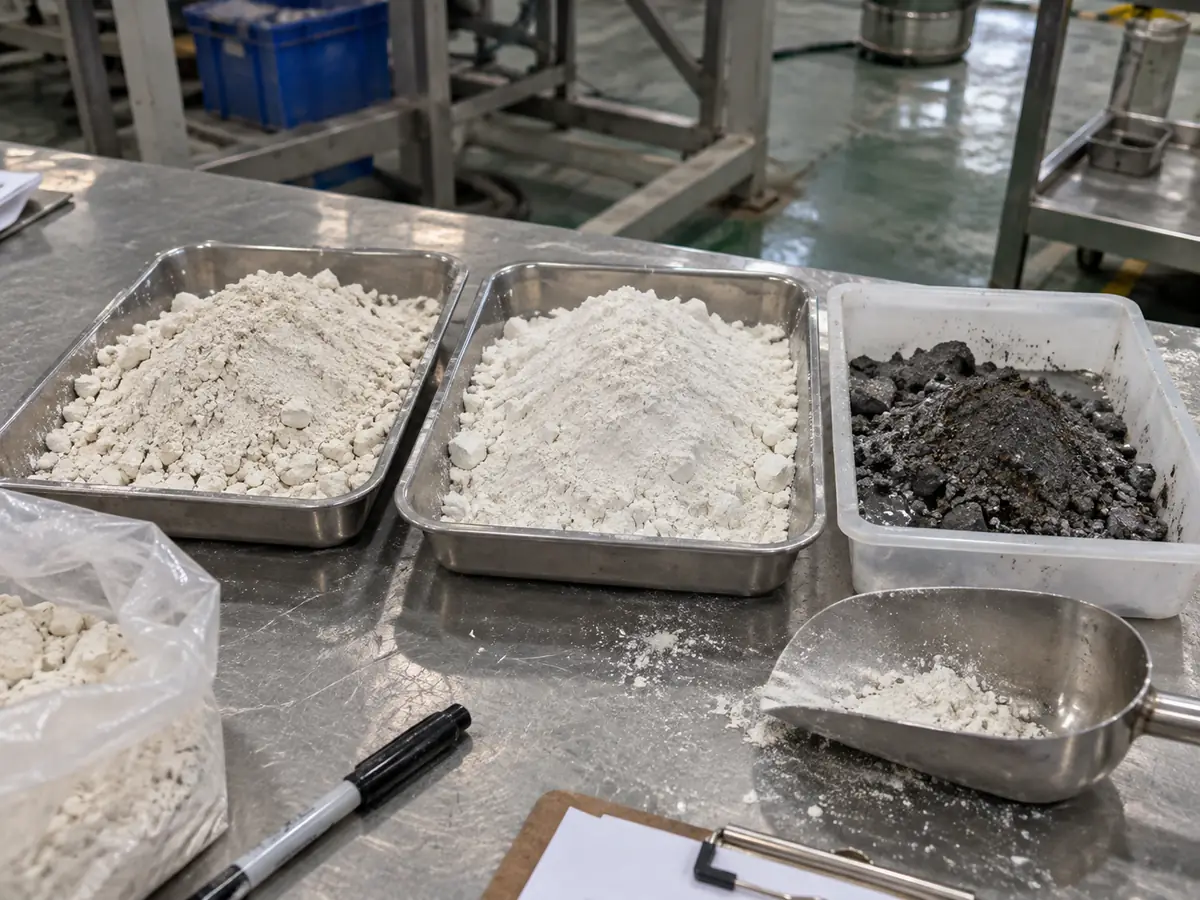
Magnetic separation can remove iron-bearing grains that respond to the field as particles. It readily targets ferrous wear debris and strongly magnetic grains such as magnetite. A matrix-type unit can also capture some finer, weaker material, including liberated hematite or goethite. Capture depends on the particle size, mineral form, and feed condition.
Identify the form of iron
Start with bulk chemistry, then look at what carries the iron. An XRF report gives the total amount of iron, often expressed as Fe₂O₃. Use mineralogical examination or microscopy on the feed and separated fractions to see whether the iron occurs as free grains, coatings, inclusions, or part of the kaolinite structure. A composite particle may report to the magnetic stream and carry clay with it. Iron within the kaolinite crystal stays with that clay particle.
If the dark particles are concentrated in just one size cut, assay that cut separately. If they are wear fragments from a mill or pump, collect samples before and after the suspected equipment before changing the mineral circuit. UNIDO discusses differences in magnetic response and the removal of some coatings and inclusions in its kaolin beneficiation report, High Intensity Magnetic Separation section.
Find where the titanium goes
Measure TiO₂ in the feed, clean clay, and magnetic reject if titanium affects your grade. Some iron-bearing titanium particles can follow the magnetic reject. Titanium in a poorly responsive phase can stay in the product even when Fe₂O₃ drops. That pattern points to checking the residual titanium mineral and testing a suitable alternative, especially when brightness still misses the target.
Which Wet Separator Fits Fine Kaolin Slurry?
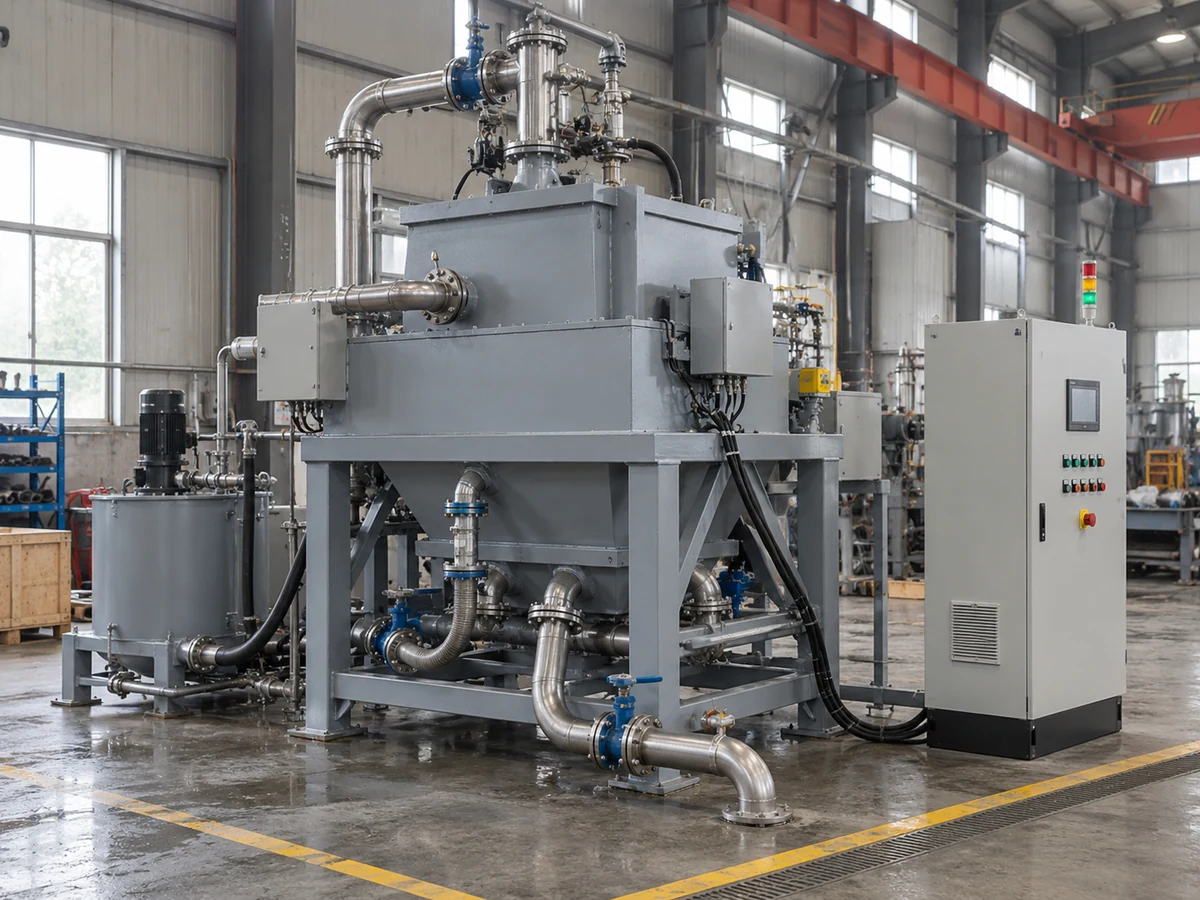
Use a matrix-type wet HGMS as the first trial for fine, liberated, weakly magnetic particles in a dispersed slurry. Put a wet plate separator on the shortlist when the feed spreads evenly and a test shows that it can capture enough of the target at the required flow. The two designs expose particles to different capture surfaces. WHIMS means wet high-intensity magnetic separation. The label describes a family of wet machines, so ask what the slurry actually flows over or through.
Matrix separators for finely dispersed clay
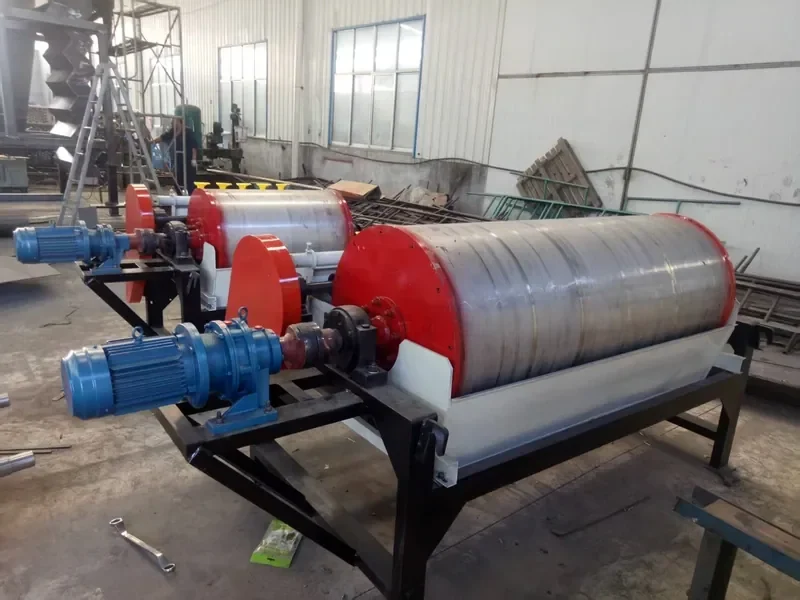
The magnetic field magnetizes the metal matrix. Near wires or edges in the matrix, the field changes quickly over a short distance. Those local gradients help draw a responsive particle to a collection surface while the clay slurry flows through. A cyclic canister may pause feed to purge and rinse its matrix. A moving ring presents fresh matrix to the feed as the loaded sections move to their wash zone. Check the actual feed and wash sequence when comparing designs. See Metso’s HGMS design description for the role of the matrix.
Wet plate separators for evenly spread slurry
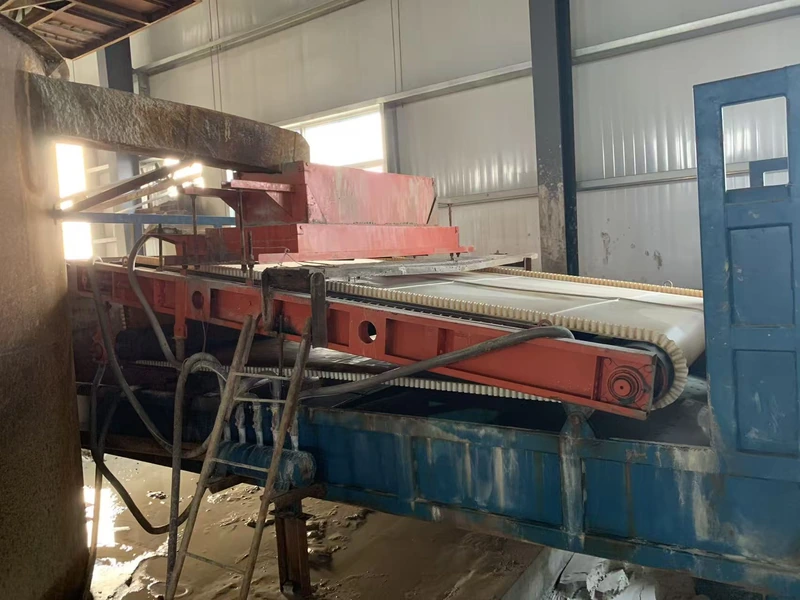
A wet plate and belt unit spreads slurry across a magnetic working area and uses a belt to transport captured material toward discharge. Select this route for a trial when the slurry forms an even feed layer and tests show the remaining iron responds. When the clean clay still carries the finest iron-bearing fraction, compare a matrix unit on a split of the same feed. Compare Fe₂O₃, the buyer’s color metric, dry yield, water use, and dry tons per hour at a stable run condition. Review the structure and selection conditions for the Corvelan wet high-intensity plate magnetic separator.
When Does Dry Magnetic Separation Make Sense?
Start with a dry route when kaolin must stay dry, can be metered evenly, and has a magnetic impurity the dry test can capture. Evaluate the upper end of normal feed moisture before committing to an all-dry line.
Choose between a roll and a dry matrix
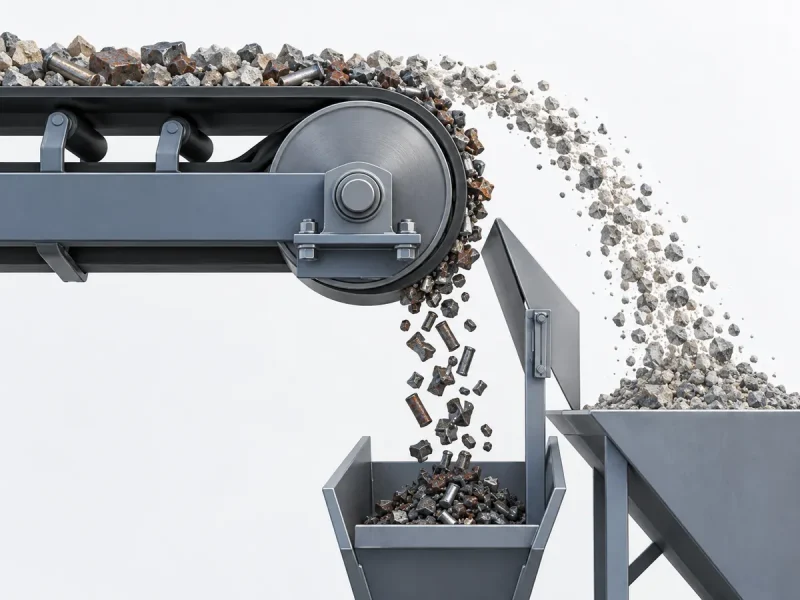
Test a high-intensity roll when a screened or classified fraction can be delivered as a thin, stable layer. The roll and splitter separate streams by their trajectories, so a wide size spread or uneven feed can make the cut harder to control. For fine powder that can be dispersed and metered, consider an enclosed dry matrix filter. Test its feed system and cleaning cycle with the separator. A published dry HGMS study on ultrafine kaolin specifically built in powder dispersion to break up clusters.
Test the powder at its highest expected moisture
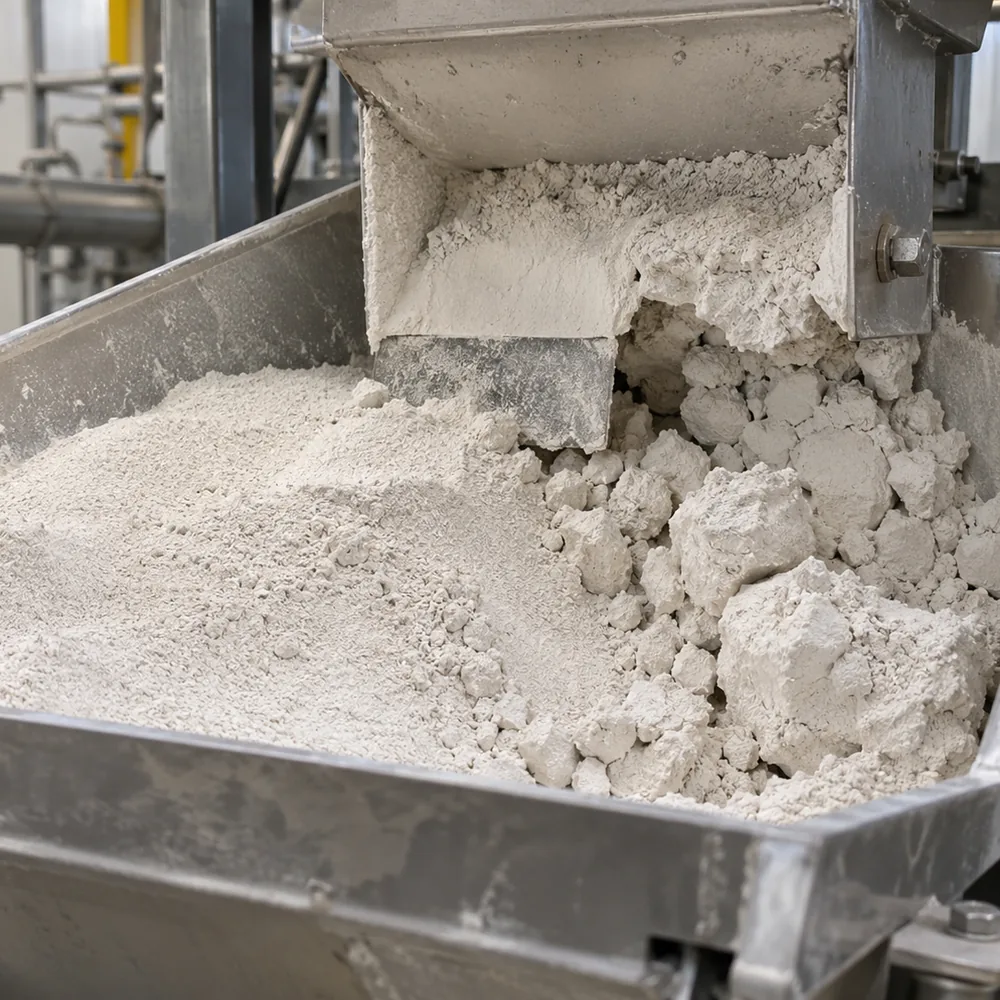
Measure moisture by mass in both a routine sample and a damp production lot. Look for hopper buildup, pulsing feed, or clay clumps in the reject. If the result deteriorates only with the damp lot, test drying or deagglomeration and include the associated energy, dust collection, and reject handling in the comparison. If the next stage already mixes the powder with water, a wet test at that point may be more practical. If you must return the clay to dry form, include dewatering and drying in the wet route’s cost.
Where Should the Separator Sit in a Kaolin Plant?
Put coarse iron protection before the equipment it protects and the fine purification stage where the feed has the particle size and dispersion the separator was tested on. On a typical wet refining route, that means a prepared stream after blunging, degritting, and the relevant size classification step. Blunging means mixing the clay with water to break down lumps and disperse it.
Place the guard before sensitive equipment
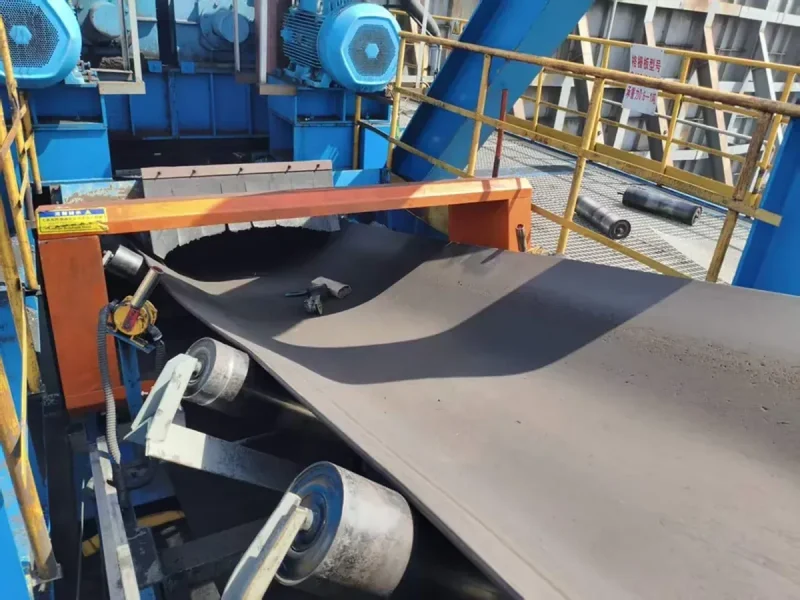
If ferrous debris enters with mined clay, place the appropriate guard ahead of vulnerable processing equipment. If new specks appear after grinding or transfer, compare samples from each side of the mill, pump, or conveyor. Put the guard where it catches the wear material before it reaches the next sensitive stage. Record the debris type and load when estimating cleanout frequency.
Feed the fine stage after classification
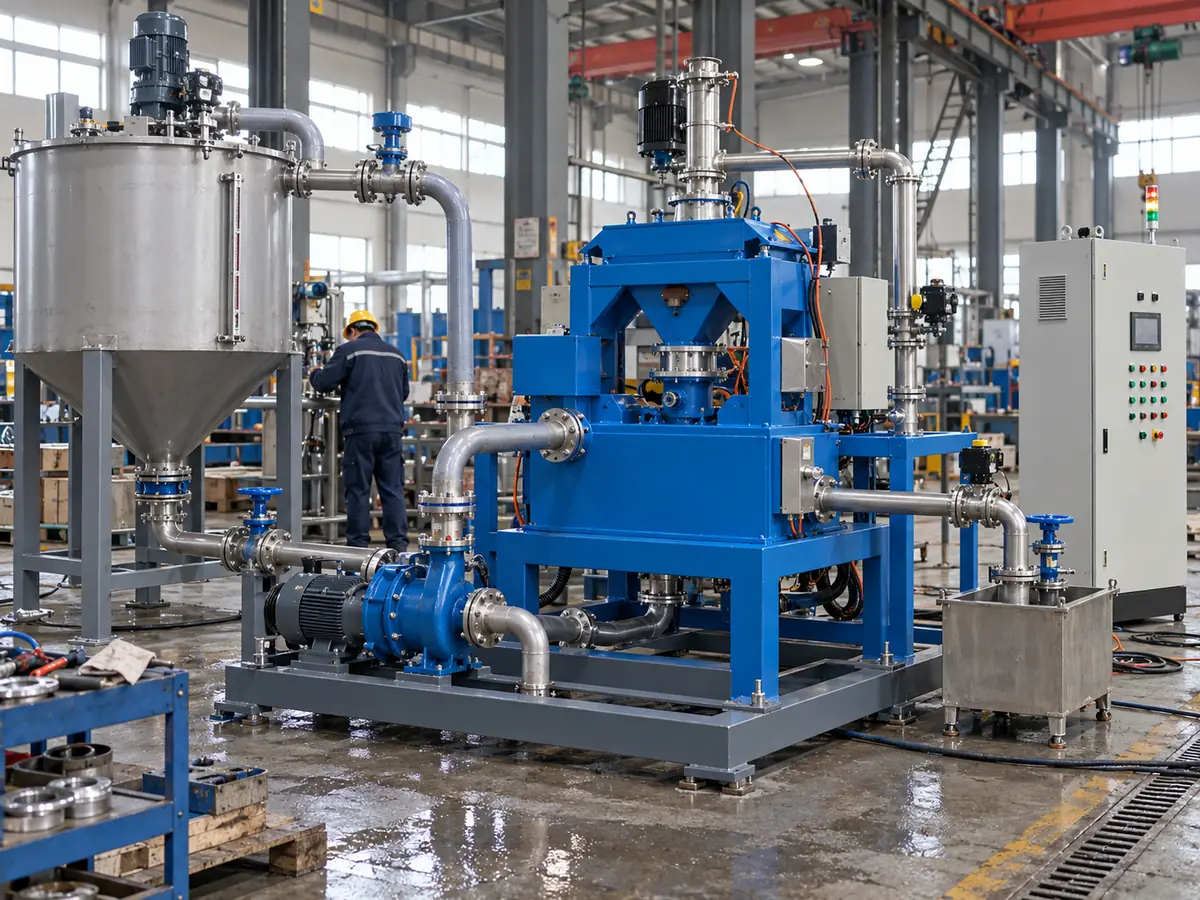
Keep feed solids and flow steady between the classifier and separator. Give the refined product, magnetic reject, and wash streams separate paths. If cleaning interrupts production, check that the feed tank has room for the incoming flow or that a second unit can carry it. If flushing or startup sends off-spec material to a rework tank, include that return stream in the production balance. See the Corvelan kaolin purification application for which sample and line details to prepare.
What Controls Capture in a Wet High-Gradient Separator?
Match the matrix and the flow to the particle you want to capture, then set the cycle to hold product quality until the next wash. Compare field readings on the same basis. Background field, field at a specified surface, and gradient in the working matrix answer different questions.
Match the matrix to the feed
A fine matrix can bring small particles close to strong gradients. It also has smaller passages that may load quickly when the feed carries coarse grit or flocs. When the same pump setting gives less flow through a loaded chamber, check feed oversize, dispersion, and the matrix condition. Where instrumented, compare differential pressure at the same flow. A kaolin study in Clay Minerals identified possible blockage of steel-wool pores by large particles in its tests. If degritting and dispersion are steady, compare a more open matrix against the original and measure both color and yield.
Set the flow and flush cycle
Higher feed velocity can give small particles less time to reach a capture surface. A thicker or poorly dispersed slurry can change how easily particles move and how quickly the matrix loads. An Indonesian Mining Journal kaolin trial varied slurry solids and flow to evaluate their effect on iron removal. Use your own trials to set those values. Take timed clean-product samples near the start and end of a cycle. If the end sample worsens while the feed stays steady, shorten the loading period or compare a different matrix at the same feed condition. Count wash time and water when evaluating the change.
How Do You Measure Iron Removal, Brightness, and Yield?
Measure the clean product and both feed and reject on the same dry basis, then judge the saleable clay against the buyer’s specification. Report iron assay, color result, and dry mass yield together. Dry mass yield is the share of dry feed that reports to the product. A mineral-specific kaolinite recovery would also require kaolinite grades in those streams.
Test the property your customer buys
For a paper-coating pigment, use the requested brightness method and a consistent size distribution or report changes in size cut alongside brightness. For a ceramic body, make test pieces with the agreed recipe, preparation, and firing schedule. Measure fired color or count specks according to the buyer’s method. Keep brightness and whiteness labeled as measured.
In a laboratory study of Kalabsha kaolin, the classifier overflow fed to a wet high-intensity separator assayed 0.62% Fe₂O₃. The nonmagnetic product assayed 0.55% Fe₂O₃ and carried 89.39% of that stage’s feed mass. Whiteness rose from 89.08 to 90.80 on the study’s reported scale. These figures describe the separation step on the classified feed. Table 4 also reports 64.42% overall mass yield for this route when classification is included. See Tables 4 and 5 of the Kalabsha study.
Calculate dry yield and iron removal
For an illustrative trial, 1,000 kg of dry feed assays 1.00% Fe₂O₃. It yields 900 kg of dry product at 0.60% Fe₂O₃ and 100 kg of dry reject. The feed contains 10.0 kg of Fe₂O₃ equivalent, and the product contains 5.4 kg. If these are the only two outlets and the balance closes, the reject accounts for 4.6 kg, or 46% of the feed’s Fe₂O₃ equivalent. Dry mass yield is 90%, and product Fe₂O₃ concentration is 40% lower than the feed. Test the reject to check the balance. If measured outputs fall short, trace wash solids, spills, or retained material before accepting the reported removal.
How Do You Run a Kaolin Separation Trial You Can Scale Up?
Use a bench trial to compare routes and a pilot run to show that quality, yield, and throughput hold together on real feed. Sample from the planned separator inlet. Include the routine material and any ore or moisture condition that could change the choice.
Build a fair bench comparison
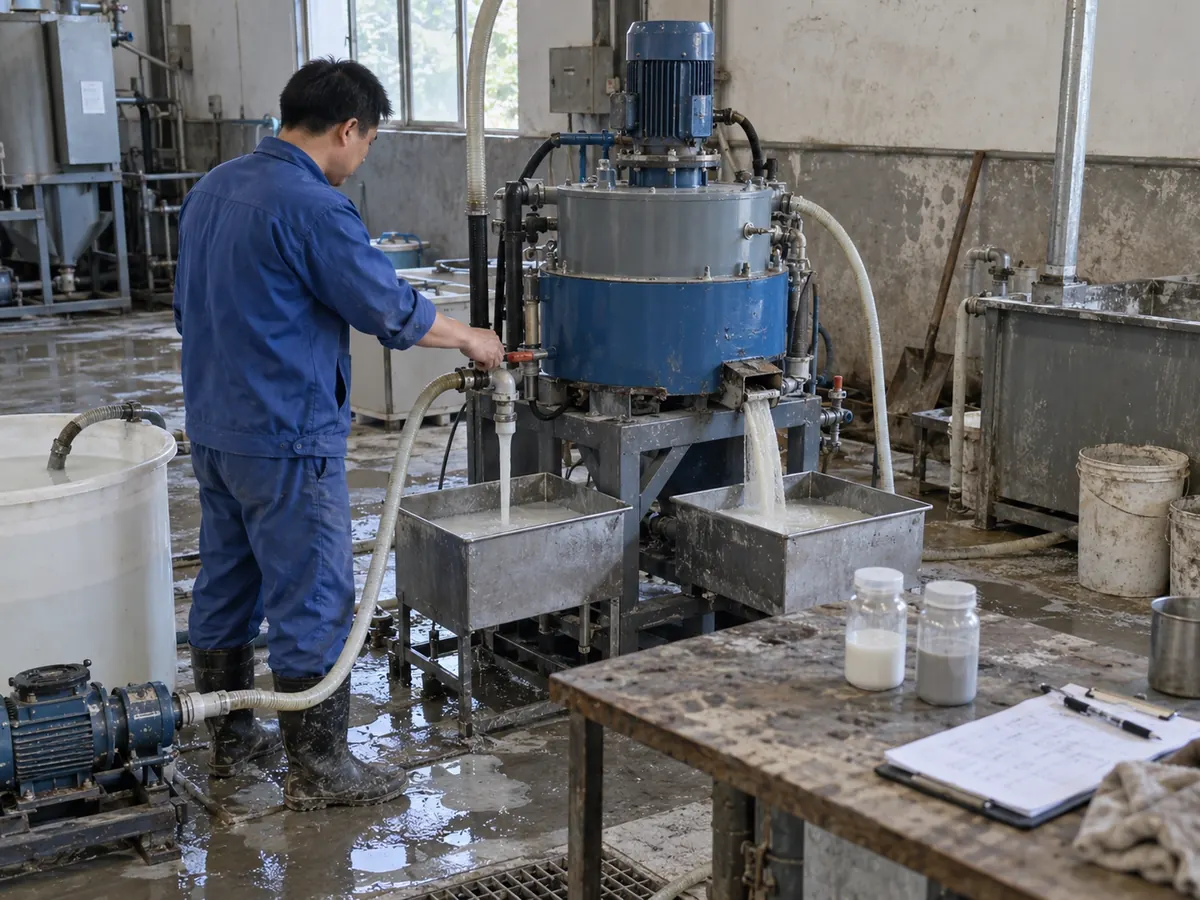
- Split and label representative feed. Record the source, preparation, particle-size distribution, dry moisture or slurry solids, and baseline product quality. Keep a retained reference sample.
- Run matched portions through the shortlisted routes. Within a route, vary one setting at a time where possible, such as flow with the same matrix and field. For a dry-versus-wet comparison, include the preparation and post-treatment each route needs.
- Save the feed, saleable stream, reject, and any wash solids or middlings separately. Record dry weights and assays. Select a trial condition that meets the output quality and retains enough clay to justify a pilot.
Prove the result in a pilot run
Specify the expected range of feed solids, particle size, and dry throughput. Run long enough to observe repeated load and wash cycles or steady continuous discharge under representative conditions. Capture start, stable, and late-cycle quality data and note the time spent flushing or reworking product. If the bench result passes but the pilot loses product during cleaning, review the rinse, reject circuit, and actual cycle time before increasing unit size or field.
Why Did Iron Removal or Brightness Get Worse?
Use the timing of the change to separate feed problems, matrix loading, and downstream contamination. Compare fresh feed, clean clay, and reject taken in the same run and account for the time it takes slurry to reach the sampling point.
Find the pattern inside a run
If the first product is clean and the last product carries more iron, look for a loaded matrix, reduced effective flow area, or a cycle that runs too long. If the next cycle begins off-spec, check the wash result and valve sequence for residual material carried back into product. If off-spec material follows a maintenance stop, verify feed routing and sample the first product separately. Before opening a chamber for service, follow the site’s energy isolation procedure, including electrical, pressure, and mechanical sources. See OSHA’s control of hazardous energy standard for U.S. servicing requirements.
Compare feed and product when the change starts
If both feed and product change together, check ore source, size cut, incoming solids, and dispersion. If Fe₂O₃ improves but color stalls, compare TiO₂, particle size, and the actual color test on both streams. For dark fired specks with acceptable chemistry, inspect for localized wear particles and compare fired pieces made from samples taken before and after downstream handling. Repeat the same sampling and test method after any correction so the results are comparable.
When Should You Add Flotation, Bleaching, or Another Step?
Choose the next step by identifying the impurity still in the clean clay and seeing how it responds. Pull a sample after the magnetic stage and compare the residual mineral or color problem with the original target.
Pick the next step from the residual impurity
If microscopy shows iron-bearing grains locked in larger particles, test a narrowly targeted change in liberation. Remeasure particle size because finer grinding can affect both the product grade and dewatering. If responsive mineral remains in the product after the first pass, compare a second pass and include cumulative clay loss. For residual iron-oxide staining, test bleaching on the magnetic product. Where poorly responsive titanium minerals remain, investigate flotation or another surface-based separation method suited to that mineral. UNIDO describes these as distinct tasks in its kaolin cleaning processes report sections.
When a higher-field test is worth running
Compare a higher-field or superconducting option when the residual impurity is demonstrably magnetic and a conventional test has plateaued after feed, flow, and matrix checks. Use matched splits and compare the extra saleable dry tons or product premium against added capital, power, and service. In the published superconducting kaolin tests, raising the tested field from 3.5 to 5.5 T produced no further iron removal on those samples. Measure the incremental benefit at your plant’s target throughput and recovery.
What Should a Kaolin Separator Quote and Acceptance Test Cover?
Ask each supplier to quote on the same feed range, net dry throughput, product limits, and trial procedure. Include the slurry or powder conditions and the plant interfaces so the quoted separator can run as proposed.
Size the machine on dry tons and slurry flow
Suppose the inlet is 20 m³/h of slurry at 1.15 metric tons/m³ and 20% solids by mass. Multiply slurry flow by slurry density and the solids mass fraction to get 20 × 1.15 × 0.20 = 4.6 dry metric tons per hour during feeding. If one unit feeds for 45 minutes and spends 15 minutes washing with zero feed, its average is 3.45 dry metric tons per elapsed hour, before any other downtime. If you need 4.6 dry tons per elapsed hour, ask the supplier to test a workable duty cycle or compare parallel units. A buffer can handle short interruptions, while the average capacity must cover the incoming load.
Write acceptance around the saleable product
Set out the feed source and allowable range, the sampling points and timing, the dry tons per elapsed hour, minimum product yield, and specific lab methods and limits. Ask for the unit and auxiliaries covered, including the feed system, required pumps or air, wash water and drain interfaces, controls, and clearance to service the matrix or belt. Compare ongoing cost per saleable dry ton using tested yield, wash or drying demand, and expected maintenance. Ask which parts wear and which spares are needed for the intended duty. Keep the pilot results with the quote so changes in mineralogy or feed rate trigger a clear retest discussion.
Next Step for Your Kaolin Sample
Choose a magnetic separator for kaolin by matching the test route to the actual feed and the finished-grade specification. Send the material source, moisture or slurry solids, particle size, dry throughput, and the Fe₂O₃, brightness, or fired-color target. If the separator already runs, add feed, product, and reject results and the time in the cycle when quality changes. Contact Corvelan about your kaolin separation duty to discuss candidate equipment and the conditions a material trial should cover.
Kaolin Magnetic Separation FAQ
Can a hand magnet tell me whether HGMS will work?
A hand magnet can confirm that an easily captured fraction is present. Keep the pickup and compare it with the dark grains or wear debris in the feed. If the hand magnet collects little, use a matrix trial to check for finer weakly magnetic particles.
Can I compare two 8,000-gauss quotes?
Compare the readings only after both suppliers state the measurement point and setup. Ask whether each figure is a background field or a reading at a named surface and distance. Then compare product quality and yield at the same dry throughput with the intended matrix or plate installed.
Does recycled process water change the test?
It can if its chemistry changes clay dispersion. Compare plant recycle water and trial water with the same solids and mixing procedure. Record settling or flocculation, then compare the magnetic product. Use representative recirculated water in the pilot if the difference affects performance.
Should I redry a wet sample before testing a dry separator?
Use a sample that represents the powder entering the proposed production feeder. If you dry a wet sample, match the intended plant drying and handling steps and verify moisture, size, and clumps before feeding it. Include a sample from the wetter end of normal production.
Can a second pass pay for itself?
It can when the added grade or price gain covers the lost clay and the added treatment cost. If the first pass yields 90% and the second yields 95% of its own feed, combined dry yield is 85.5%. Compare that final quantity and quality with the first-pass product before pricing the extra stage.
Why did a cleaner slurry still fire with dark specks?
A few coarse contaminants can make spots even when average iron content falls. Check samples and test tiles made before and after downstream transfer or mixing. Use the same firing schedule and compare speck count and appearance to locate where new material enters.
Can I blend different mine faces into one test sample?
Use a representative blend for routine production and separate samples for mine faces that can change the result. A good average can hide a face with more grit, different iron minerals, or a clay that takes more effort to disperse. Use the separate results to define the feed range for acceptance.
Can I send my slurry flow in gallons per minute?
Yes. Specify U.S. or Imperial gallons and include slurry density and percent solids by mass. With those three inputs, the supplier can convert to dry solids throughput. If flow varies, include the normal and peak values and the duration of the peak.
What should I check after replacing a pump or pipe?
Take paired samples on either side of the replacement once flow stabilizes. Check for new metallic fragments, compare the material of the repaired section with the suspected debris, and trace carryover through the next tank. Keep those samples separate from any dirty first flush.
What should I sample after a restart?
Sample the first product separately from the product after the line reaches steady conditions. If only the first fraction fails, review valve timing, flush completion, and material that settled during the stop. If both fractions fail, compare the inlet sample and operating settings with the last good run.