Find equipment by installation point and separation task.
All magnetic separators →Start with the material or production line you need to protect.
All applications →Compare technologies, check parameters and prepare your RFQ.
All guides →See the factory, quality checks and answers before you request a quotation.
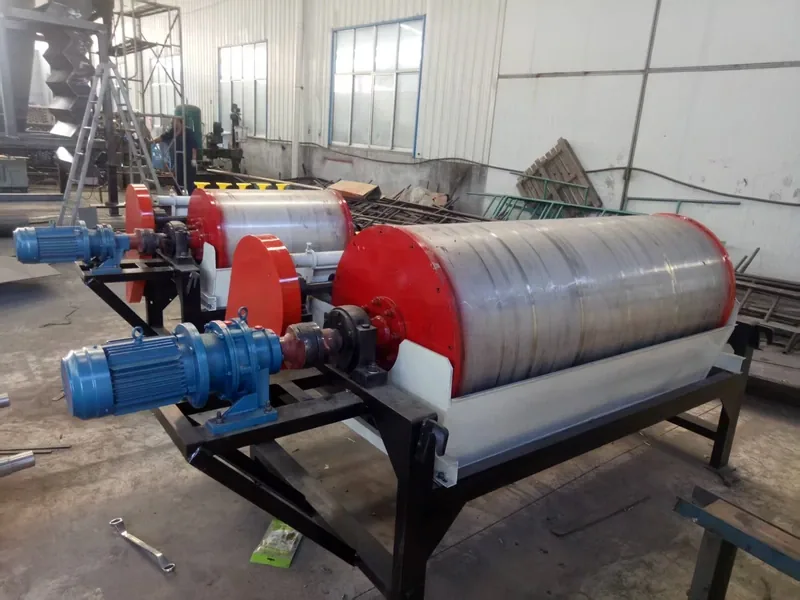
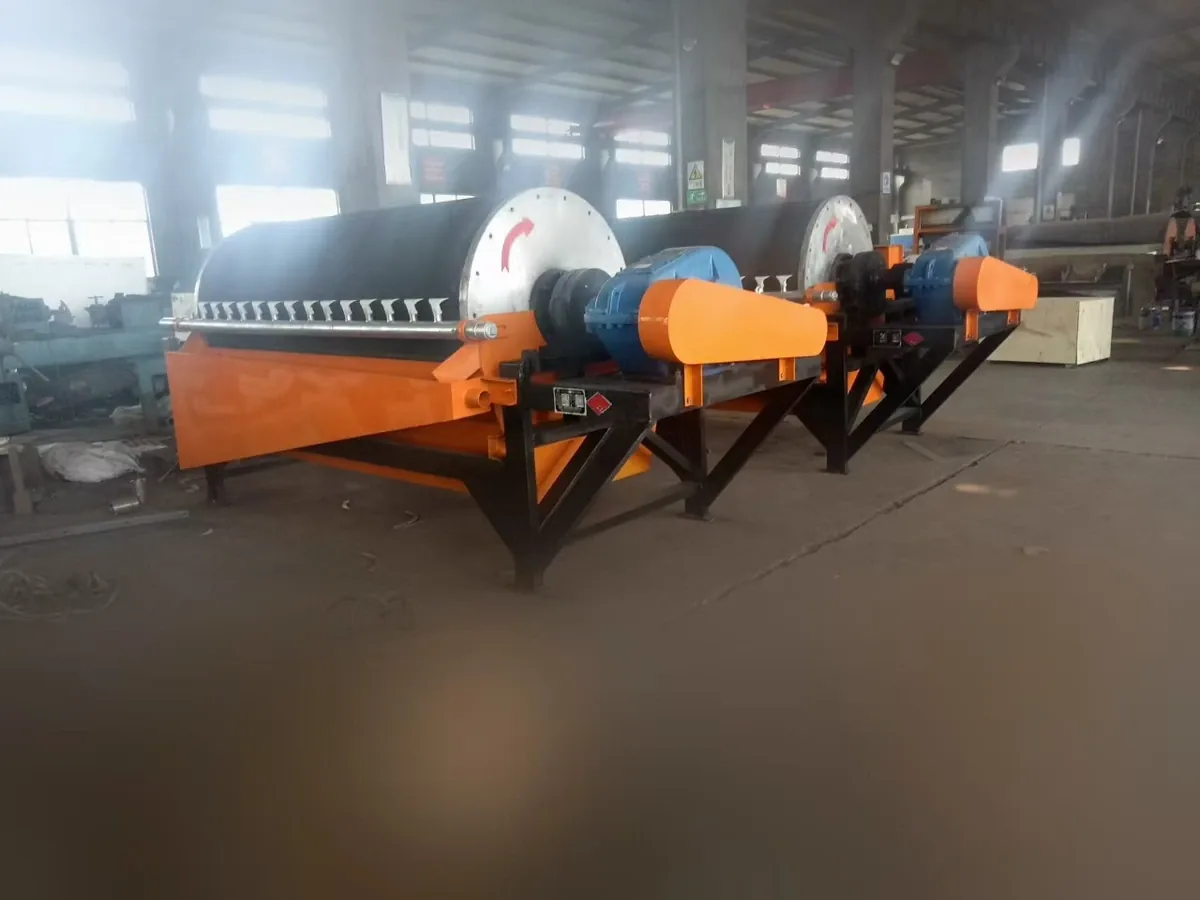
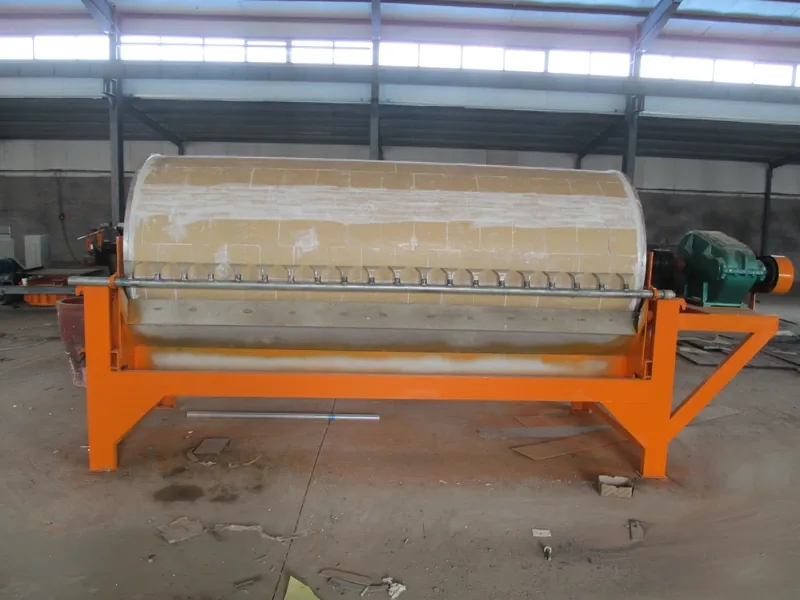
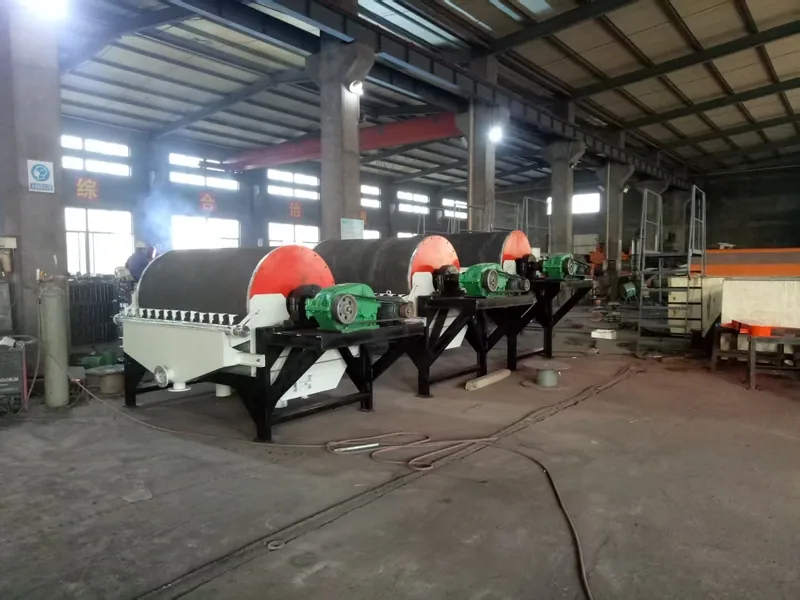
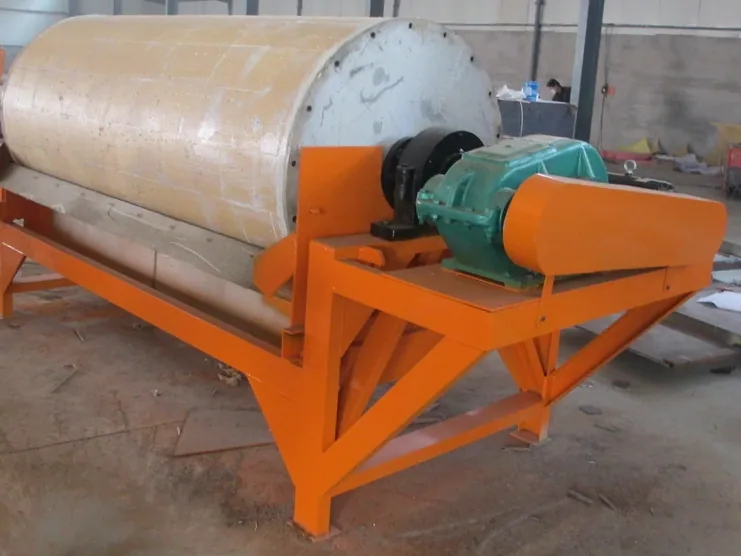
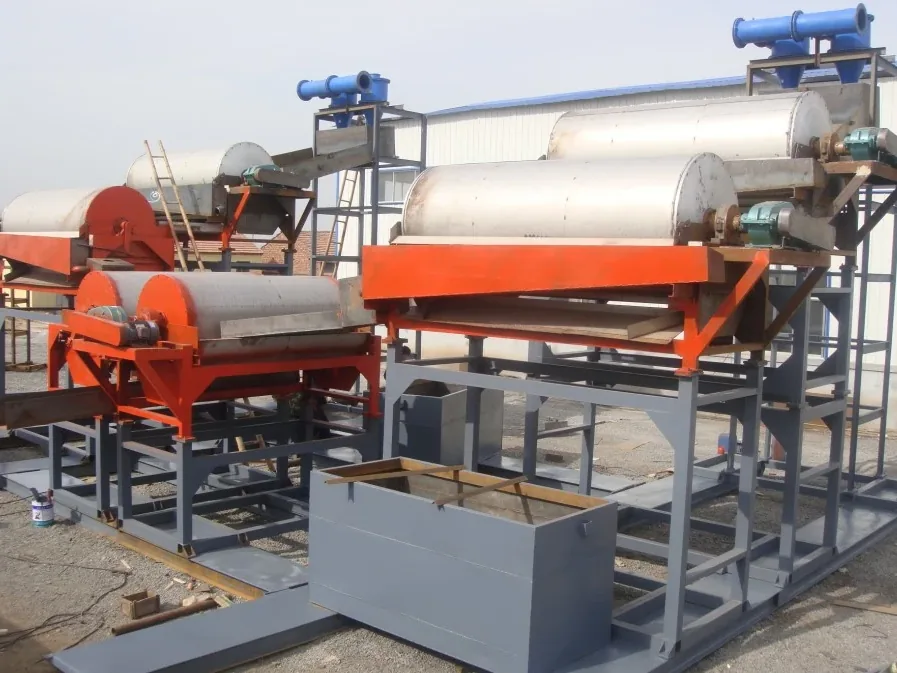
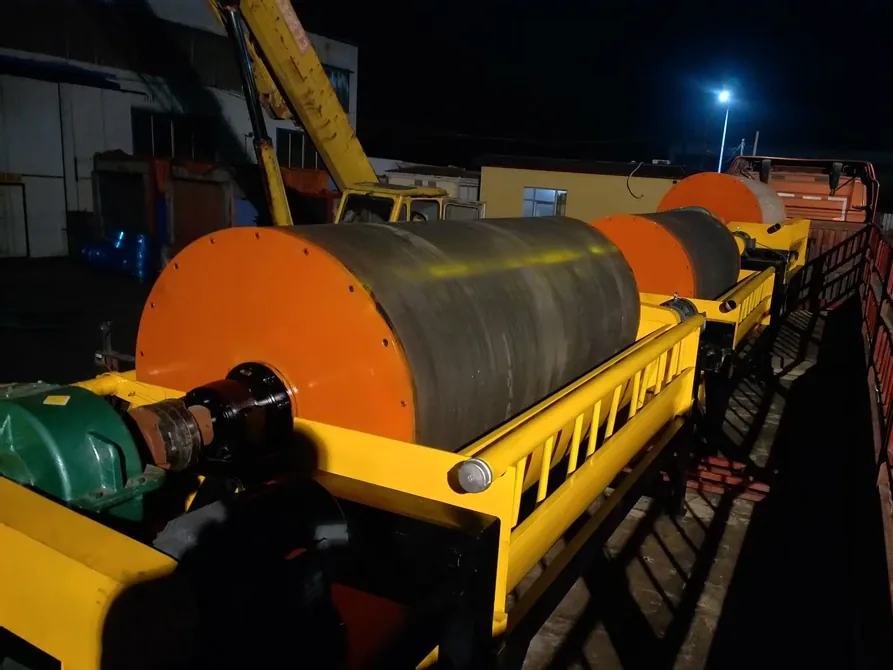
We build CTS(N.B.) wet drum magnetic separators to recover strongly magnetic material from slurry or pulp. To choose the right drum and tank, we look at particle size, slurry concentration, flow rate, magnetic loading and the result you need. We also check whether the magnetic mineral has been freed from the surrounding material. This is called liberation, and it has a major effect on recovery and the quality of the magnetic product, or concentrate.
Use a wet drum when the feed is slurry or pulp and the target responds strongly to a magnet. The drum separates the slurry continuously into magnetic and non-magnetic streams. If the feed is dry, the target is aluminum or copper, or the mineral is only weakly magnetic, choose another separator type.
Use it for magnetite-bearing slurry, strongly magnetic mineral recovery, wet cleaning or final recovery from tailings, and magnetite or ferrosilicon medium recovery.
Very fine particles or poorly liberated minerals need closer checking. We also need more information when slurry concentration changes a lot or the material is highly abrasive or corrosive. Heavy magnetic loading and very tight recovery or concentrate-grade targets also need closer checking.
Use another separator for dry bulk feed or for aluminum and copper. Weakly magnetic minerals may need a higher-intensity separator. A closed pressurized liquid line also needs another design if it cannot use an open wet-drum tank.
Start with what the separator needs to do, not the model code. We use that information to choose the tank flow, drum size, useful width and number of separation stages.

| Your process condition | Our starting choice | What we check next |
|---|---|---|
| Magnetite slurry after grinding | Wet drum concentration or recovery stage | How well the magnetite is freed from waste mineral, particle size, slurry concentration, magnetic loading and the concentrate or tailings result you need. |
| Coarser strongly magnetic feed or wet pre-separation | Flow setup for stable transport and clean magnetic discharge | Particle size, how well the mineral is liberated, slurry flow and how much magnetic material the drum must carry. |
| Fine liberated magnetic material where magnetic loss in the non-magnetic tailings matters | Flow setup that gives fine particles more time in the magnetic working area | Fine-particle response, slurry density, how slurry moves through the tank, magnetic loading and the allowed magnetic loss in tailings. |
| Cleaning stage where concentrate grade matters | Setup that limits non-magnetic material entering the concentrate | How well the mineral is liberated, feed dilution, rinse water, tank flow and the concentrate quality you need. |
| Dense-media magnetite or FeSi recovery | Wet drum for magnetite or FeSi medium recovery | Circulating-medium flow, solids concentration, contamination, allowed magnetic loss and whether a second stage is needed. |
| Tailings still contain recoverable magnetics | Add or resize a final recovery stage instead of relying on one higher field number | Tailings test results, liberation, magnetic response, current loading and the space available for another separator. |
| Weakly magnetic hematite, manganese mineral or similar target | Use a higher-intensity wet magnetic separator | Test magnetic response, particle size and mineral type, then match the equipment to the recovery and grade you need. |
| Dry ore or dry bulk material | Use a dry magnetic separator | Feed depth, particle size, working distance, dry-flow behavior and discharge arrangement. |
We choose the separator around the material and the result you need. Magnetite and ferrosilicon are common strongly magnetic targets, but the mineral name alone is not enough. We also check particle size, slurry concentration, flow rate and whether the magnetic mineral is free from the surrounding waste material. That last condition is called liberation.
| Tell us | Why it matters | What this changes |
|---|---|---|
| Feed material and mineral type | Different minerals respond differently to a magnet and can have very different wear or corrosion conditions. | Separator type, magnetic system and wear protection. |
| Target magnetic fraction | A strongly magnetic target and a weakly magnetic target do not need the same magnetic intensity. | Wet drum or a higher-intensity wet magnetic separator. |
| Particle size and liberation | If waste mineral is still locked to the magnetic mineral, the separator may recover both and lower concentrate grade. | Tank flow, grinding or classification needs, and how we test the separator. |
| Slurry flow and solids concentration | These tell us how much liquid and solid material must pass through the tank. | Useful drum width, tank size and whether one or more separators are needed. |
| Main separation goal | Maximum recovery, cleaner concentrate, low magnetic loss and impurity removal are different jobs. | First recovery stage (rougher), concentrate-cleaning stage (cleaner), final recovery stage (scavenger), or magnetic-medium recovery. |
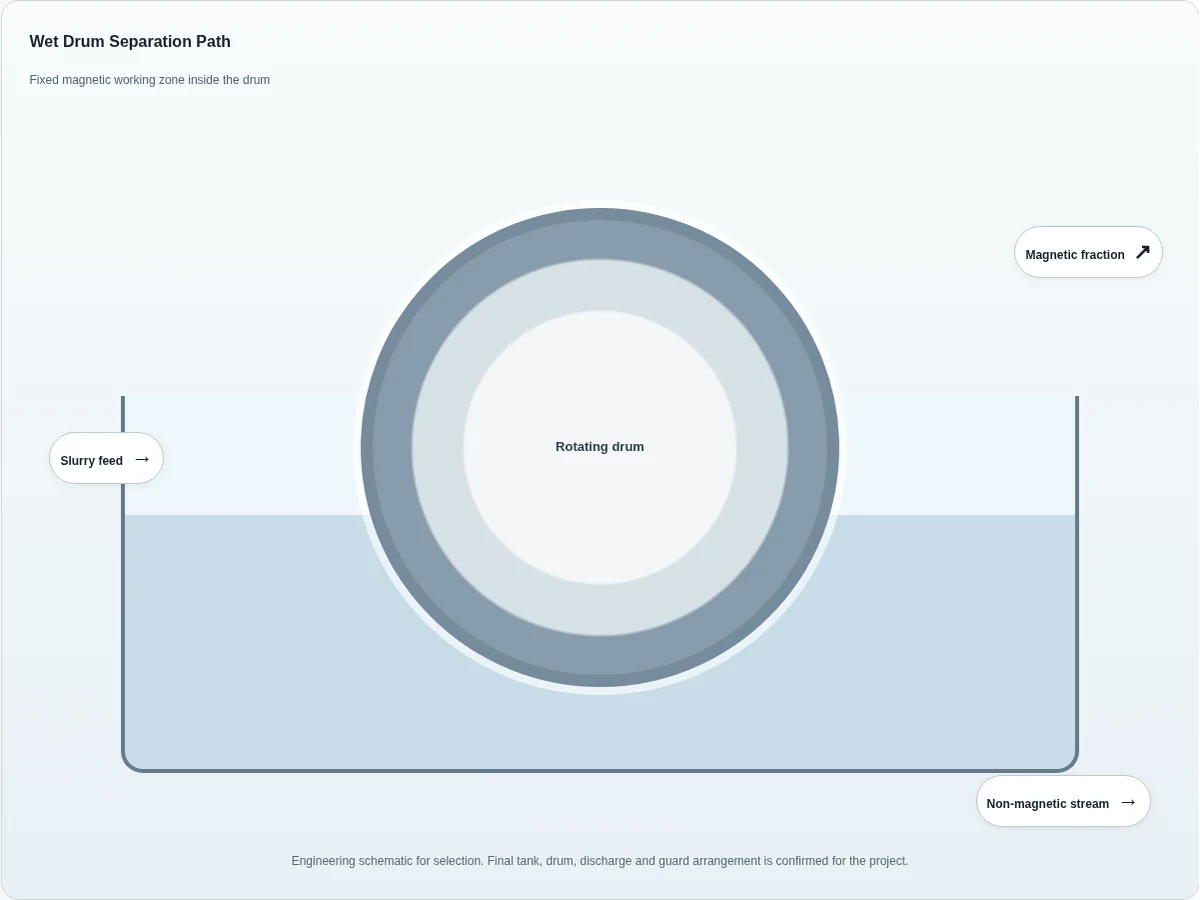
Slurry passes through a tank beside a rotating drum that contains a stationary magnetic system. Magnetic particles are attracted to the drum shell and carried away from the main slurry flow. After they leave the active magnetic zone, they release into the magnetic-product discharge. Less-magnetic material follows the slurry flow to the non-magnetic discharge.
We spread feed across the useful drum width so one side of the separator is not overloaded while the other side is underused.
Capture depends first on how strongly the particle responds to a magnet and whether it is liberated. Distance from the magnetic system also matters. Water and slurry flow can pull particles away from the drum.
The rotating shell carries captured material toward the magnetic discharge. Drum speed and magnetic loading control how the layer forms and moves.
Tank geometry, water level, discharge lips and any rinse water must prevent concentrate and tailings from mixing again.
Do not choose a wet drum by copying a CTS, CTN or CTB model code from another catalogue. Suppliers do not always use these letters in the same way. We first choose how the slurry should move through the tank. The quotation and drawing then show the exact Corvelan model, tank direction and geometry for your machine.

This is a practical starting setup for wet pre-separation or coarser magnetic feed when the particles are well liberated and the main goal is reliable recovery.
We give fine particles more time in the magnetic working area. This time is called residence time. We also pay close attention to slurry flow and magnetic loading.
We use this kind of flow when fine magnetic material is well liberated and concentrate quality matters as much as recovery.
We check the basics first. The target must respond strongly enough to a magnet, and it must be separated from the surrounding waste mineral. This is liberation. Next, we check how much slurry and magnetic material enter the drum and how the slurry moves through the tank. Only then do we fine-tune drum speed and magnetic settings.
If the target is only weakly magnetic, a larger drum will not make the wrong separator type work. The first step is to choose equipment with the right magnetic intensity.
If waste mineral is still locked to the magnetite, the separator may recover both. This unwanted material is often called gangue. If liberation is poor, stronger magnetics cannot replace grinding or classification.
We need slurry flow and the amount of solids in that slurry. This solids loading tells us much more than drum diameter alone.
A heavy magnetic fraction can overload the working zone and increase loss even when the magnetic field is strong enough.
If one side receives much more slurry than the other, part of the useful drum width is wasted and separation becomes uneven.
Water level, flow direction, feed speed and discharge shape control how particles pass the magnetic zone. Engineers often call this tank hydraulics.
Speed changes how long particles stay in the magnetic working area, how the magnetic layer moves and how captured material leaves the drum.
A first recovery stage (rougher), concentrate-cleaning stage (cleaner), final recovery stage (scavenger) and magnetic-medium recovery stage do not have the same job.
Use the symptom to decide what to check. Do not jump straight to a higher magnetic field.
| What you see | Check first | What we change |
|---|---|---|
| Magnetic loss in tailings is too high | Check for feed surges, high slurry concentration, heavy magnetic loading, uneven feed, poor liberation, poor tank flow and unsuitable drum speed. | Stabilize the feed, reduce overload, change the tank flow, use more drum width or add a final recovery stage. We only increase magnetic capability when the material response shows that it is actually needed. |
| Recovery is high but concentrate grade is low | Check whether waste mineral is still locked to the magnetite. Also check whether slurry flow is carrying non-magnetic particles into the concentrate. This second problem is called hydraulic entrainment. | If liberation is poor, improve grinding or classification. If liberation is good, adjust slurry concentration, tank flow, rinse water or add a cleaner stage. |
| Recovery drops when throughput rises | Check solids loading, slurry flow, magnetic loading, useful drum width and whether feed is spread evenly. | Give the material more drum area to separate. This may mean a wider drum, a longer working section, another separator in parallel or another separation stage. |
| Results change with slurry density | Check feed-density swings, tank level, slurry thickness and the amount of water coming from upstream. | Stabilize slurry density and flow first. Then set the drum and tank for that normal operating range. |
| Magnetite or FeSi medium loss is high | Check medium loading, contamination, slurry density and how much magnetic material leaves with the non-magnetic discharge. | Adjust the medium-recovery setup. Add a second recovery stage when one stage cannot keep magnetic loss inside the required limit. |
| Concentrate and tailings mix again at discharge | Check the discharge lip, product trough (launder), tank level, flow speed and whether product is backing up. | Change the discharge shape, level control or trough position before changing the magnetic system. |
If you are seeing high tailings loss, low concentrate grade or unstable results, send us the feed material, slurry concentration, normal and peak flow, and the result you need. We can use that information to narrow down the wet drum setup before quotation.
The examples below show how we diagnose common wet-drum problems. They are selection examples, not customer test results. The purpose is to show what we check first and what we change when the cause is clear.
What this usually tells us: the separator is becoming overloaded before the magnetic system becomes the main limit.
Check first: solids throughput, slurry flow, magnetic loading, useful drum width and feed distribution.
What we change first: give the material more separation area. This can mean more useful drum width, another separator in parallel or another recovery stage.
What confirms the cause: recovery stays stable at lower loading but falls as loading rises, while slurry and feed quality remain otherwise similar.
What this usually tells us: stronger magnetic attraction is not automatically the answer. Waste mineral may still be locked to the magnetite, or slurry may be carrying non-magnetic particles into the concentrate.
Check first: liberation, grinding size, classification and hydraulic entrainment.
What we change first: improve grinding/classification when liberation is poor. If liberation is already good, adjust slurry concentration, tank flow, rinse water or add a cleaner stage.
What confirms the cause: mineral or sample checks show locked particles, or concentrate quality changes strongly with dilution and tank-flow conditions.
What this usually tells us: one correctly loaded recovery stage may not be enough for the allowed medium loss.
Check first: circulating-medium flow, solids concentration, contamination, magnetic loading and magnetic material in the non-magnetic discharge.
What we change first: optimize the first recovery stage. If the stage is stable but medium loss is still too high, add a second recovery stage instead of treating Gauss as the only answer.
What confirms the cause: the first stage is operating inside its normal loading range but the measured medium loss still remains above the agreed target.
What this usually tells us: unstable feed is changing the separation conditions faster than the wet drum can be optimized.
Check first: slurry density, water balance, flow rate, tank level and upstream surges.
What we change first: stabilize the feed before resizing the magnetic separator. A buffer tank, density control or steadier water balance may solve the problem upstream.
What confirms the cause: recovery or concentrate quality becomes stable again when slurry density and flow are held inside a narrow operating range.

We do not use one fixed drum diameter, motor power, speed, field value or throughput for every CTS(N.B.) separator. We choose those values from your operating conditions and show the selected values in the quotation, drawing or machine specification.
| Machine item | How we choose it |
|---|---|
| Drum diameter | We choose the diameter from magnetic loading, tank design, how long particles need to stay in the working area and the space available. |
| Drum length / useful width | We use slurry flow, solids throughput, magnetic loading and the width needed to spread feed evenly. |
| Tank-flow arrangement | We choose the tank flow from particle size, liberation, slurry movement and whether recovery or concentrate quality matters more. |
| Magnetic system (magnetic circuit) | We choose the magnetic system from how strongly the target responds to a magnet and where the magnetic force is needed inside the drum. |
| Drum speed | We set the speed from how long particles need to stay in the magnetic working area, how the magnetic layer moves and how material leaves the drum. |
| Feed box / distribution | We size and shape the feed box so slurry spreads across the useful drum width without overloading one side. |
| Tank material / wear protection | We choose materials from abrasion, slurry chemistry, temperature and how often wear parts need service. |
| Concentrate discharge | We match the discharge to magnetic loading, product flow and the equipment receiving the concentrate. |
| Tailings discharge | We set the outlet from tank level, slurry flow and the downstream connection. |
| Rinse / spray water | We add rinse or spray water when it helps release magnetic product or improves cleaning. |
| Drive and motor | We choose the drive from drum size, operating load, speed range and your site power supply. |
| Controls and interlocks | We match the controls to standalone operation or your plant control system. Interlocks can start or stop connected equipment in the required sequence. |
| Guarding and access | We allow for rotating parts, strong magnetic zones, maintenance space and your site safety rules. |
| Overall dimensions / connections | We set the final dimensions from the tank, supports, feed and discharge heights, drive side and service clearance. |

| Feed / target | Use this separator | Why |
|---|---|---|
| Wet slurry + strongly magnetic mineral | Wet drum magnetic separator | Continuous magnetic recovery in a slurry tank. |
| Dry strongly magnetic ore or dry bulk material | Dry drum magnetic separator | No wet tank is needed; dry feed behavior and working distance control the design. |
| Fine weakly magnetic mineral | Higher-intensity wet magnetic separator | The target may need a stronger and more concentrated magnetic force than a standard wet drum used for strongly magnetic material. |
| Tramp iron above a conveyor | Suspended / overband magnet | The separation point is above a moving dry burden, not inside slurry. |
| Ferrous recovery at conveyor discharge | Magnetic head pulley | The magnetic element becomes the conveyor head pulley. |
| Aluminum, copper or other non-ferrous metal | Eddy-current or another non-ferrous separation method | A wet magnetic drum does not separate non-ferrous metal in the same way. |
A wet drum works inside the connected tanks, pipes, pumps and equipment that move slurry through the process. This is the slurry circuit. We therefore plan the feed box, tank level, concentrate and tailings troughs, drive side, support points and service space together. The separator cannot fix an unstable upstream feed.

Plan maintenance access before the machine is installed. Wet-drum service combines rotating equipment, strong magnetic fields, slurry and electrical/mechanical drive components.
Inspect the drum surface, bearings, drive parts, fasteners, tank wear areas, feed/discharge buildup and any rinse or flushing points included in the machine.
Keep loose ferrous tools and magnet-sensitive devices away from strong magnetic zones. Site procedures must also account for implanted medical devices where applicable.
Tell us before quotation if your site needs a specific IP rating, CE-related documentation, hazardous-area equipment, special corrosion protection or another electrical or safety feature. We include the items agreed in the order specification.
If you need us to meet a specific recovery, concentrate grade, magnetic-medium loss or impurity-removal result, we first agree on how that result will be tested. Machine checks, magnetic readings and real separation tests measure different things.
Use this when you mainly need to check the machine itself. We can check dimensions, rotation direction, connections and a magnetic reading at an agreed position using an agreed instrument and test condition.
Use this when separation performance matters. We test representative feed and record particle size, slurry concentration, flow rate, drum setting and tank level. We then sample the feed, magnetic product and tailings to calculate recovery and concentrate grade.
Use this for magnetite or FeSi medium recovery. We record circulating-medium flow, slurry density, magnetic loading and how much magnetic medium leaves with the non-magnetic discharge. The result is medium loss or recovery, not a surface Gauss reading.
A useful test report must show both the material and the machine conditions. A recovery number without the feed condition, slurry concentration and machine settings cannot be compared fairly with another result.
| Record | Why it matters |
|---|---|
| Feed sample | Shows the material entering the test. |
| Particle-size distribution | Shows whether coarse or fine particles are changing recovery. |
| Slurry concentration / density | Shows the hydraulic and solids loading during the test. |
| Feed assay or magnetic content | Provides the starting point for recovery and product-quality calculations. |
| Magnetic product sample | Used to check concentrate quality. |
| Tailings sample | Used to check magnetic loss and recovery. |
| Record | Why it matters |
|---|---|
| Wet drum model / drum size | Identifies the machine used for the result. |
| Tank-flow setup | Shows how slurry moved through the separator. |
| Drum speed | Changes particle contact time and magnetic-product transport. |
| Slurry flow / solids throughput | Shows the actual load on the machine. |
| Magnetic measurement condition | Allows a field reading to be compared at the same point and gap. |
| Sampling method | Shows how feed, concentrate and tailings samples were taken. |
A Gauss value is useful only when the measurement position and test condition are known. We do not treat an isolated field number as proof of recovery or concentrate grade.
Record whether the probe is on the drum surface or at a defined air gap. Also record where the point sits relative to the magnetic pole or working zone.
Record the meter used and whether the drum is stopped or operating. Use the same method when comparing readings.
Use the magnetic reading to describe the magnetic system. Use material samples and operating data to prove recovery, grade or medium loss.
Before production, we put the agreed machine details into the quotation and drawing. Your team can then see the drum size, tank arrangement, connections, drive, utilities and any agreed test details before the machine is built.
Selected wet-drum configuration, tank-flow arrangement, drum dimensions and main process direction.
Feed connection, magnetic and non-magnetic discharge, support points, heights and the service space needed around the machine.
Drive arrangement, motor and controls, water connections when used, and connections to your plant.
The mechanical, magnetic or separation test method when a specific test is included in the order.
Before production, the selected machine should be tied to clear technical information. The exact documents depend on the order, but the following items are the ones that most directly affect installation, checking and handover.
Selected drum size, tank arrangement, drive, motor, speed range and other agreed machine data.
Overall size, feed and discharge positions, support points, drive side and service clearance.
The dimensions, running checks, magnetic measurement or other checks that are included before shipment.
When recovery or concentrate quality is part of the order, the feed condition, sampling method and pass/fail result should be agreed before testing.
Before shipment, we can check the items agreed in your order. Machine checks and separation-performance tests are kept separate because they prove different things.

Recovery, concentrate cleaning, final recovery from tailings and magnetic-medium recovery are different jobs, so we do not give them the same machine setup.
We use slurry flow, solids concentration and magnetic loading together instead of treating tonnes per hour as enough information by itself.
A field reading describes one part of the magnetic system. Recovery and concentrate grade still depend on the real material and operating conditions.
If a performance result matters, we agree on the feed conditions, machine settings, sampling and calculation method before we use the result to decide whether the test has passed.
A wet drum magnetic separator continuously separates a strongly magnetic fraction from slurry or pulp. A rotating drum carries captured magnetics to a separate discharge while the less-responsive fraction follows the tank flow.
Do not choose a wet drum from the CTS, CTN or CTB letters alone. Different suppliers may use these model letters differently. We first choose how the slurry should move through the tank, then state the exact Corvelan model and tank arrangement on the quotation and drawing.
Start with particle size, slurry concentration, magnetic loading and the result you need. We also check whether the magnetic mineral is fully liberated. A coarse recovery stage and a fine cleaning stage usually need different slurry-flow conditions.
Yes, when the magnetite is sufficiently liberated and the feed is slurry. We still check particle size, slurry concentration, magnetic loading and whether you need maximum recovery, cleaner concentrate or lower magnetic loss in tailings.
Yes. Wet drums are commonly used to recover strongly magnetic magnetite or ferrosilicon medium. We size the separator from circulating-medium flow, solids concentration, contamination and how much magnetic medium is allowed to leave with the non-magnetic discharge.
First check overload, changing slurry density, uneven feed and poor liberation. Also check how slurry is moving through the tank and the drum speed. If those conditions are correct but the separator is still overloaded, use more drum area or add another final recovery stage.
First check whether waste mineral is still locked to the magnetite or whether slurry flow is carrying non-magnetic particles into the concentrate. If liberation is poor, improve grinding or classification. If liberation is already good, adjust slurry concentration, tank flow, rinse water or the cleaning stage before increasing magnetic intensity.
No. Gauss is a magnetic-field reading at a defined point. Recovery also depends on how strongly the material responds to a magnet and how well it is liberated. Slurry concentration, magnetic loading, tank flow, drum speed and discharge conditions also matter.
Capacity depends on slurry flow, solids throughput, solids concentration, particle size, magnetic loading, useful drum width, how slurry moves through the tank and the result you need. Drum diameter alone does not guarantee capacity.
Use one stage when it can meet the recovery and product quality you need at the real operating load. Add a cleaner stage when concentrate quality is too low. Add a final recovery stage when too much magnetic material remains in the tailings. For medium recovery, add a second stage when one stage cannot keep medium loss low enough.
Yes when the available footprint, feed elevation, discharge routes, support points, tank level, drive side and maintenance access allow the selected configuration. Send a line drawing or dimensions so we can place the interfaces correctly.
Price changes with drum size, useful width, tank design, magnetic system, drive, wear protection, controls, connections and the number of separation stages. Send the material, target, normal and peak throughput, and where the separator will work in your process so we can size the machine before quotation.
Start with four items: material, target magnetic fraction, normal and peak throughput, and where the separator will work in your process. If available, also send particle-size distribution, slurry concentration or density, required recovery or concentrate grade, slurry chemistry or temperature, and a line drawing.
It should show the feed material, particle size, slurry concentration, feed condition, wet drum setup, drum speed, flow or solids throughput, sampling method, magnetic product, tailings and the result being calculated. A recovery or grade number without the operating conditions is not enough for a fair comparison.
State the measurement point, the distance or air gap from the drum, the instrument used and whether the drum is stopped or operating. Use the same method when comparing two readings. A Gauss reading describes the magnetic field at that condition; it does not by itself prove recovery or concentrate grade.

Ore/mineral or process medium, and whether the feed is slurry, pulp or dilute medium.
The magnetic mineral, magnetite/FeSi medium or magnetic contamination to recover or remove.
Normal and peak solids throughput, or normal and peak slurry flow, plus solids concentration when available.
Tell us whether it is the first recovery stage (rougher), a concentrate-cleaning stage (cleaner), a final recovery stage (scavenger), or a magnetic-medium recovery stage. Also send the nearby equipment and space available.
Material, target magnetic fraction, normal and peak throughput, and where the separator will work in your process.
We check whether a wet drum fits the material. If not, we tell you whether a dry separator or a higher-intensity wet separator makes more sense.
We choose the tank flow, drum size, useful width, drive, connections, wear protection and any agreed test method from the data you send.
You receive the selected machine setup and the operating information we used to size it.
Send us your material, magnetic target, normal and peak throughput, and where the separator will work in your process. We will use these four items to choose the right wet drum setup and tell you what else we need to complete the quotation.