Quick Summary
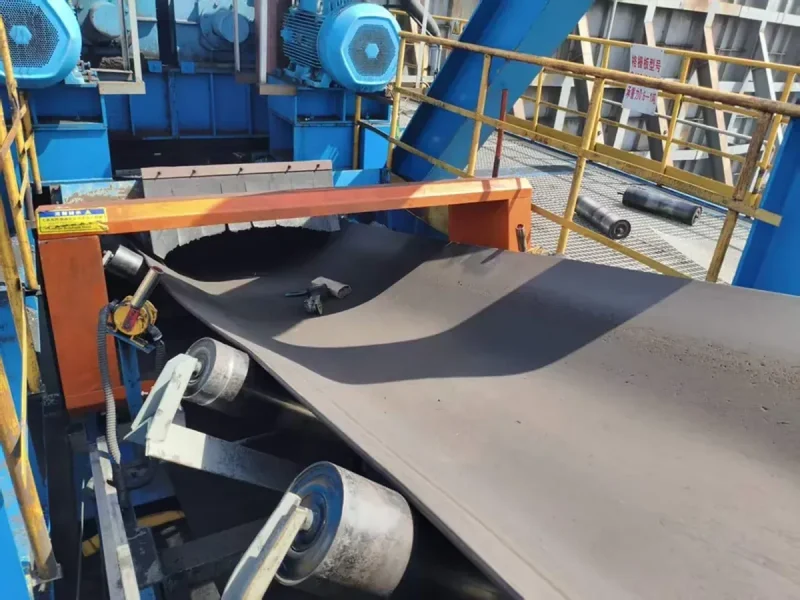
Tramp iron removal protects equipment or cleans a material stream by taking out unwanted iron and steel. Mineral recovery collects a valuable mineral into a useful product. The difference changes which stream you keep, how the separator handles the feed, and how you judge the result.
For tramp iron removal vs mineral recovery, start with the separation goal, then match the equipment to the feed:
- Protect an existing conveyor line from steel pieces: start with a suspended or overband magnet where it can reach the deepest target and discharge it safely.
- Separate a magnetic fraction from controlled dry material: consider a dry drum, with the feed and product splitter set for the required result.
- Recover strongly magnetic material from slurry: consider a wet drum, sized for both slurry flow and magnetic material loading.
Neither “iron removal” nor “mineral recovery” tells you the required magnetic strength on its own. Magnetite, weakly magnetic iron minerals, and a steel bolt are different targets. First identify what must leave the feed—and where it should go.
On This Page
What Changes When the Magnetic Fraction Is Waste or Product?
The magnetic fraction can be unwanted contamination, a valuable concentrate, or an impurity removed from a valuable non-magnetic product. Decide which of these jobs you need before choosing a separator.
| Separation goal | What enters the magnetic discharge? | What counts as a good result? |
|---|---|---|
| Tramp iron removal | Foreign bolts, wire, wear fragments, or other magnetically responsive steel | The specified harmful pieces are removed at the required feed rate, with reliable discharge and little good material carried away. |
| Mineral recovery | A valuable magnetic mineral, such as magnetite | Valuable material reports to the concentrate while grade and throughput meet the process target. |
| Mineral purification | Magnetic impurities removed from a valuable non-magnetic mineral | The clean product meets its impurity limit without excessive loss to the magnetic reject. |
Tramp iron is foreign material introduced into the process. It can come from mining tools, handling equipment, or wear. An iron-bearing mineral that naturally forms part of the ore is a different target, even when both respond to a magnet.
This distinction matters when reading an assay. A total iron result includes iron in the mineral structure as well as any metallic iron present. It does not tell you how many bolts are in the feed, or how much of the iron occurs as recoverable magnetite. Use mineral identification when the mineral form changes the equipment choice.
A magnetic drum can serve more than one goal. The Eriez SB-345 technical brochure describes both tramp removal and concentration duties, with different magnetic circuits for different applications. Sharing a machine category does not make two configurations interchangeable. A drum selected to discard occasional steel needs a fresh process review before it becomes a mineral recovery stage.
How Should You Measure Success for Each Separation Goal?
Use a capture test for the specified tramp pieces, a product-quality test for purification, and a mass balance for mineral recovery. A percentage is useful only when its numerator, denominator, and test conditions are clear.
For tramp iron, test the pieces that can damage your equipment
Define the target by material, size, shape, and position in the burden—the layer of material on the conveyor. A long wire, a heavy bolt, and a small wear fragment can present different capture problems. Include the deepest practical target position and the normal and peak belt conditions in the agreed test.
Record capture by target class rather than combining all pieces into one impressive average. Also record where the captured metal goes and whether it brings useful material with it. A successful lift is incomplete if the cleaning belt drops the metal back onto the main conveyor.
Use a planned, guarded test with the plant team and a way to account for every test piece. Do not hand-place metal into running equipment. Stop and isolate the line before setup or manual collection. Permanent magnets remain active after the drive is isolated.
For a purification job, take representative feed, clean-product, and reject samples. Measure the remaining impurity and the mass of saleable material lost. A lower impurity concentration alone does not show how much good product was sacrificed.
For mineral recovery, calculate grade, recovery and mass yield
Grade tells you how rich the concentrate is; recovery tells you how much of the feed’s valuable component reached it. Mass yield tells you how much total feed became concentrate. Keep all three in the test report.
Use dry masses from the same batch or matched flow rates from the same stable operating period. Let F be feed dry mass, C concentrate dry mass, f feed grade, and c concentrate grade. Both grades must measure the same component on the same basis.
- Mass yield (%) = 100 × C ÷ F
- Component recovery (%) = 100 × (C × c) ÷ (F × f)
- Component lost outside the concentrate = (F × f) − (C × c)
Enter grades as fractions for component mass: 20% becomes 0.20. The same recovery formula also works with both grades entered as percentages because their common factor cancels.
Consider a 1,000 kg dry sample containing 20% of the target mineral. It contains 200 kg of that mineral. Suppose a trial produces 250 kg of concentrate at 72% target-mineral grade:
- Target mineral in concentrate: 250 × 0.72 = 180 kg.
- Target-mineral recovery: 180 ÷ 200 × 100 = 90%.
- Concentrate mass yield: 250 ÷ 1,000 × 100 = 25%.
- Target mineral outside the concentrate: 200 − 180 = 20 kg.
Now suppose another setting produces 300 kg of concentrate at 60% grade. It still recovers 180 kg of target mineral, so recovery stays at 90%. The extra 50 kg is non-target material. If this example requires at least 70% grade, the first setting meets that requirement; the second does not.
This is why “more magnetic product” can be the wrong purchasing target. Choose the setting that delivers the required grade, component recovery, and throughput together.
Weigh and analyze the tailings as well. For a closed two-product test, feed dry mass should reconcile with concentrate plus tailings, and the measured component should reconcile in the same way. The Orica Flotation Guidebook, hosted by AusIMM, explains recovery from product dry weights and assays in Section 10.2. The mass-accounting principle applies here: account for the same component in every stream.
If the assays measure Fe, the result is Fe recovery. To report magnetite recovery, use a method that identifies and quantifies magnetite. Total Fe recovery is not automatically magnetite recovery when other iron-bearing materials are present.
Which Separator Fits the Feed and the Separation Goal?
Start with an overband for accessible conveyor tramp iron, a dry drum for controlled dry separation, and a wet drum for strongly magnetic material in slurry. Then choose the magnetic system, working area, feed arrangement, and discharge layout for the actual target.
When should you start with an overband magnet?
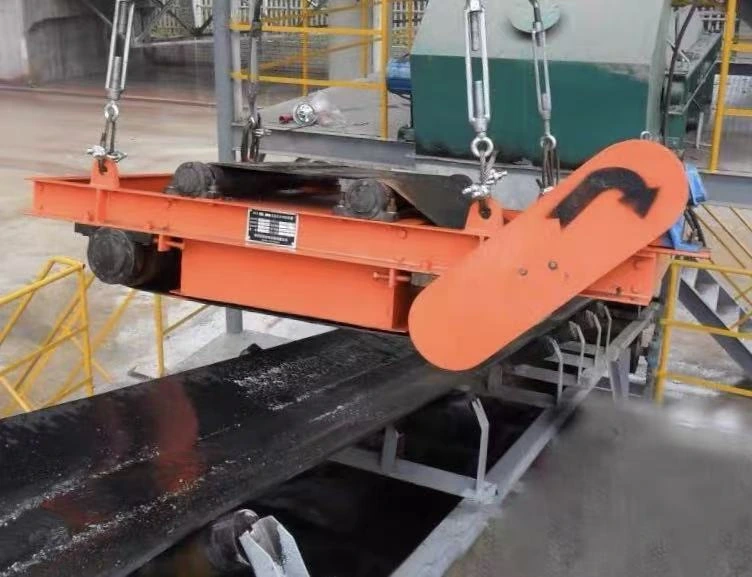
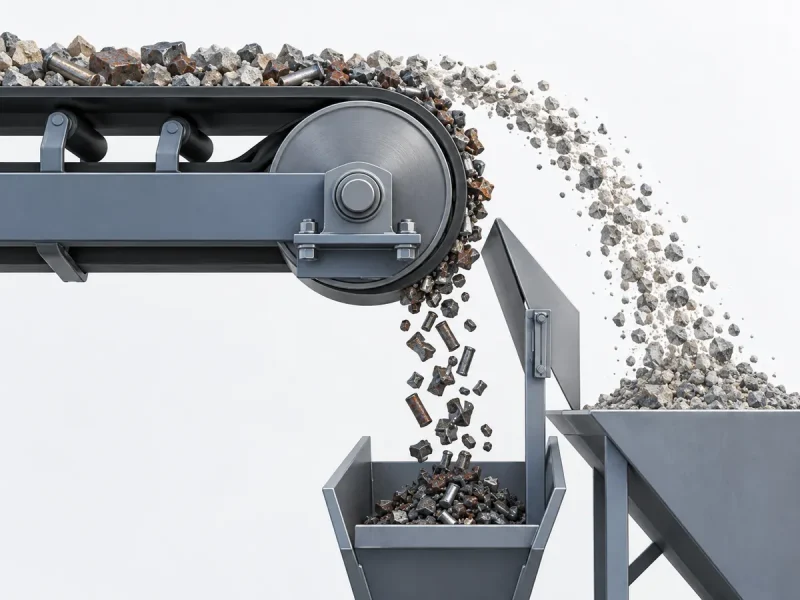
Start with an overband when you need to lift recurring iron or steel from an existing conveyor before it reaches vulnerable equipment. It keeps the main material stream on the belt and carries the captured fraction to a separate discharge.
Our overband magnetic separator uses a permanent magnetic field and a driven cleaning belt. Selection starts with belt width and speed, normal and maximum burden depth, target dimensions, and the distance from the magnet face to the deepest target. Leave space for the removed metal, belt movement, and service access.
Frequent steel makes continuous discharge useful. For occasional pieces, a manual-clean suspended magnet can be practical when safe cleaning access and planned stops are available. Deep material, a large mounting gap, or demanding target sizes may call for a different magnetic design, including an electromagnetic option. Choose from the required capture at the working distance rather than surface Gauss alone.
An overband is not the first choice for collecting a fine mineral fraction through the full depth of an uncontrolled ore burden. That job needs controlled exposure of the feed and a way to manage a sustained magnetic product load.
When should you choose a dry drum?
Choose a dry drum when dry material can be spread evenly through the separation zone and the target responds to the selected magnetic circuit. A standard dry drum is a starting option for ferrous or strongly magnetic targets; weaker minerals need a suitable higher-intensity design.
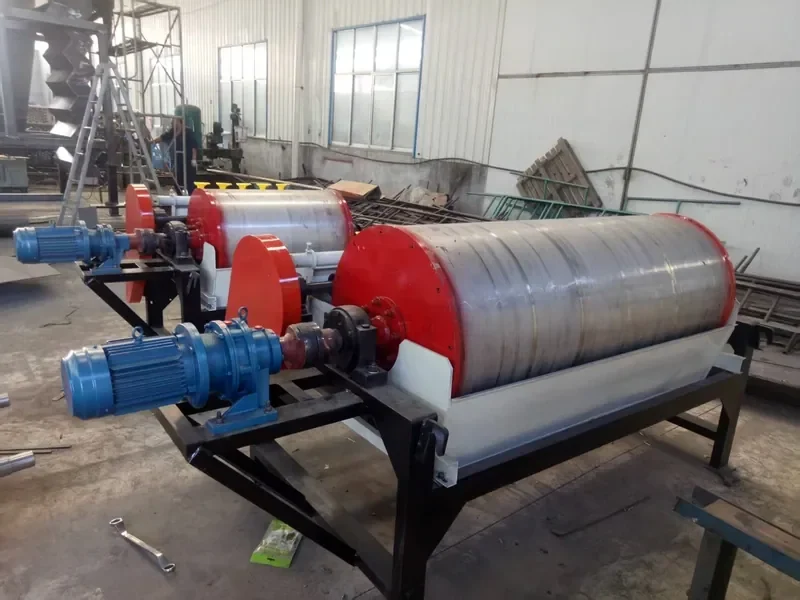
In our dry drum magnetic separator, the shell carries captured material beyond the magnetic zone to a separate outlet. Feed distribution, layer depth, drum speed, and splitter position work together. The splitter is the divider that keeps the two discharge paths apart.
For tramp removal, keep steel out of the continuing product while limiting material carried into the reject. For mineral recovery, collect the valuable magnetic fraction and measure its grade and recovery. A wider magnetic collection cut can admit more non-target material, so weigh and analyze both outputs after a setting change.
Check the practical feed condition too. Damp fines can form lumps or stick to surfaces, turning a controlled layer into uneven piles. Stabilize feeding and address buildup before deciding that the magnetic field is too weak.
When should you choose a wet drum?
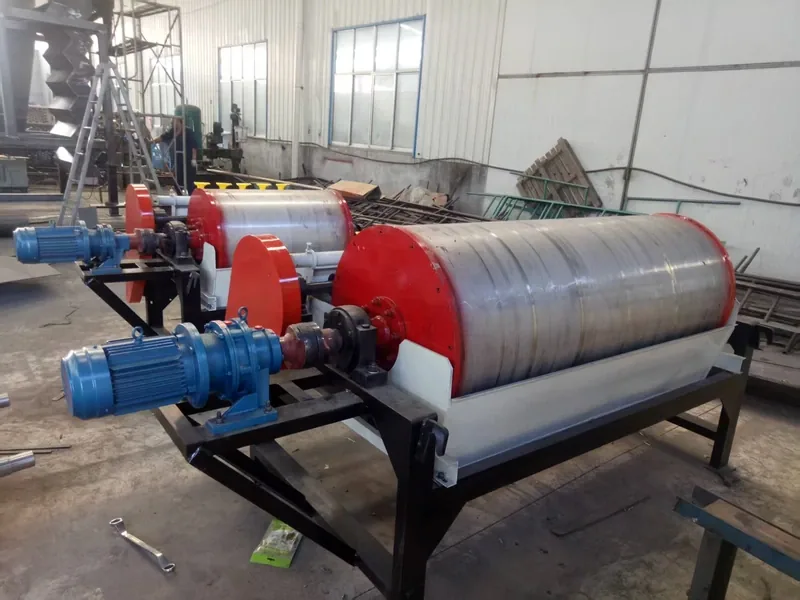
Choose a wet drum when the feed is slurry and the recovery target is strongly magnetic, such as magnetite or a magnetic dense-medium material. Our wet drum magnetic separator is designed around this type of continuous slurry separation.
Size the duty using three connected inputs: slurry flow in m³/h, dry solids in t/h, and magnetic solids in t/h. Water flow loads the tank; magnetic solids load the drum’s collection and transport area. A dilute stream can have modest solids tonnage but still push too much water through a separator.
The purpose of each stage also matters. A rougher first collects valuable magnetic material. A cleaner treats that concentrate to improve grade. A scavenger treats a low-value discharge to recover remaining value. These duties can need different tank flow, magnetic circuits, and operating settings even within the wet-drum family.
The Eriez technical paper Separation magnetism identifies slurry volume and magnetic loading as separate wet-drum sizing factors. This explains why a t/h rating by itself is incomplete. Compare equipment under the same feed and result requirements.
What if the target is weakly magnetic?
Use a suitable high-intensity or high-gradient separator when the valuable or unwanted mineral responds too weakly for a conventional low-intensity drum. Hematite-rich material needs a different assessment from liberated magnetite.
First identify the mineral and its separation response. High gradient means the field changes sharply over a short distance, helping produce useful force on small or weakly magnetic particles. It does not free minerals that remain physically joined to other material. For ore-specific preparation and staged separation, use our iron ore magnetic separation guide.
Why Can a Stronger Magnet Still Give the Wrong Result?
A stronger field cannot correct poor mineral liberation, uneven feed, or products mixing again after capture. Find where the unwanted result begins before changing the magnetic system.
Mineral liberation means freeing the valuable mineral from the surrounding waste mineral, often called gangue. If magnetite and gangue remain joined in one particle, the magnet can collect both. More capture can then increase concentrate mass without producing a sufficiently rich concentrate.
Use the result you observe to choose the next investigation:
| What you observe | What to examine first | What the evidence should change |
|---|---|---|
| Steel is missed mainly during feed surges | Actual burden depth, belt speed, and deepest target position during the surge | Stabilize or spread the feed; retest capture at the required peak condition before changing the magnet. |
| Mineral recovery is good but concentrate grade is low | Concentrate particles: is gangue physically joined to magnetic mineral, or carried alongside it? | Joined particles point to liberation work. Free gangue points toward feed control, cleaning, or product splitting. |
| Liberated magnetite appears in wet tailings as flow rises | Slurry flow, magnetic loading, and distribution across the drum | Compare lower loading with the required production rate. If only the lower rate works, review working area, tank arrangement, or staging. |
| Products look separate at the drum but mix downstream | Splitter, discharge chutes, splash, spillage, and shared collection points | Correct the outlet arrangement, then resample at the actual final collection points. |
For a low-grade concentrate, ask the laboratory to examine representative feed and product samples by size fraction. Microscopy or mineralogical analysis can distinguish locked composite particles from free gangue carried into the concentrate. A sieve separates particle sizes; it does not establish liberation by itself.
If the target is still locked, compare suitable grinding or classification changes with their energy use and effect on fines. If it is already free, first compare feed distribution and the separator’s cleaning or split settings. Do not add another separation stage until the remaining material has a clear, recoverable target.
After each change, repeat the same quality and recovery measurements at the required rate. Keep a baseline run in the comparison. An improvement caused by a different feed sample should not be credited to the new setting.
Can One Plant Need Both Tramp Removal and Mineral Recovery?
Yes. Remove damaging foreign metal before vulnerable equipment, then recover the valuable mineral where the feed has been prepared for separation. The two stages solve different problems and need separate acceptance tests.
For example, a magnetite plant may remove tramp steel before crushing, then use controlled dry pre-concentration or wet recovery after suitable preparation. Recovering magnetite later does not protect a crusher from a steel piece that has already passed through it.
However, a protection magnet also responds to magnetic ore. Collect and examine its discharge during a representative operating period. Separate the steel pieces from accompanying ore where practical, then weigh and analyze the ore portion. If valuable ore loss is excessive, review the capture geometry, feed presentation, and handling of the removed material alongside the protection requirement. Do not simply discard everything attracted by the first magnet.
The reverse problem occurs when tramp steel enters a mineral concentrate. The steel adds magnetic mass and can raise an Fe assay, although it is not recovered magnetite. Record metallic contamination separately when interpreting the concentrate result.
A published Approtec case describes Magnesita Refractories using an Eriez suspended electromagnet with a metal detector to protect dolomite crushing equipment. The useful lesson is the division of work: the magnet removes responsive ferrous pieces; detection provides another way to identify metal requiring a line response. A detector needs a planned stop, diversion, or reject action—it does not attract and remove metal by itself.
For two-stage selection, write two requirements: which harmful pieces must be removed before which machine, and which component must reach which product at what grade and recovery. Avoid one vague requirement such as “remove iron efficiently.”
What Should You Test Before Choosing the Final Configuration?
Test the proposed separator against the real feed range and the result you need to keep. Use representative material and measure both output streams, rather than selecting from the cleanest-looking sample.
- Write the acceptance target first. For protection, list the harmful target pieces and required capture conditions. For recovery, specify the component, minimum grade, recovery target, and production rate. For purification, specify the product impurity limit and acceptable good-material loss.
- Take samples across the relevant feed variation. Include ore sources, particle sizes, moisture or slurry conditions that can change the recommendation. Mix and divide a representative bulk sample into comparable test portions. Keep sample identities linked to the results.
- Record the conditions that reach the machine. For a conveyor, record speed, burden profile, target position, and mounting gap. For a dry drum, record feed distribution, layer depth, moisture, drum speed, and splitter setting. For a wet drum, add slurry flow, solids concentration by mass, dry solids rate, magnetic loading, tank setup, and water settings.
- Collect matched outputs after operation stabilizes. Use the same sampling period or a complete batch. Include intermediate products and retained material in the balance if they exist. For wet samples, determine dry solids mass rather than comparing wet concentrate with dry feed.
- Measure what the decision needs. Scales give mass; screens give particle-size fractions; assays give component concentrations; mineralogical examination identifies the mineral forms and locked particles. Use timed collections or suitable flow instruments to establish throughput. A hand magnet is only a preliminary response check.
- Compare normal and peak operation. Change a setting while keeping the other relevant conditions comparable, then repeat the baseline. Read grade, recovery, material loss, and throughput together. If the outputs do not reconcile with the feed, investigate sampling, retained material, moisture correction, and assay consistency before ranking settings.
Put each trial in one row with its feed identity, settings, output dry masses, grades, and calculated results. This makes an apparently better recovery easy to trace back to a larger collection cut, a different sample, or a real separation improvement.
If the separator passes at low feed but fails at the required rate, it has not yet met the production task. Try a more even feed and an appropriate loading level, then compare added working area or staging if the process still falls short. If a cleaner raises grade but loses too much value, examine that discharge before deciding whether to retreat it or change the cleaning condition.
Choose the Goal Before the Machine
Tramp iron removal vs mineral recovery starts with deciding what must be removed, what must be kept, and how success will be measured. Use conveyor protection equipment for the specified foreign-metal risk. Use controlled dry or wet separation to recover a mineral, matching its magnetic response and feed condition.
Keep protection, purification, and recovery targets distinct even when the same drum family can serve more than one duty. Select the configuration that meets the required result at production throughput, with separate discharge paths and manageable product loss.
For a Corvelan equipment recommendation, send your material, target, dry or slurry condition, normal and peak throughput, and required product result through our contact form. For conveyor protection, include belt speed, burden depth, and available working distance. For slurry recovery, include slurry flow and solids concentration. Mention any drawings or test reports in your message so we can arrange the next exchange.
Frequently Asked Questions
Why is total iron still high after a magnet removes the bolts?
The remaining iron may be part of the minerals rather than foreign steel. Separate representative metallic fragments from the sample and obtain mineral identification alongside the chemical assay. If weakly magnetic iron-bearing impurities are the problem, compare an appropriate higher-intensity or high-gradient process. If the iron is locked within the product mineral, stronger capture alone will not selectively remove it.
Is magnetite or ferrosilicon medium recovery the same as iron ore recovery?
Both can use wet drums, but medium recovery collects circulating process material for reuse. In dense-medium separation, magnetite or ferrosilicon helps form the separation medium. The recovery stage aims to limit medium leaving with the effluent and return material suitable for the circuit. Measure medium losses and non-magnetic contamination as well as recovery; an ore-concentrate grade target does not define this job.
Can a mineral recovery project use dry separation when water is scarce?
Yes, if the target can be separated at a practical dry feed size and the material remains controllable. Start with a dry separation trial that measures both grade and recovery. If acceptable separation needs finer grinding or wet preparation, compare the complete water supply, recovery, and dewatering arrangement with the dry option. Water scarcity changes the process comparison; it does not change the mineral’s magnetic response.
Do we need a metal detector if a protection magnet is already installed?
Add detection when damaging targets remain outside the magnet’s effective capture duty. This can include poorly magnetic pieces or non-ferrous metal. Match the detector to the actual burden and any magnetic or conductive background, then test the alarm and intended stop or reject action together. A detector that signals correctly but leaves the metal moving toward the crusher has not completed the protection task.
Can a hand-magnet test identify the final separator?
A hand magnet can reveal an attracted fraction, but it cannot establish production grade, recovery, or separator size. The test changes particle exposure and distance by hand and does not reproduce the production load. Keep the attracted and remaining fractions for examination, then test representative feed with controlled presentation and measured outputs.
What if a quotation promises “99% separation” without defining it?
Ask for the calculation and the material conditions before comparing that promise with another offer. It could mean captured test pieces, component recovery, impurity reduction, or product purity. Request the feed and product measurements, normal and peak throughput, and the target sizes or mineral component used. A quotation for high mineral recovery still needs a concentrate-grade requirement if that grade determines whether the product is usable.