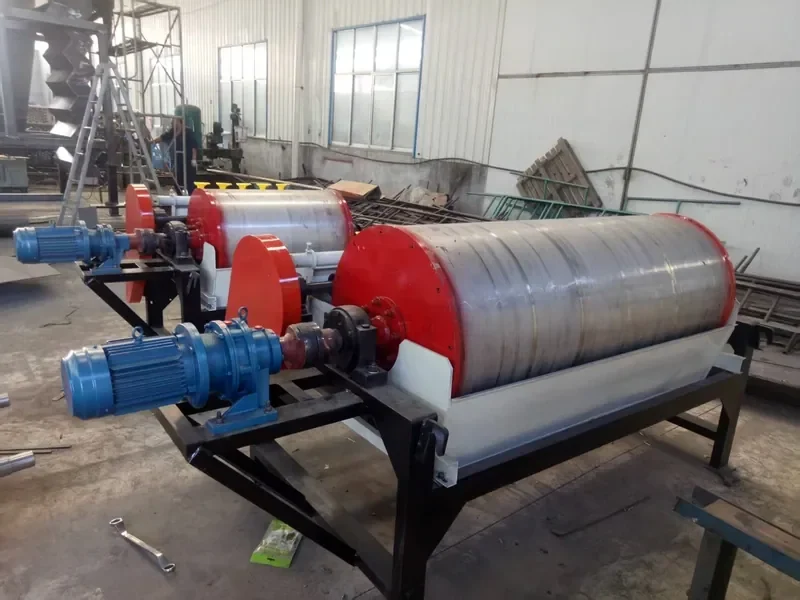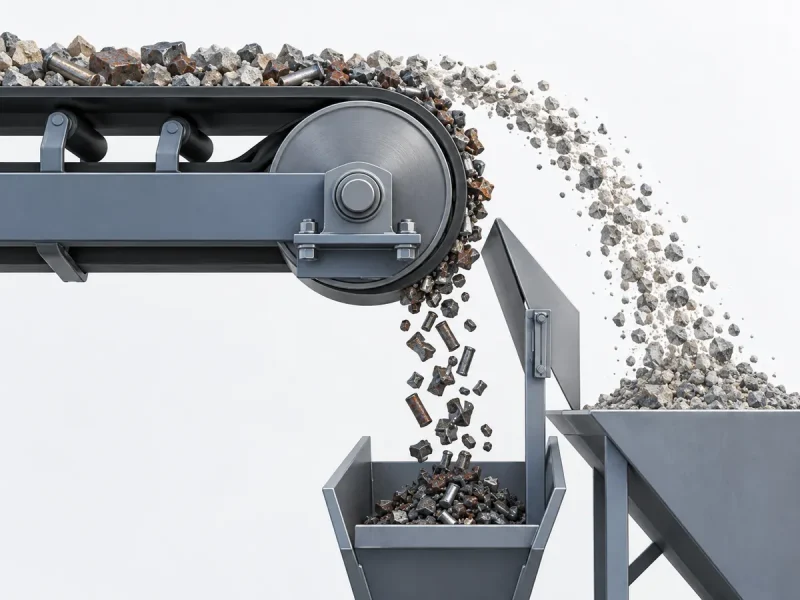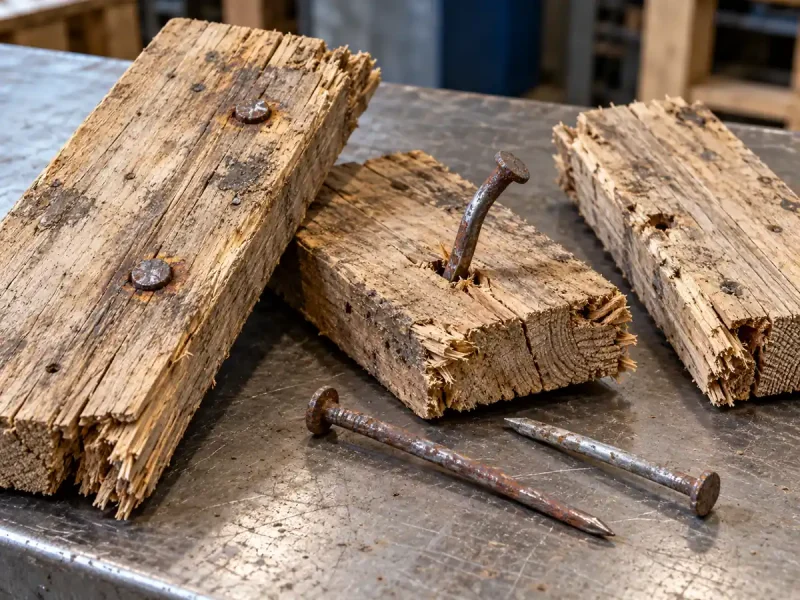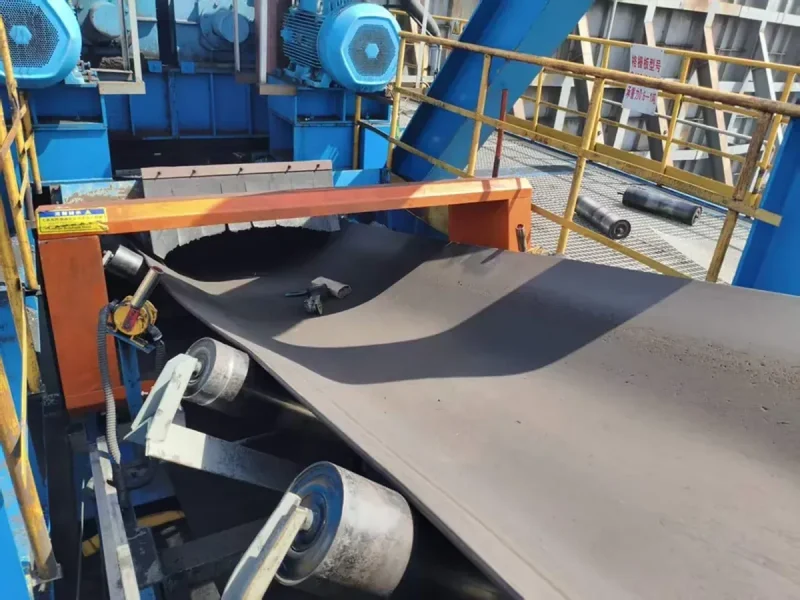
Choose a magnetic separator by matching the metal you need to capture to the way your material moves. On a conveyor carrying rock or other bulk material, start with a suspended magnet where it can intercept tramp iron before the equipment you want to protect. For fine powder falling through a hopper, bring the magnetic surface closer to the product with a grate or similar close-contact design. For mineral recovery, test the feed and choose the separator that can meet both grade and recovery targets. In each case, shortlist the equipment under your peak operating conditions and agree on how you will verify it before ordering.
How to Choose a Magnetic Separator
Start with the result you need and the point in the line where the separator can achieve it. If you’re choosing an iron separator to protect a quarry crusher, start with the bolts or steel fragments that could jam or damage it. A powder producer instead needs to know how much fine iron stays in the product. An ore plant may want to recover the magnetic fraction as a product. Write that result down first so you can compare machines on the same basis.
Define what counts as a successful separation
For equipment protection, describe the smallest piece that could damage the downstream machine and the largest piece your separator must discharge. For product purity, define the acceptable contamination level and the sampling method. For recovery, agree on the required concentrate grade and the fraction of the valuable material you want to recover. Grade tells you what is in the concentrate. Recovery tells you how much of the valuable material in the feed made it there. ERGA’s explanation of separation criteria gives examples of how these objectives differ.
Follow the material through the line
Trace where the metal enters, where it can do damage, and where the product passes closest to a magnetic surface. Then record the line’s normal and peak feed, the target metal, and how much space there is to remove captured metal. A good installation point gives the separator a chance to catch the target and lets the reject leave the process without falling back into clean product.
Which Separator Fits Your Material Flow?
Match the equipment to the way the material is presented at the installation point. A conveyor magnet must reach into a moving layer. A grate in a gravity chute brings the material to the magnets. A liquid trap must fit the pipe and pass the required flow at the available pressure.
Shortlist by installation point
| Material path or separation duty | Equipment to check first | What can change the choice |
|---|---|---|
| Open belt carrying bulk material to a crusher or mill | Suspended magnet or self-cleaning overband | Deep peak burden, high belt speed, high iron loading, or limited space for reject discharge. |
| Belt discharge or a controlled dry falling stream | Magnetic head pulley at the belt end or a dry drum at the transfer | Deep feed may warrant upstream removal. Confirm the stream splits cleanly at peak flow. |
| Dry gravity-fed powder or granules | Grate or drawer for free-flowing material. Plate, wider passage, or rotary grate trial for feed prone to bridging. | Moisture, lumps, stickiness, abrasion, and product lost during cleaning. |
| Pressurized pneumatic line or pumped liquid | Rated pneumatic line magnet or a liquid magnetic trap, respectively | Design pressure, temperature, pressure drop, connection size, and cleaning access. |
| Wet mineral processing or dense-medium recovery | Wet drum for strongly magnetic material. Trial a wet high-intensity separator for suitable weakly magnetic minerals. | Mineralogy, liberation, solids loading, feed size and grade, and recovery requirements. |
| Dry, free-flowing mineral feed with weakly magnetic particles | High-intensity rare-earth roll trial | Moisture, feed uniformity, particle size, and where the splitter divides the product streams. |
Choose the point before you size the unit
Check whether you can move the separator to a transfer point or spread the feed upstream. Both changes can bring buried metal closer to the working surface. Compare practical mounting locations before spending more on the magnetic circuit. If both locations are viable, ask for the same target and feed conditions in both proposals. See Goudsmit’s guide to magnetic separator configurations and our magnetic separation equipment range.
What Metal or Mineral Do You Need to Separate?
Identify the actual target and use representative pieces or samples to check how it responds. A heavy steel bolt and a thin wire of the same length can act differently as they pass a magnet. Shape, orientation, and where the piece sits in the material all affect capture.
Collect samples from the problem point
Save pieces found near the damage point or in reject bins. Photograph them beside a scale and record their material, length, thickness, shape, and where they turned up. Check weakly magnetic pieces individually. Alloy and processing history can change the magnetic response of stainless steel. A quick attraction check can help sort your samples for a trial. Installed capture still depends on whether the same pieces can be lifted and held while the product is moving. See Outokumpu’s explanation of how cold working affects some stainless steels.
Plan for metal a magnet may miss
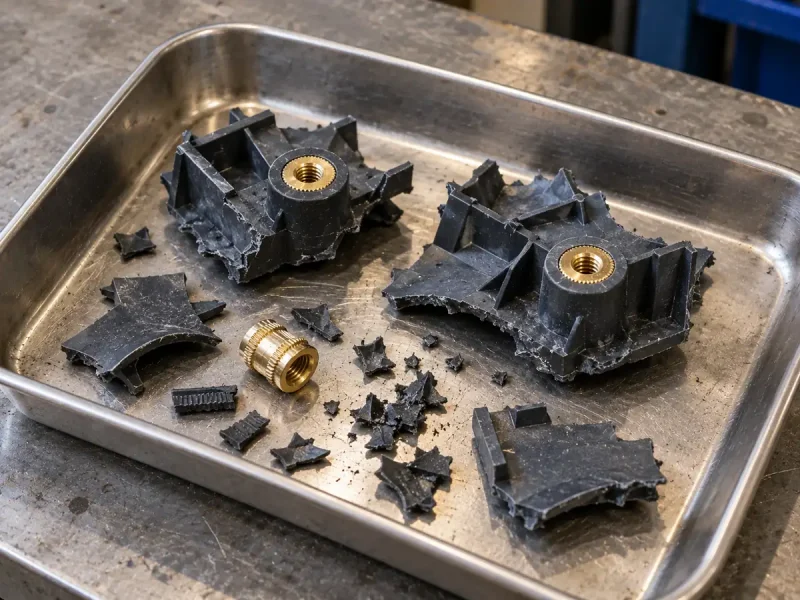
Use a conveyor metal detector with an appropriate stop or reject system when the protection target includes aluminum, copper, or stainless steel that has too little magnetic response for reliable removal. Verify detection with the actual feed, target size and orientation, belt opening, and operating speed. An eddy current separator serves a different task. It can eject suitable conductive nonferrous pieces in recycling, with effectiveness depending on feed preparation and piece characteristics. Eclipse Magnetics’ selection guide explains which contaminants can be difficult to capture magnetically. See also Eriez’s eddy current separator documentation.
Where Should You Install a Conveyor Magnet?
Install the separator upstream of the equipment at risk and compare an overhead cross-belt position with the head-end discharge. The best spot is the one that exposes the target to the working field while giving both the product and expelled metal a clear path.
Choose between cross-belt and head-end mounting
A cross-belt installation is often practical for a retrofit when the active conveyor is accessible and there is room for a side reject chute. The magnet has to pull buried iron up through the material bed. At the head end, material can spread as it leaves the belt, exposing pieces that were buried upstream. Check where the stream travels at each expected belt speed and feed rate. Provide a splitter or other reject path that keeps the metal out of the falling product.
A magnetic head pulley is a separate option. It replaces the head pulley and retains susceptible pieces close to the belt around the discharge until they can drop into a separate stream. It may complement an overhead unit when metal is distributed across the depth of the burden. Check shaft and drive compatibility before using it as a retrofit. For position drawings and the effect of burden depth, see Eriez suspended electromagnet manual SM-323, pages 6–7.
Measure how far the magnet must reach
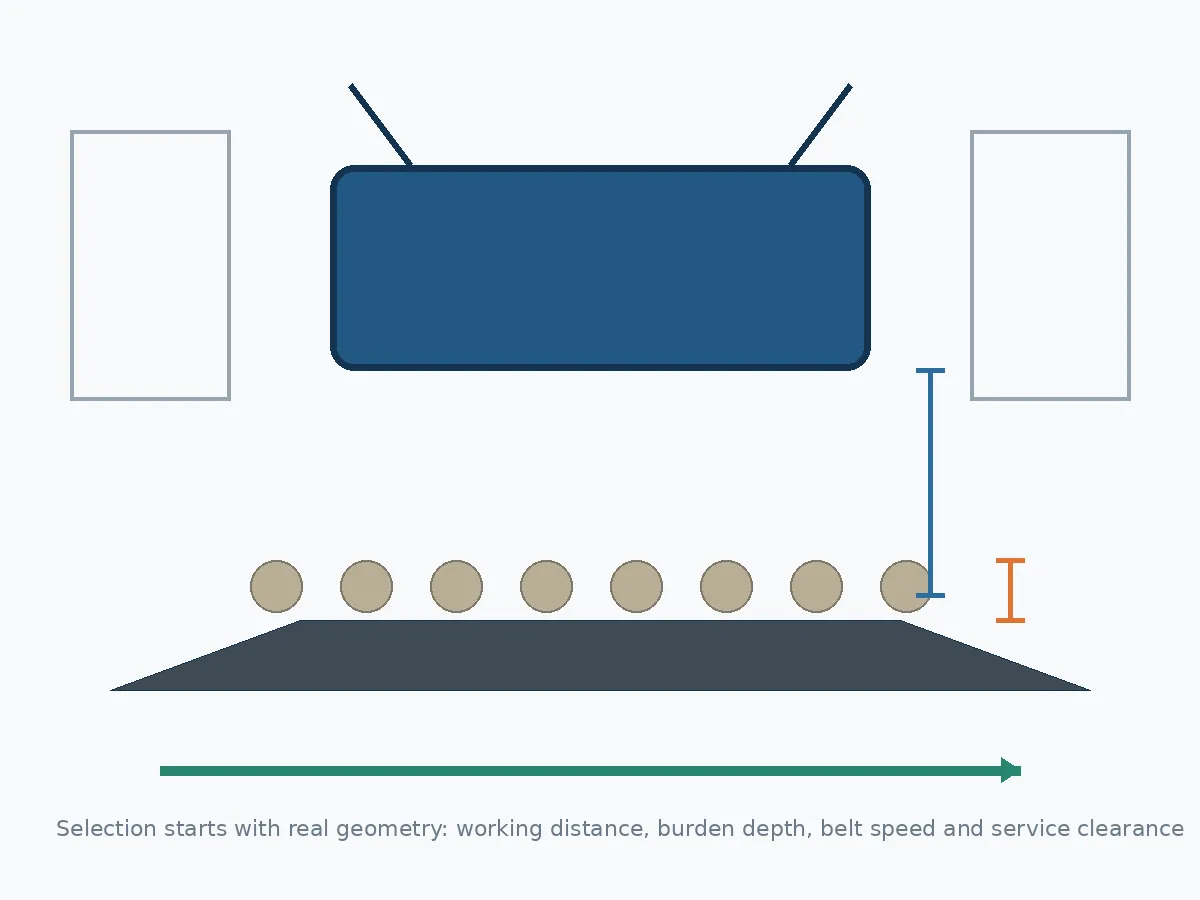
For a cross-belt unit, mark the separator’s working face and the carrying belt on a section drawing. Label the distance between them, the maximum material depth, and the clearance above the highest expected load. Ask the supplier to mark the reference surface it uses for suspension height. Some drawings measure from the magnet face to the carrying belt. For a self-cleaner, the underside of the cleaning belt may be the relevant clearance surface. A target buried near the carrying belt is farther from the working surface than a piece on top of the load. Include any feed surges, bouncing lumps or nearby steelwork that could change clearance or performance.
For example, if the available clearance above the peak material bed is 60 mm and the bed is 190 mm deep, a piece at the carrying belt is about 250 mm below that clearance reference surface. Moving the separator to an approved transfer point may expose the piece at a shorter distance. Use the drawing to compare each location and ask the supplier to verify the buried target at the actual working point. The dimensions in this example show how to measure the gap.
Should You Choose a Permanent Magnet or an Electromagnet?
Choose a permanent magnet if it can meet the capture requirement at the installed distance and peak load. Include a suspended electromagnet in the comparison when a deep or fast-moving burden, large clearance, or challenging target makes capture uncertain. A layout change that improves exposure can also change which magnetic circuit you need.
Where a permanent overband fits
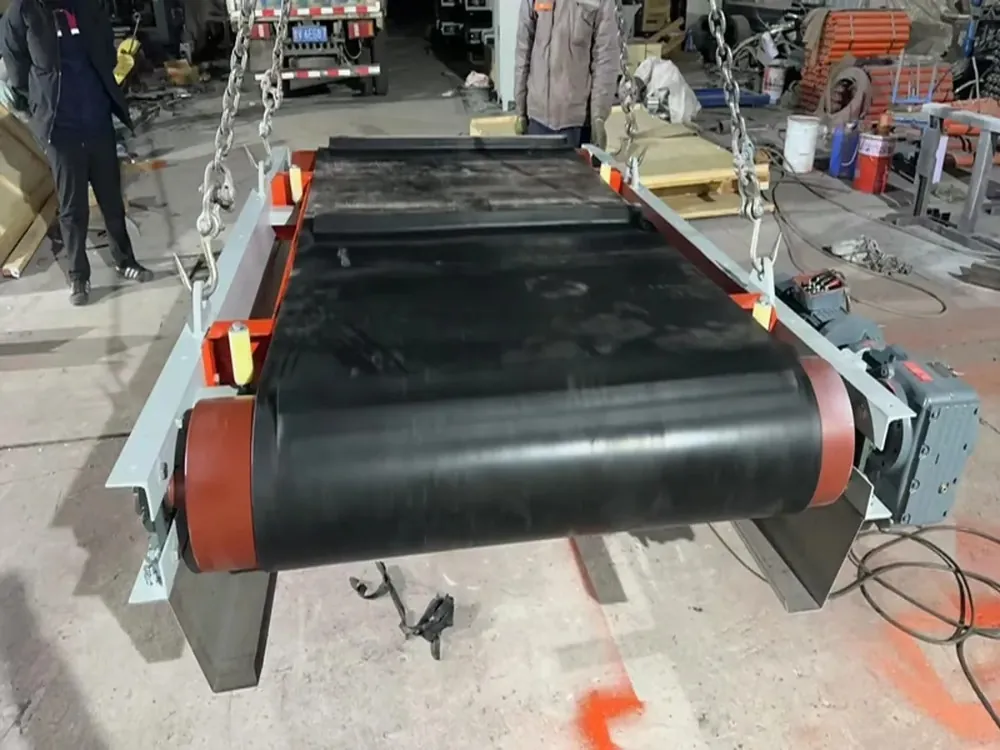
Permanent magnets create the field without coil power. A permanent overband magnetic separator is a practical candidate for continuous removal when the target is within reach and you have room to discharge it. A self-cleaning model still needs drive power. Compare each proposal at the same working height, belt speed, and peak burden with the same steel target. Belt width helps size the equipment, while those other inputs set the capture duty.
Where a suspended electromagnet fits
Ask for the continuous-duty rating at your ambient temperature, the coil and rectifier power, and the cooling and mounting requirements. If your feed problem only appears after the line is hot and running at full rate, verify performance after the equipment reaches normal operating temperature. Our RCDB suspended electromagnetic separator is a manual-clean family for duties where planned iron removal is acceptable. If you need an electromagnetic field and continuous discharge, specify a self-cleaning electromagnetic design in the request.
When Does a Separator Need Automatic Cleaning?
Use automatic cleaning when iron arrives too often for a planned cleaning stop, or when a spike in iron loading can fill the capture area before operators can clear it. Carry the expected peak iron load through the full reject path when checking the design.
Plan a manual cleaning interval
A manual-clean suspended magnet can fit a line that sees occasional pieces and has safe stops at workable intervals. Observe how fast iron builds up during the worst shift or feed batch. Set a cleaning point before accumulation interferes with capture or blocks clearance. Give operators safe access and a way to contain heavy or sharp pieces. Check the interval again when feed changes or more metal starts appearing upstream.
Verify where automatic discharge goes
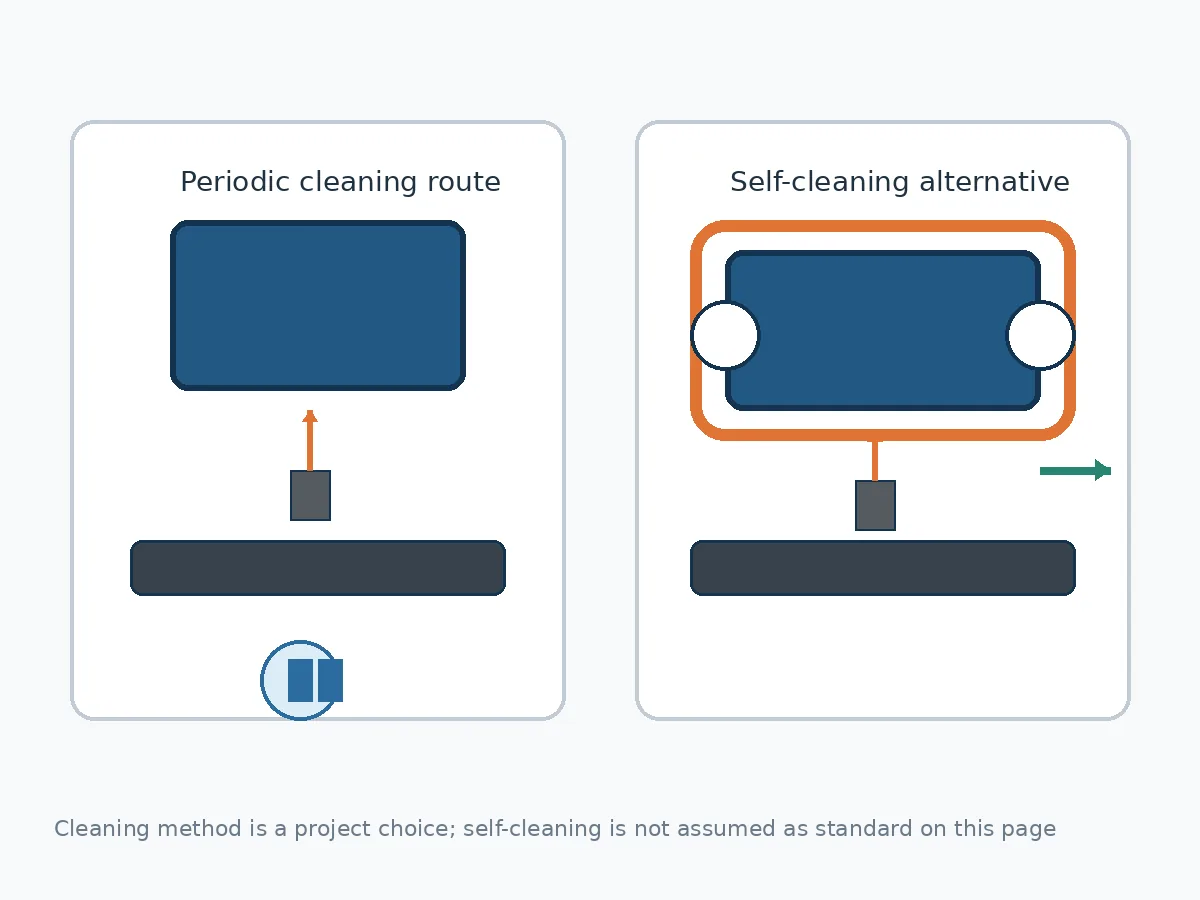
On our RCYD(C) self-cleaning cross-belt permanent magnet separator, the moving cleaning belt carries captured iron away from the product and releases it outside the effective magnetic zone. Make sure the chute and bin can handle the longest piece and peak reject load. Leave access for belt tracking, guards and service. During commissioning, watch for bounce-back, long pieces that snag, and a bin that fills before the planned emptying time. See Storch’s description of the cross-belt discharge path and Eriez SM-307’s troubleshooting guidance.
How Do You Remove Iron From Powder or a Pipeline?
Bring the powder close to the magnetic surface without choking the line or sending too much good product to reject. Use the actual powder, including its wettest or least free-flowing condition, when you check a candidate.
Dry powder in a gravity chute
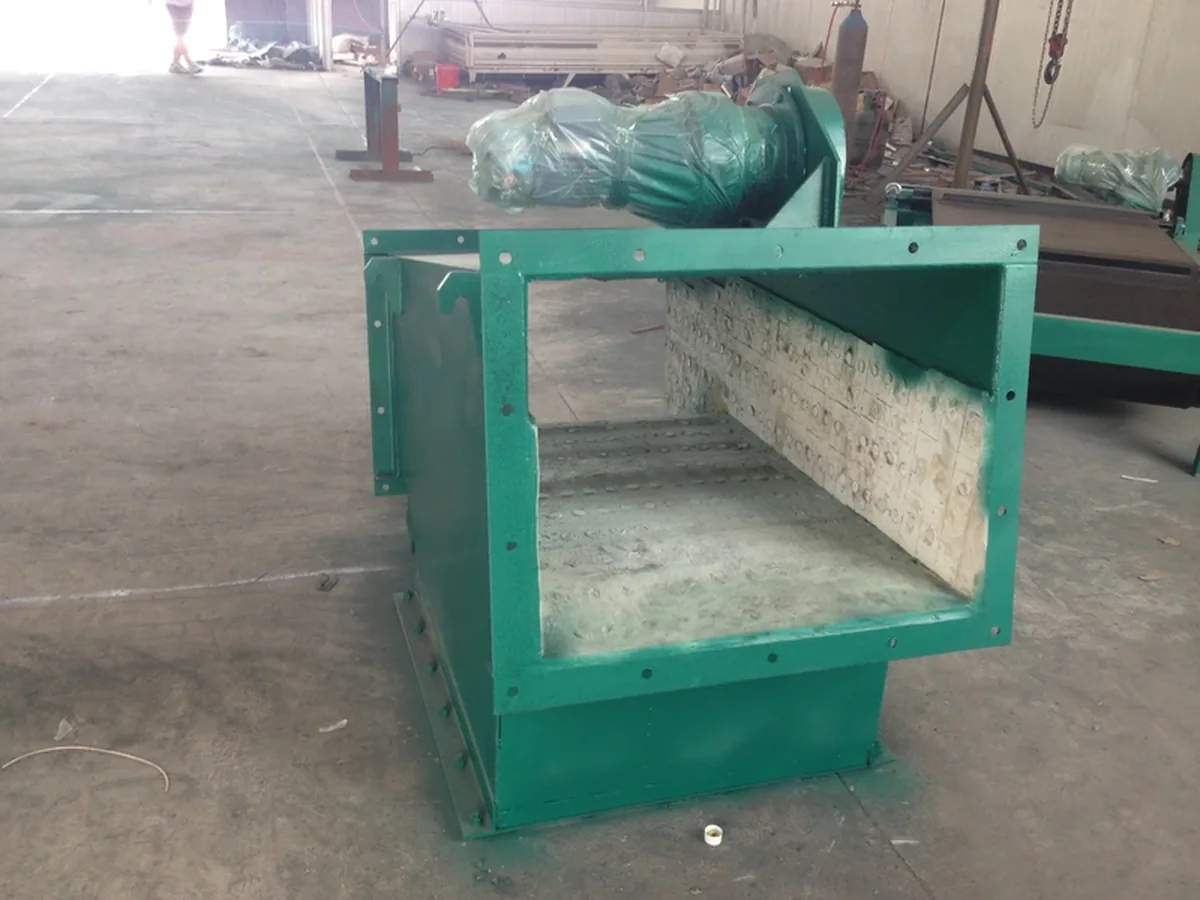
Start with a grate or drawer when the powder falls cleanly through open spaces between the bars. If it packs or bridges, try a rotary grate or a wider, more open plate arrangement. Watch for product buildup and changes in throughput as the magnet loads. Compare matched runs for contamination in the accepted stream and good powder carried away during cleaning. Our dry gravity pipeline separator is an option for an enclosed chute or spout. A rotary-grate design is another candidate for bridging powders.
Pneumatic conveying and pumped liquid
A closed gravity spout, a pressurized pneumatic line, and a liquid pipe can look similar on a drawing. For a pneumatic system, specify the conveying pressure, flow direction, powder, and connection details. For a liquid or slurry line, give the flow rate, pressure, temperature, solids or viscosity, and cleaning method. Check pressure drop with a clean unit and near its expected cleaning point. If the solids are stringy or the liquid is thick, ask how the passages will stay open and how operators can isolate and drain the housing. Chemical Processing’s separator guide describes how these different feeds affect the design.
When Do You Need a Drum, a Roll, or Wet Separation?
Use a drum to split a continuously fed stream, a high-intensity roll to test suitable dry weakly magnetic feed, or a wet separator for a controlled slurry. Decide first whether the magnetic fraction is valuable or is a reject. That choice determines which product stream you sample and what loss you can accept.
Dry drums and rolls
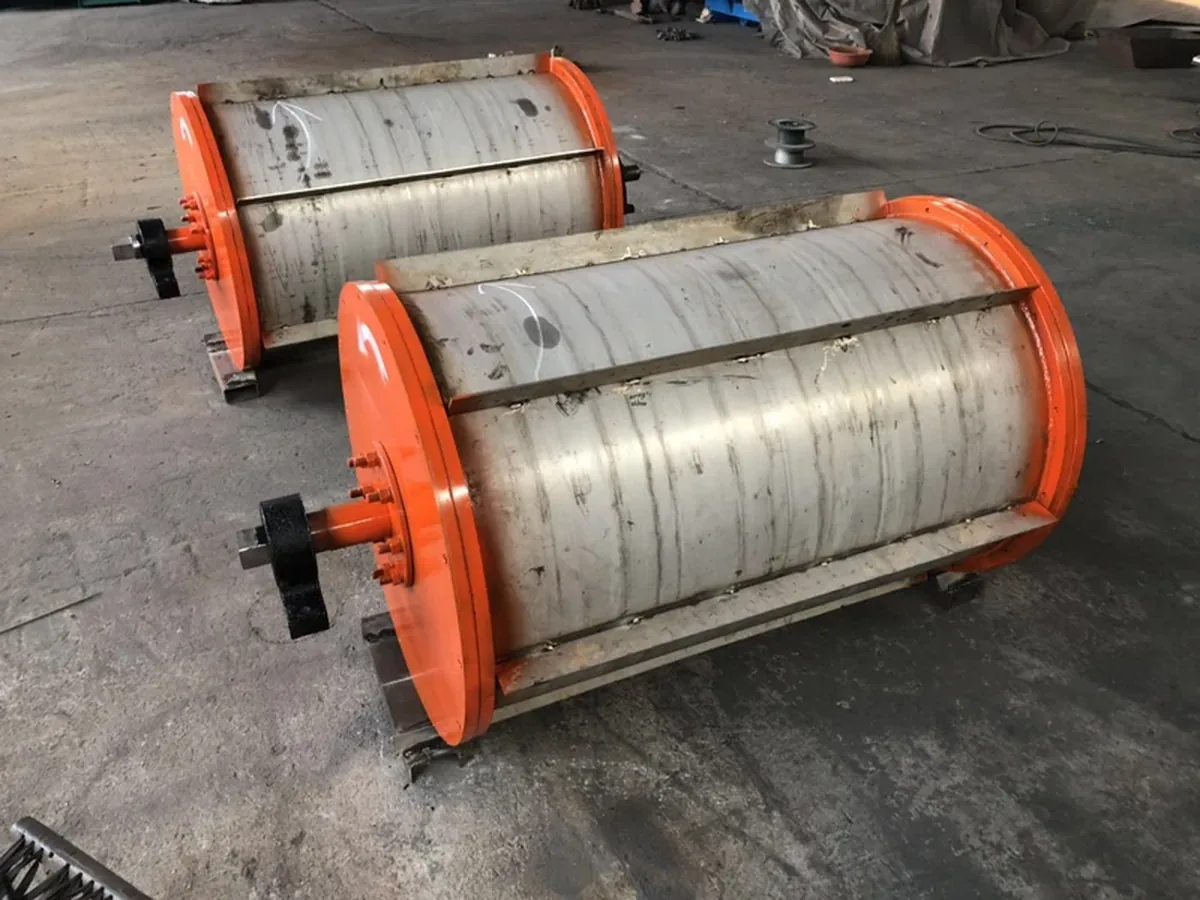
A dry magnetic drum can remove magnetic material where dry solids are fed across the rotating drum surface. For dry, free-flowing feed with weakly magnetic particles, a rare-earth roll may be a better trial candidate. Spread the feed evenly and compare results at defined feed rates and splitter positions. If damp material clumps, test whether screening, drying, or controlled feeding improves the split enough to justify the added handling. See Bunting’s rare-earth roll documentation.
Wet drums and high-intensity wet separation
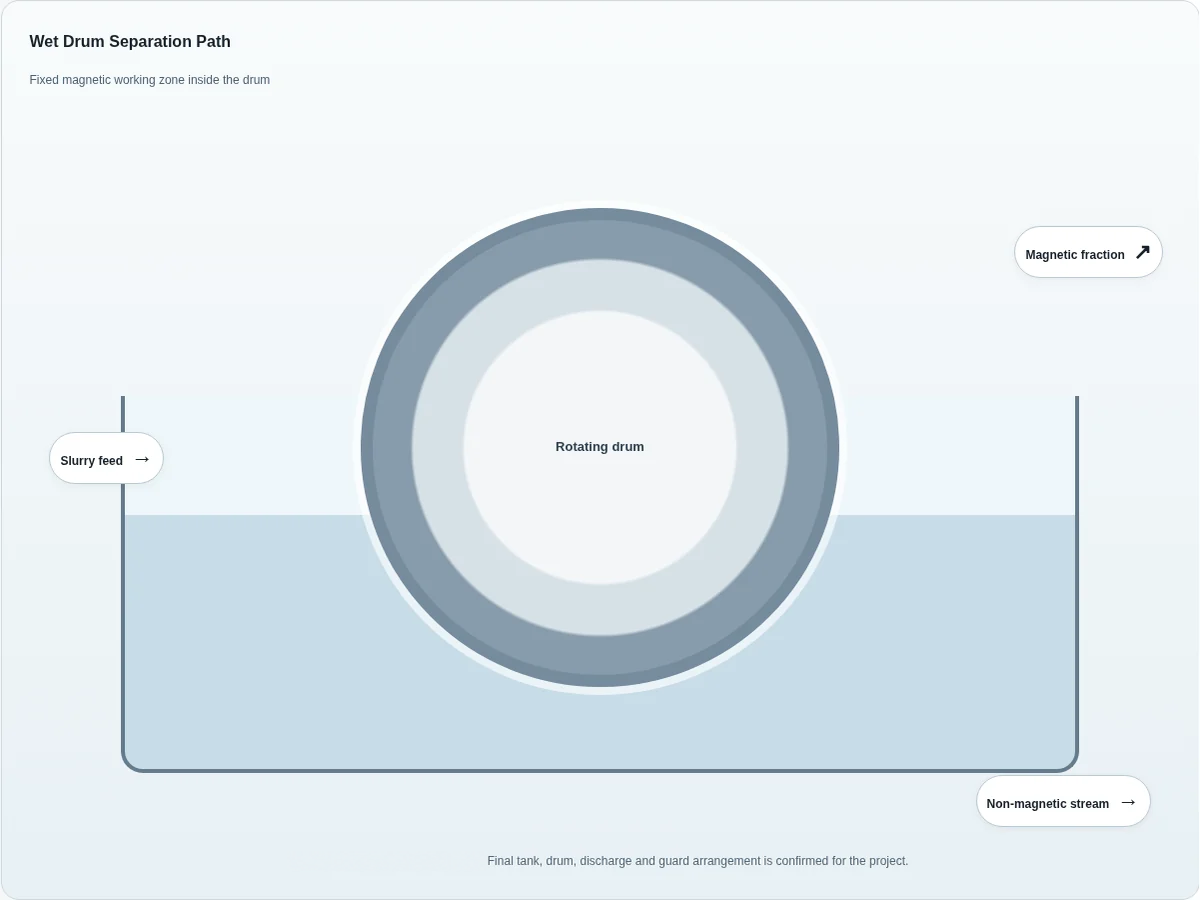
A wet drum is a starting point for strongly magnetic solids such as magnetite or for recovery of magnetic dense-medium solids. Where you need to separate weakly magnetic minerals, test wet high-intensity magnetic separation (WHIMS) on representative feed. Check whether the target is liberated from other minerals, then measure both product grade and recovery at a solids rate and slurry concentration relevant to the circuit. A test at a convenient dilute feed can answer a different question from your production trial. Compare Eriez’s wet drum manual for dense-medium recovery and its WHIMS application notes.
Which Specifications Matter Before You Order?
Compare offers against the same feed, target, mounting geometry, and test method. Ask each supplier to show where its measurements were made and what the proposed unit is expected to do at normal and peak conditions.
Compare Gauss, pull force, and process results
Gauss and millitesla express magnetic flux density at a stated point. A face reading and a reading at the working distance describe different locations. Pull force is the force needed to detach a defined test piece at a stated position with a defined method. For a fair comparison, match the point and gap for field readings and match the piece, direction, and procedure for pull tests. Use a feed trial to check the actual result when the target has to move through a burden or be retained in a flowing stream. See our comparison of Gauss and pull-force measurements.
Check installed dimensions and operating costs
For belt duty, include belt width and speed, peak burden profile, and a side and plan view of the intended location. Add available power, structural mounting points, room to open guards, and clearance to remove service parts. For chutes or pipes, record clear opening, connection details, process temperature, and allowable pressure drop where relevant. In a hot, dusty, corrosive, washed-down, or classified area, provide the site requirements so the enclosure, materials, drives, and electrical equipment can be checked for that duty.
Ask for installed costs on the same basis. Include supporting steel, power, reject handling, cleaning stops, and expected wear parts. Where fan or drive noise matters, give the site a measurement position and operating condition for the supplier’s noise data. A cheaper quote can cost more to run if routine cleaning interrupts a busy line.
How Do You Verify Capture and Product Yield?
Check mechanical fit and function, then verify the separation result under representative feed conditions. Agree on the test method and acceptance limits before ordering so the result can be used to make a buying or commissioning decision.
Test both capture and discharge
For a crusher-protection duty, agree on target pieces, locations across the belt, orientations, and depths in the material. Have the site and supplier set up an approved trial with a way to account for each test piece and prevent it from reaching downstream machinery. Position test pieces using the site’s safe handling and isolation procedure. Test normal feed and the worst expected operating condition. Count pieces successfully captured and discharged, any pieces that fell back into product, and any unrecovered pieces. State the number of trials and the test conditions with the result. An empty-belt test can check movement and discharge. The loaded test answers whether the magnet can reach the target through material at production speed.
Weigh the accepted stream and the reject
For powder or mineral tests, sample over the same run, record feed and both output streams, and report on the same mass basis. Where moisture changes, compare dry mass. If you need to know how much usable product is lost, identify the good fraction in the reject as well as weighing total reject. For a mineral concentrate, measure the feed mass and assay both feed and concentrate. Multiply each stream’s dry mass by its valuable-component grade to find the component mass. Recovery is the component mass in the concentrate divided by the component mass in the feed.
Worked example using assumed dry masses. A batch starts at 100 kg, including 1 kg of magnetic contamination. It produces 97 kg of accepted material and 3 kg of reject. If the reject contains 0.8 kg of the contaminant, capture is 0.8 ÷ 1 = 80%. The other 2.2 kg in reject is assumed to be usable product. Usable product recovery is (99 − 2.2) ÷ 99 = 97.8%. The accepted stream still contains 0.2 kg of contaminant, or about 0.206% by dry mass. Each result answers a different acceptance question.
Write down which result decides acceptance. A clean-looking reject can still represent significant yield loss. Our quality control and testing page explains how magnetic measurements, mechanical checks, and material trials answer different questions.
What Should You Check if Iron Gets Through?
Find out when the misses happen before changing magnet strength or buying another unit. Record what was missed, when it happened, and whether the conditions changed at the feed, separator, or reject point.
Use the pattern to find the cause
- Misses during surges. Compare peak bed depth, feed distribution, belt speed, and clearance with the conditions used to select the unit. A feed spreader, revised position, or different unit may be needed.
- Iron gathers under the magnet but still reaches downstream equipment. Check whether material peaks sweep captured pieces off the magnet or the chute and splitter return pieces to clean material.
- Capture drops suddenly. Check magnet position, buildup, and cleaning-belt tracking. On an electromagnet, have qualified personnel check power and control status. If the missed piece is unlike older rejects, compare its material and shape against the original test target.
Isolate equipment and repeat the relevant check
Follow your site’s energy-control procedure before accessing moving belts, opening pressure housings, or handling collected iron. Control stored pressure or movement and follow the manufacturer’s magnetic-field restrictions, including for staff with implants. Permanent magnets continue to attract steel after their drives are isolated. After the correction, repeat the relevant test with the same target, gap, and feed condition. A change in the amount caught is easier to interpret when you know the incoming load and record any target pieces that still get through. See OSHA’s hazardous-energy control standard for U.S. workplaces and Eriez SM-307’s adjustment and troubleshooting guidance.
What Should You Send for a Magnetic Separator Quote?
Send the material, the metal or mineral target, normal and peak throughput, and a drawing or photo of the installation point. Add the outcome you need, such as protecting a crusher from specific steel pieces or meeting a residual contamination limit in powder. These inputs let us screen equipment types and identify the measurements or test that would confirm your choice.
Provide the dimensions that affect fit
For conveyors, send the belt width and speed, maximum material depth, available mounting height, and where rejected metal can go. For an enclosed line, send the opening or pipe size, connection details, and pressure and temperature if applicable. For a wet recovery duty, share slurry flow, solids loading, feed size, and any feed and product assays. If all you have is a photo and a throughput figure, mark the intended location and say which measurements are still pending.
Agree on what the quote should confirm
Ask for the equipment type, the proposed working distance, and an installation outline. Request the cleaning or discharge method and any remaining input needed to confirm the model. If capture or yield drives the purchase, also agree on which sample to use, test conditions, and the acceptance results you need in writing.
Make the selection at your worst operating condition
Shortlist the equipment by flow path and target, then verify it where the duty is hardest. For belt protection, that usually means testing the smallest damaging piece in the deepest or fastest expected burden and checking that the reject leaves the line. For powder or mineral separation, report throughput and the accepted and rejected material together so the decision accounts for both cleanliness and usable yield.
Magnetic Separator Selection FAQ
Can one separator protect a crusher and polish the final product?
Use separate stages when the two goals require different capture conditions. An overband before a crusher can catch damaging pieces. A close-contact unit after milling can target smaller wear particles from the process. Verify each stage against the metal and product condition it actually sees.
Can a magnet remove stainless steel wire?
Test a piece of the actual stainless wire. Its alloy and processing history affect magnetic response, and thin wire may be hard to capture in a moving bed. If magnetic capture is unreliable, check a suitable detector with that wire in several orientations and verify how the line stops or rejects it.
What if you only know tons per hour?
Use it to start a quote, then supply the belt width, speed, and peak material depth. The same throughput can move in a thin layer on a wide, fast belt or in a deeper layer on a slower belt. A safely collected section measurement or a dimensioned drawing at the intended location will narrow the options.
Does a self-cleaning permanent magnet still need power?
Yes. The cleaning belt drive needs power while the permanent magnet supplies the field. Ask how the separator and upstream feed are interlocked if the cleaning drive stops. Iron will continue to collect on a stationary unit while the feed runs.
Can you use a dry gravity separator in a pressurized line?
Use a unit rated for the line’s actual pressure, temperature, and material. Confirm the housing and connection pressure ratings from the equipment documentation. Check pressure drop and the procedure for isolating the housing before cleaning.
Can a magnetic separator remove iron dissolved in water?
A magnetic trap captures susceptible particles suspended in a liquid. Dissolved iron takes a water-treatment process suited to its form. If the source is unclear, establish whether the iron is dissolved or particulate before choosing equipment.
Why is there good powder in the reject bin?
Check for powder carried out with collected iron, buildup on the magnet, or an overly wide reject split. Record accepted and rejected dry mass at the same feed rate. Change one factor at a time, such as cleaning interval or splitter setting where the machine has one, and measure both contamination and usable-product loss again.
Is a Gauss reading enough to accept a used separator?
Ask for the model and service records, inspect its mechanical condition, and verify capture under your duty. Check mounting, belt tracking, controls, safety devices, and the reject outlet. If you plan to rent or trial a unit, agree in advance on the feed, test setup, and results that would let you buy with confidence.
Should you use two magnets in series?
Use two stages when each covers a distinct target or part of the stream. A suspended magnet can remove bulky tramp steel before a head pulley collects susceptible metal close to the belt. Test each discharge stream and check for metal that gets past both before treating the additional stage as effective.
What happens when a suspended electromagnet loses power?
Loss of excitation can let captured metal fall back into the line. Ask how the feed equipment responds to power or rectifier failure, where released metal could fall, and what checks operators must complete before restart. Verify that sequence under the site’s commissioning plan.
How do you find the source of recurring metal fragments?
Track the pieces by size, shape, shift, and collection point, then inspect the equipment between the last clean point and the first contaminated point. Repeat observations for the same material and operating condition. A group of similar flakes or wire strands can point to a worn component that will keep shedding metal until it is repaired.