Find equipment by installation point and separation task.
All magnetic separators →Start with the material or production line you need to protect.
All applications →Compare technologies, check parameters and prepare your RFQ.
All guides →See the factory, quality checks and answers before you request a quotation.
Use an RCDE oil-cooled suspended electromagnet on a dry belt conveyor when you need to remove iron or steel tramp metal and planned magnet cleaning is acceptable. If captured iron must discharge automatically while the conveyor keeps running, choose a self-cleaning suspended electromagnet instead. Start model selection with belt width, maximum material depth and actual suspension height.

Use this quick range check before reading the full model table. The exact model still depends on belt width, maximum material depth and actual suspension height together.
RCDE-4 to RCDE-22
400–2200 mm
120–600 mm, depending on model.
Up to 70–550 mm, depending on model.
Up to 2.5 m/s
Continuous duty
Standard / T1 / T2 / T3
Choose this RCDE when the conveyor is dry, the unwanted material is iron or steel, and planned manual cleaning is practical. Choose a self-cleaning electromagnet when the line must keep running while captured iron is discharged automatically.
Use the manual-clean RCDE when bolts, steel pieces, tools or plate fragments appear occasionally and the magnet can be cleaned during a safe planned stop.
If the magnet needs cleaning more than once per shift, if each stop interrupts production, or if captured iron must discharge automatically, check a self-cleaning suspended electromagnet first.
Do not use this RCDE for aluminum or copper separation, wet slurry duty, or fine weakly magnetic mineral separation. Use the separator family designed for that material and target.
Start with three values: belt width, maximum material depth and actual suspension height. All three must fit the same RCDE model. After the model size fits, check belt speed, target iron, installation position and magnetic-field version.
Choose the first RCDE size that covers the conveyor belt width.
Use the deepest material layer expected in operation. This is also called burden depth.
Compare the real magnet position with the model's rated suspension-height limit.
Only after the size fits, choose Standard, T1, T2 or T3 from the real capture difficulty.
The examples below show the starting model choice before target-iron testing.
Start with RCDE-8.
800 mm belt: fit. 180 mm material depth: below the 200 mm RCDE-8 limit. 220 mm suspension: below the 250 mm limit. Next, check the target iron and magnetic-field version.
Do not choose RCDE-8.
The 230 mm material depth is above the RCDE-8 limit of 200 mm. Check RCDE-10 first. Do not try to solve this with T1, T2 or T3 on RCDE-8.
RCDE-10 is the minimum catalog size.
If the magnet protects a critical crusher or mill, Corvelan checks RCDE-12 first instead of stopping at the minimum size, then defines a real tramp-iron capture test.
| Situation | Belt Width | Material Depth | Suspension Height | Corvelan Starting Choice |
|---|---|---|---|---|
| A · Fits | 800 mm | 180 mm | 220 mm | RCDE-8 |
| B · Too deep | 800 mm | 230 mm | 230 mm | Do not use RCDE-8; check RCDE-10 |
| C · Critical duty at limits | 1000 mm | 250 mm | 300 mm | RCDE-10 minimum; check RCDE-12 first for critical crusher/mill protection |
These are selection examples, not customer performance results. Final capture performance depends on the actual iron, working distance, material and conveyor conditions.
Use this table to find the RCDE models that fit your conveyor dimensions. First check belt width, material depth and rated suspension height. The approved quotation and general arrangement (GA) drawing control the final project configuration.
| Model | Belt Width (mm) | Rated Suspension Height (mm) | Material Depth ≤ (mm) | Magnetic Field ≥ (mT) | Excitation Power ≤ (kW) | Weight (kg) |
|---|---|---|---|---|---|---|
| RCDE-4 | 400 | 120 | 70 | 50 | 0.6 | 300 |
| RCDE-5 | 500 | 150 | 100 | 60 | 1.0 | 500 |
| RCDE-6 | 600/650 | 180 | 130 | 60 | 1.5 | 650 |
| RCDE-6.5 | 650 | 200 | 150 | 70 | 2.0 | 750 |
| RCDE-8 | 800 | 250 | 200 | 70 | 3.0 | 1150 |
| RCDE-10 | 1000 | 300 | 250 | 70 | 4.5 | 1400 |
| RCDE-12 | 1200 | 350 | 300 | 70 | 6.0 | 2780 |
| RCDE-14 | 1400 | 400 | 350 | 70 | 8.5 | 4200 |
| RCDE-16 | 1600 | 450 | 400 | 70 | 12 | 5700 |
| RCDE-18 | 1800 | 500 | 450 | 70 | 18 | 7300 |
| RCDE-20 | 2000 | 550 | 500 | 70 | 22 | 8500 |
| RCDE-22 | 2200 | 600 | 550 | 70 | 27 | 10500 |
For every order, we confirm the selected model, final dimensions, electrical scope and acceptance method in the approved project documents.
Choose the RCDE size first. Choose the magnetic-field version second. T1, T2 and T3 are listed at 90 mT, 120 mT and 150 mT. They add magnetic-field strength; they do not replace the correct RCDE size.
Start with Standard when belt width, material depth and suspension height all have clear margin and the target is larger iron or steel.
One difficult condition → start with T1. Examples: suspension height close to its limit, material depth close to its limit, smaller target iron, buried iron or belt speed close to the catalog limit.
Two difficult conditions together → start with T2. Example: deeper material plus a higher suspension position, or a smaller target combined with a faster belt.
Three or more difficult conditions, or high damage risk → start with T3. For critical-duty applications, define an application-specific capture test. Final performance is verified against the agreed test conditions.
Use manual cleaning only when the cleaning stop is practical and does not disrupt normal production. If the magnet needs cleaning more than once per shift, the line cannot stop, the magnet is hard to reach safely, or captured iron must discharge automatically, check a self-cleaning electromagnet first.
| Your Conveyor | What Corvelan Starts With | What to Check |
|---|---|---|
| Iron appears only occasionally | Manual-clean RCDE | Safe access, retained-iron capacity and cleaning interval |
| One planned cleaning stop per shift or less is practical | Manual-clean RCDE | Safe stop procedure and cleaning access |
| Cleaning is needed more than once per shift | Check self-cleaning first | Automatic discharge, drive and maintenance clearance |
| Conveyor cannot stop for cleaning | Self-cleaning electromagnet | Drive, guarding, tracking and discharge point |
| Magnet cannot be reached safely for manual cleaning | Self-cleaning electromagnet | Access, guarding and maintenance space |
| Captured iron must discharge continuously to the side | Cross-belt self-cleaning configuration | Side clearance and discharge chute/bin |
Oil cooling is mainly about heat management during electromagnetic operation. It does not by itself guarantee better separation performance.
| Operating Condition | Start With | Why |
|---|---|---|
| Continuous energized duty | Oil-cooled | Circulating insulating oil carries heat away from the coil. |
| Long operating periods where heat removal matters | Oil-cooled | The RCDE construction is designed around oil circulation and external heat dissipation. |
| Oil-free construction is preferred | Check an air-cooled alternative | The cooling method should match the operating and maintenance preference. |
| Special hazardous location | Do not assume the standard unit is suitable | Confirm the site's electrical, enclosure and certification requirements first. |
| High ambient temperature or high altitude | Check thermal and electrical conditions first | Cooling and electrical limits can change with site conditions. |
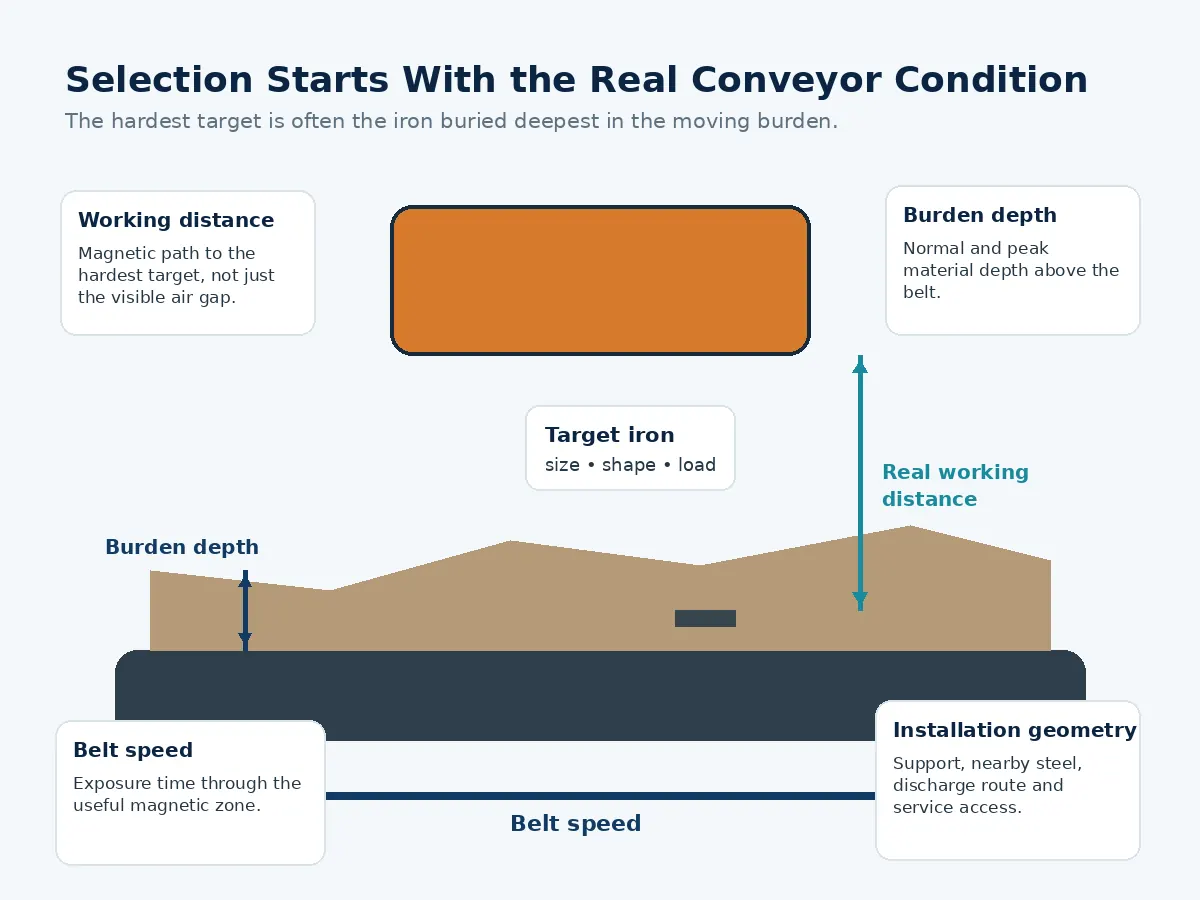
Use the RCDE series when a dry belt conveyor carries unwanted iron or steel pieces. These unwanted pieces are commonly called tramp iron. The hardest piece to remove is often the one buried deepest in the material, not the one lying on top.
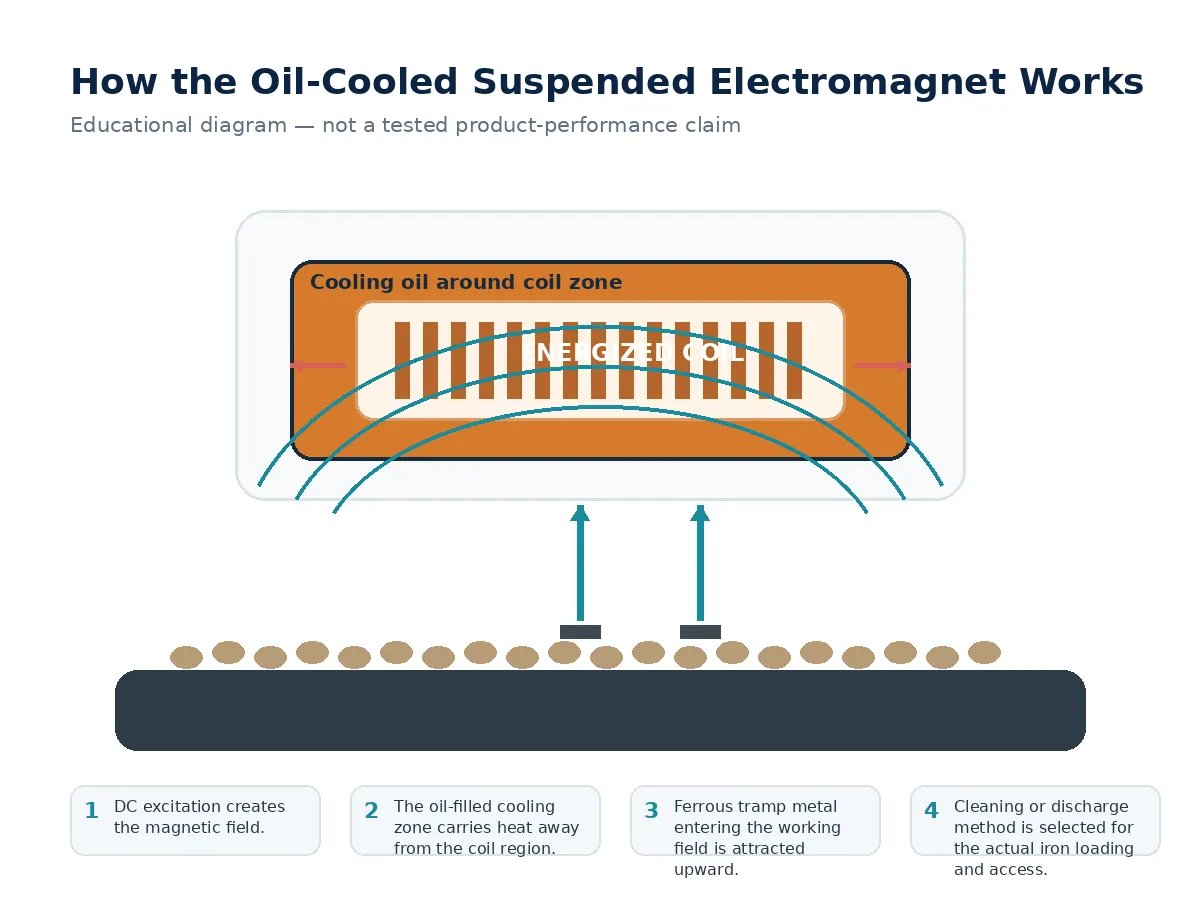
Direct current powers the magnetic coil and creates a strong magnetic field. The field pulls iron and steel pieces out of the material on the conveyor. Oil circulates inside the unit to carry heat away from the energized coil.
The conveyor carries bulk material below the suspended magnet at the real belt speed and material depth.
Iron and steel are pulled toward the magnet. Gravity, belt speed and the material around the iron can make capture harder.
Captured iron stays on the magnet until the planned cleaning procedure removes it.

The RCDE series uses circulating insulating oil to carry heat away from the coil. The unit has a fully enclosed body and external cooling sections that help release this heat. The technical data specifies Class F or higher coil insulation.

Use above-belt installation as the starting position when the material layer is moderate, the target is larger iron and the overhead space is clear. Check the conveyor discharge/head-end position first when the material is deep or important iron may be buried near the belt.
Start here for many retrofits when the material layer is moderate, larger tramp iron is the main risk, and there is enough headroom, support and cleaning access.
Check this position first when the material is deep, the important iron may sit low in the burden, or the magnet protects critical downstream equipment. As material leaves the head pulley, the bed opens and buried iron can become easier to reach.
If steel chutes, support beams or idler frames sit close to the magnetic area, do not approve the final position until these items appear on the GA drawing.
Use the real conveyor angle and real support geometry in the GA drawing. Do not copy a generic catalog angle when the site is different.
| Conditions | Corvelan Starting Position |
|---|---|
| 120 mm material depth, larger steel pieces, good overhead clearance | Above-belt installation |
| 300 mm material depth, important iron may be buried low, discharge area available | Check discharge/head-end installation first |
| Steel structure close to the magnet | Show it on the GA before final approval |
| Inclined conveyor | Use the real conveyor angle in the GA |
Whether the magnet captures the iron depends on several things working together. The most important are working distance, material depth, belt speed, iron size and the way the magnet is installed.
Use the distance from the magnet face to the critical iron piece, not only the visible air gap above the material.
Use normal and peak material depth. Deep or uneven material makes iron near the belt harder to reach.
The RCDE technical data lists belt speed up to 2.5 m/s. Higher speed gives the magnet less time to pull the iron and needs a separate check.
Size, shape, mass, orientation, how strongly the iron responds to the magnet, and how often it appears all change capture difficulty.
Bulk density, particle size, moisture, lumping and interlocking can make it harder to lift the iron.
Nearby steel, trough shape, support structure and cleaning space can change how the magnet should be installed.

No. A higher magnetic-field value does not automatically mean better tramp-iron removal. A field value only makes sense at a defined measurement point and distance.
The magnetic-field strength at a defined point under defined conditions.
Working distance, material depth, belt speed, iron size, iron position, material behavior and installation position.
| Process Condition | Use This RCDE? | What to Use Instead |
|---|---|---|
| Dry belt conveyor with bolts, steel fragments or other iron/steel tramp | Yes | Size the RCDE by belt width, material depth and suspension height |
| Frequent iron/steel tramp and automatic discharge required | No — use self-cleaning | Self-cleaning electromagnetic separator / overband |
| No electrical supply is available, or you prefer not to use electromagnet power | No — consider a permanent magnet | Use a suspended permanent magnet if the duty fits |
| Aluminum, copper or other non-ferrous target | No | Use a non-ferrous separator such as an eddy-current separator where applicable |
| Wet slurry process | No | Use a wet magnetic separator matched to the material and target |
| Fine weakly magnetic mineral target | No | Use a high-gradient or mineral-beneficiation magnetic separator designed for that target |
| Hazardous dust or explosion-classified area | Do not use the standard RCDE configuration without a project-specific check | Confirm the hazardous-area electrical, enclosure and certification requirements first |
| Food / pharmaceutical process | Do not use the standard RCDE configuration without a project-specific check | Use a design with documented hygienic materials, cleanability and the required compliance documents |
| High ambient temperature or high altitude | Do not select directly from the standard table | Check electrical and cooling derating before confirming the model |
Confirm lifting points, support structure, final equipment position and installation angle from the approved GA drawing.
Show us nearby steel idlers, beams and chutes. Nearby steel can affect the magnetic field, so we check these parts before the installation position is approved.
Confirm the site power supply, rectifier/control system, isolation method and lockout requirements for the selected equipment.
Leave service space for inspection and oil-system maintenance around the housing and cooling sections.
Define where captured iron will be removed, how the conveyor and magnet are isolated, and where the removed iron is placed.
Allow enough physical clearance for the largest expected captured steel piece so it does not jam against the conveyor structure.
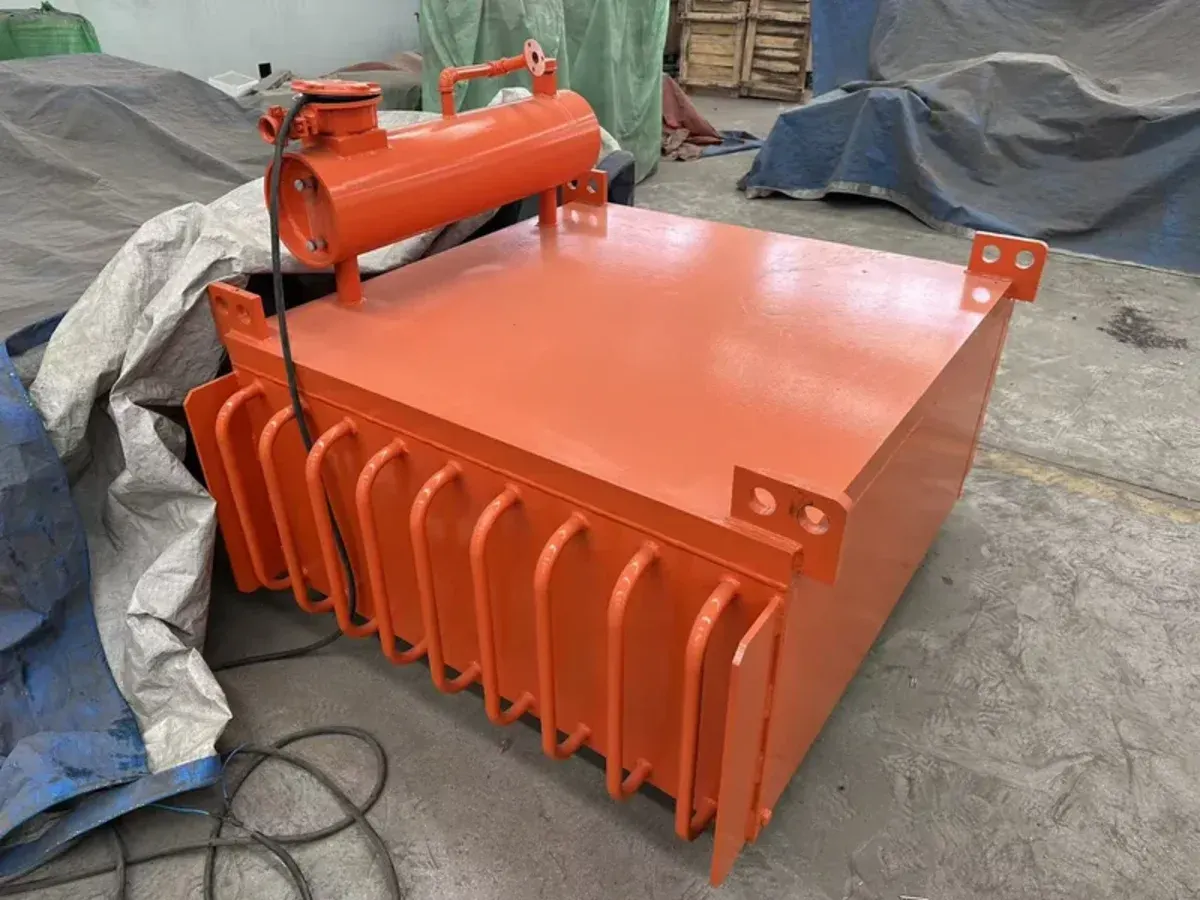
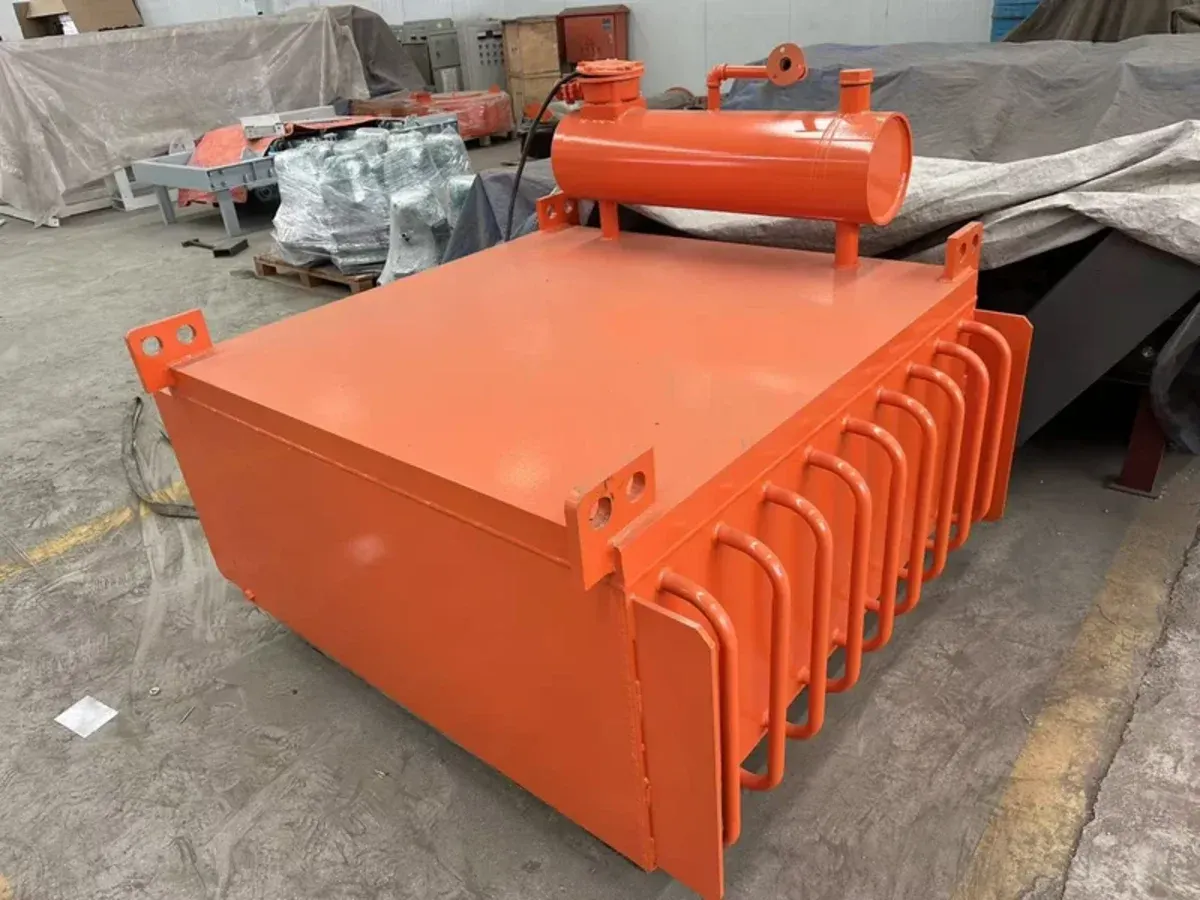
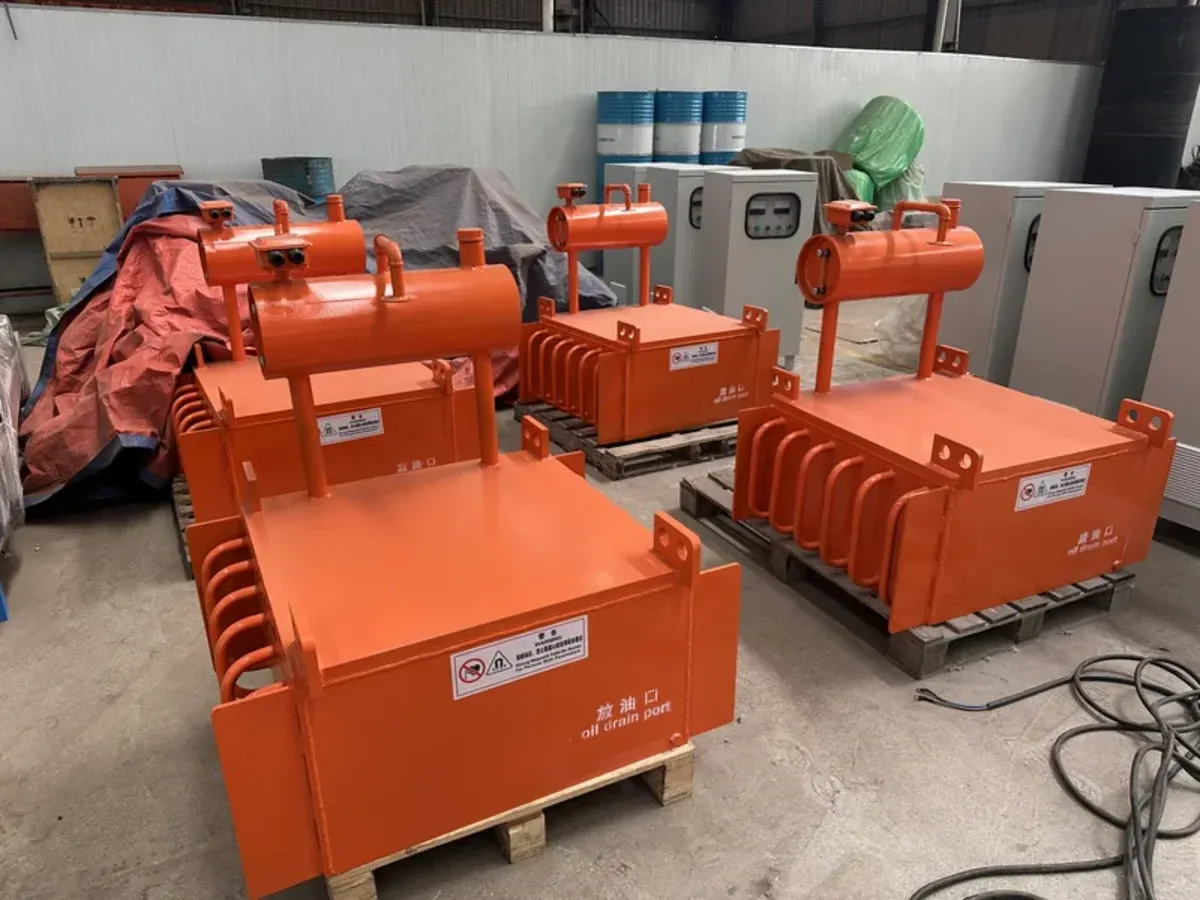
The photos show the suspended electromagnet body, external cooling sections, lifting points and different RCDE sizes. Your final unit is built to the approved model and project drawing.

Use the check that answers the real project question. A drawing check confirms fit. A magnetic-field measurement confirms an agreed field value. A capture test checks whether a defined steel object is captured under defined conveyor conditions.
Use for every order. Check model identity, overall dimensions, suspension points, installation position, actual suspension height, angle, maintenance clearance and agreed connections against the approved GA.
Use when the order specifies mT or Gauss. Define the instrument, exact measurement point, distance, probe direction, energized condition and pass value before the check.
Use for critical crusher/mill protection, T3 duty, smaller buried iron, high working distance, or when the order requires a capture result. Define the steel object and conveyor conditions before testing.
| Situation | Corvelan Check |
|---|---|
| Standard catalog order with no agreed mT/Gauss shipment value | Level 1 model & dimension check |
| Quotation/order includes a specific mT or Gauss requirement | Level 2 magnetic-field check becomes a shipment inspection item |
| Main question is “Will this defined steel piece be captured?” | Do not rely on Gauss alone; use Level 3 capture test |
| Item | What to Define |
|---|---|
| Instrument | Gaussmeter or teslameter |
| Magnet condition | Energized and stable |
| Measurement position | Defined point or grid |
| Measurement distance | Exact distance in mm |
| Probe direction | Defined before the check |
| Required result | Agreed mT or Gauss value |
| Record | Measurement sheet and photo when included in the order |
Use the real conveyor conditions whenever capture performance matters more than a magnetic-field number. Define the target object, material bed and operating conditions before testing.
| Test Item | Example Test Setup |
|---|---|
| Test piece | Carbon-steel block |
| Example size | 100 × 40 × 20 mm |
| Material depth | 220 mm |
| Belt speed | 2.0 m/s |
| Suspension height | 300 mm |
| Test-piece position | Bottom of material bed |
| Number of passes | 10 |
| Pass requirement | Define before testing; for example, 10/10 capture if that is the agreed project requirement |
The technical quotation should tell you exactly what Corvelan recommends before you place the order. It is not just a price sheet.
RCDE-8, RCDE-10, RCDE-12 or another starting size based on belt width, maximum material depth and suspension height.
Standard, T1, T2 or T3, with the reason for the starting choice.
Manual-clean or self-cleaning, based on cleaning frequency, production stops and safe access.
Above-belt or discharge/head-end starting position, plus the installation angle when known.
Catalog belt width, rated suspension height, material-depth limit, excitation power, weight and duty for the recommended model.
A clear list of the information still needed before the final technical specification and GA are confirmed.
Production starts from the approved project information, not from a generic catalog page. Corvelan confirms the final model, drawing, connections and agreed inspection items before release to production.
Material, largest damaging iron, smallest iron that must be captured, belt width, belt speed, normal/peak material depth, suspension position and downstream equipment.
RCDE model, Standard/T1/T2/T3, manual/self-cleaning choice and installation position.
Overall dimensions, suspension points, actual suspension height, installation angle, nearby steel structure, maintenance space and connection points.
Site power, magnet connection, rectifier/control cabinet scope when supplied, and the agreed isolation/control points.
Level 1 dimension check for every order, plus magnetic-field measurement or capture testing when the order requires them.
Which drawings, manuals, inspection records, final photos and packing documents will be supplied with the order.
The Corvelan shipment checklist matches the order. The quotation and order documents state exactly which checks and records are included.
| Check | What We Check | What You Receive When Included |
|---|---|---|
| Model identity | Model / unit identity against the order | Nameplate or unit photo |
| Overall dimensions | Main dimensions against approved GA | Inspection record or measurement photos |
| Suspension points | Location and main mounting dimensions | Dimension check |
| Housing & finish | Final visual condition | Final equipment photos |
| Oil system | Service points and visible leakage condition | Inspection record/photos when specified |
| Electrical / control | Connections and functional items within the supplied scope | Check record when specified |
| Magnetic field | Defined mT/Gauss test when required by the order | Measurement sheet/photo |
| Capture test | Defined steel test piece and conveyor conditions when required | Capture-test record |
| Packing | Final packing condition | Packing photos / packing list |
| Documents | Approved drawing, manual and agreed records | Final document set |
Do not leave the supply scope implied. The quotation marks each item as Included, Excluded or Optional so the final order is clear.
| Item to State Clearly | Quotation Must Show |
|---|---|
| RCDE magnet body | Included / Excluded |
| Rectifier / control cabinet | Included / Excluded / Optional |
| Suspension hardware | Included / Excluded / Optional |
| Temperature / monitoring items | Included / Excluded / Optional |
| Self-cleaning belt assembly | Included only when that configuration is quoted |
| Support steel / installation frame | Included / Excluded / Optional |
| Inspection / magnetic test / capture test | Exactly which checks are included |
| Drawings / manuals / final records | Exactly which documents are included |
Send belt width, belt speed, material depth, suspension height and target iron. Corvelan will identify the starting RCDE size, Standard/T1/T2/T3 option, installation position and any information still needed for the final quotation.
Unwanted iron or steel pieces mixed with the conveyed material.
The depth of material carried on the conveyor belt.
The working height between the magnet and the conveyor/material zone.
The suspension-height value listed for a specific RCDE model.
A suspended electromagnet with a discharge belt that continuously carries captured iron away.
The general arrangement drawing showing the main dimensions, mounting position and connection points.
Start with belt width, maximum material depth and actual suspension height. All three must fit the same RCDE model. If one value is above the model limit, move to a larger RCDE before choosing Standard, T1, T2 or T3.
RCDE-8 is the starting size for an 800 mm belt only when the other limits also fit. Its listed material-depth limit is 200 mm and its rated suspension-height limit is 250 mm. At 230 mm material depth, do not use RCDE-8; check RCDE-10 first.
After the RCDE size fits, Corvelan starts with T1 for one difficult condition, T2 for two difficult conditions, and T3 for three or more difficult conditions or high damage risk. If the model size itself is too small, move to a larger RCDE first.
Check self-cleaning first if the magnet needs cleaning more than once per shift, the conveyor cannot stop, the magnet cannot be reached safely, or captured iron must discharge automatically.
Use above-belt installation as the starting position for many moderate-depth retrofits with good overhead space. Check the discharge/head-end position first when material is deep or important iron may be buried low in the burden.
No. Gauss or mT describes magnetic-field strength at a defined point. Capture also depends on working distance, material depth, belt speed, iron size, iron position and installation geometry.
If the quotation or order includes a specific mT or Gauss value, define the instrument, measurement point, exact distance, probe direction, energized condition and pass value before shipment inspection.
Use a capture test for critical crusher or mill protection, T3 duty, smaller buried iron, high working distance, or whenever the order requires proof that a defined steel object is captured under defined conveyor conditions.
Send the material, largest damaging iron, smallest iron that must be captured, belt width, belt speed, maximum material depth, proposed suspension height and the downstream equipment being protected. A conveyor photo or layout is also useful.
Before production, the final order identifies the RCDE configuration, approved GA, connections and inspection method. Before shipment, Corvelan completes the agreed checks and document set, including magnetic-field or capture-test records when those tests are part of the order.

You do not need a finished specification to start. If you only have a conveyor photo and basic dimensions, send those first. Corvelan will tell you what is still missing.