Tramp-Iron Removal · Oil-Cooled · Automatic Cross-Belt Discharge

RCDF Oil-Cooled Self-Cleaning Cross-Belt Electromagnetic Separator

Remove unwanted iron and steel from material moving on your conveyor. The magnet pulls the metal out of the material, and the cleaning belt carries it to the side automatically. You do not need to stop the conveyor just to clean the magnet by hand.

Use this separator when unwanted iron or steel appears regularly and you have room to discharge the captured metal to the side. We choose the starting RCDF model from conveyor width, maximum material depth, suspension height and belt speed. Belt width alone is not enough.

Choose It ForRecurring ferrous tramp iron on belt conveyors.
Do Not Choose It ForAluminum/copper recovery, wet slurry or weakly magnetic mineral beneficiation.
Self-Cleaning RuleUse when automatic discharge is required or manual cleaning would interrupt production.
RCDF Reference RangeRCDF-5 through RCDF-20, with family belt-speed reference ≤2.5 m/s.
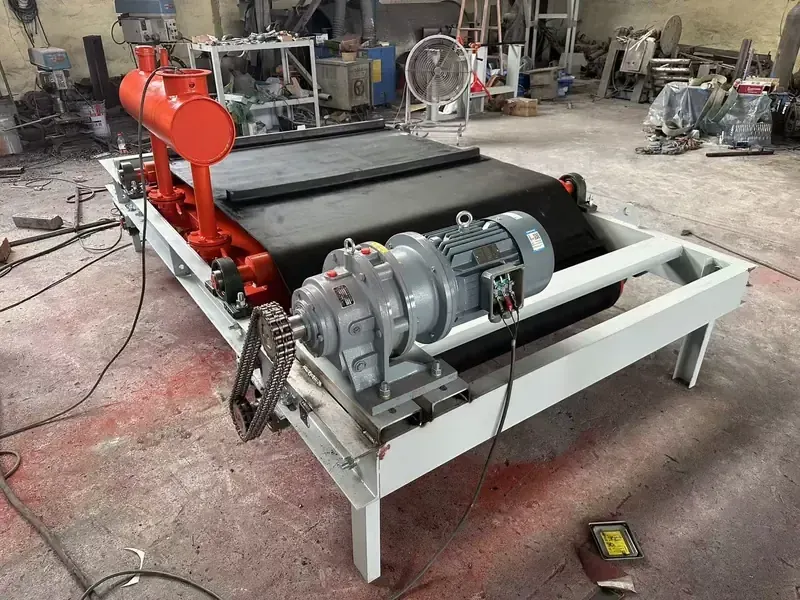
Coverlan oil-cooled self-cleaning cross-belt electromagnetic separator with automatic discharge belt and drive assembly
RCDF oil-cooled self-cleaning electromagnetic separator showing the suspended magnet body, cleaning belt, frame and drive system.
Product Basics

What Is an Oil-Cooled Self-Cleaning Cross-Belt Electromagnetic Separator?

It removes unwanted iron and steel from material moving on a belt conveyor. The electromagnet attracts the metal from the material. A powered cleaning belt then carries the captured metal to the side and drops it away from the conveyor.

Main Job

Remove unwanted ferromagnetic iron and steel, often called tramp iron.

Installation

Suspended above a belt conveyor.

Cleaning

Automatic side discharge with a powered cross-belt.

Best For

Recurring tramp iron where stopping for manual cleaning is not practical.

You may also see this equipment called an RCDF electromagnetic separator, oil-cooled electromagnetic overband separator, self-cleaning suspended electromagnet or cross-belt electromagnet.

These names can describe similar equipment. The cooling method, cleaning system and installation arrangement still need to match the actual machine.

Choose the Correct Separator Type

Is This the Right Type for Your Process?

Start with the target metal, conveyor condition and cleaning need. Choose RCDF when recurring iron or steel must be removed automatically from a dry belt-conveyor stream. Choose another separator type when the target or process is different.

Choose This Separator When

  • The target is iron or carbon steel.
  • The material moves on a belt conveyor.
  • Tramp iron appears regularly.
  • You want automatic cleaning.
  • There is safe space for side discharge.

Choose Another Type When

  • Aluminum or copper is the main recovery target.
  • The material is slurry or another wet process.
  • You need weakly magnetic mineral separation.
  • There is no safe side-discharge space.
  • Tramp iron is so rare that manual cleaning is simpler.
Your ConditionWhat We RecommendWhy
Iron or steel appears regularlyChoose a self-cleaning RCDFThe cleaning belt keeps moving captured metal away from the conveyor.
Iron appears only occasionally and stopping for cleaning is acceptableCompare a manual-clean suspended electromagnetA manual-clean unit is simpler when continuous iron discharge is not needed.
Deep material layer or a large magnet-to-conveyor gapStart with an electromagnetThe magnet must reach farther through the material. Do not choose the model from belt width alone.
Shallow material, simple duty and no need to switch the field on and offCompare a permanent overband magnetA permanent magnet can be simpler when an energized electromagnet is not needed.
The separator must sit over the main conveyor and side-discharge space is clearChoose cross-beltThe cleaning belt can move captured metal sideways and away from the product.
There is a good installation position over the head pulleyCompare an in-line setup firstThis can be a better route when the material is deep or the conveyor is fast.
There is no safe side-discharge spaceDo not use the standard cross-belt setupChange the discharge side, move the separator or use another separator type.
Aluminum, copper or brass is the main targetUse an eddy current separatorRCDF is for strongly magnetic iron and steel, not primary non-ferrous recovery.
The material is a wet slurryUse a wet magnetic separatorRCDF is an over-conveyor separator for dry bulk material.
The goal is weakly magnetic mineral separationUse a high-intensity mineral separatorThis is a different separation job from tramp-iron removal.

Cross-belt means the cleaning belt runs across the conveyor and drops captured iron to one side. In-line means the separator runs in the conveyor direction, usually near the head pulley.

Common Conveyor Applications

Where Is This Separator Commonly Used?

Use an oil-cooled self-cleaning cross-belt electromagnet where a dry belt conveyor carries bulk material and recurring iron or steel must be removed automatically.

Mining & Ore Handling

Use it above ore conveyors before crushers, mills or other downstream equipment when bolts, tools, steel fragments or broken wear parts may enter the material stream.

Quarry & Aggregate

Use it above crushed stone, sand, gravel or aggregate conveyors to remove crusher teeth, bolts, plate and other ferrous pieces before they damage crushers, screens or conveyors.

Coal Handling

Use it above coal conveyors when recurring ferrous pieces must be removed while the line keeps running.

Cement & Limestone

Use it above limestone, clinker-feed or similar dry bulk conveyors to remove unwanted iron before crushers or other processing equipment.

Recycling & Bulk Sorting

Use it to remove strongly magnetic iron and steel from a dry conveyor stream. If aluminum or copper is the main target, use an eddy current separator instead.

Bulk Material Terminals

Use it where conveyors run continuously and automatic side discharge is more practical than stopping the line to clean the magnet by hand.

The industry name does not choose the model. A mining conveyor and a cement conveyor can need different RCDF sizes even when the belt width is the same. We still check suspension height, maximum material depth, belt speed, target iron and installation space.
Material & Tramp-Iron Definition

Tell Us What Iron You Need to Remove

Do not describe the target only as “metal.” Unwanted iron and steel pieces are often called tramp iron. Tell us whether the hardest piece is a large steel part, small buried iron, long wire or rebar, or a steady flow of mixed iron pieces.

Large Heavy Iron

For crusher teeth, thick plates, large bolts or tools, send the approximate size and weight. A heavy piece needs enough magnetic force at the real working distance.

Small Buried Iron

For nails, screws and small fragments, the depth of the material is very important. Choose the model for the deepest normal position of the iron, not for the easy pieces sitting on top.

Wire, Rod or Rebar

Send a photo and the approximate length. Long wire, rod or rebar can turn, hook or tangle as it leaves the material and moves onto the cleaning belt.

How Often Does Tramp Iron Appear?

Tell us whether the iron is occasional, regular or heavy. If it is occasional, a manual-clean magnet can be simpler. If it appears regularly, use self-cleaning. If the iron load is heavy, we also check the cleaning belt, discharge area and collection bin.

Best way to show us the target: send a photo of the iron beside a ruler. If no photo is available, give the approximate length, width, thickness and weight if known, and tell us how often the iron appears.
Working Principle

How Does the Oil-Cooled Self-Cleaning Cross-Belt Separator Work?

The electromagnet pulls magnetic iron and steel out of the material. A powered cleaning belt runs across the magnet, carries the captured metal to the side, and drops it after the metal leaves the strong part of the magnetic field.

1

Material Moves Under the Magnet

Your conveyor carries the product and any unwanted iron under the suspended electromagnet.

2

Iron and Steel Move Toward the Magnet

Magnetic iron and steel move toward the energized magnet. Pieces buried deeper in the material are harder to reach.

3

The Cleaning Belt Moves Captured Iron Sideways

The powered cross-belt carries captured metal away from the product without waiting for manual cleaning.

4

Metal Drops Into the Collection Area

After the metal moves away from the magnet, it drops into the chute, bin or collection area.

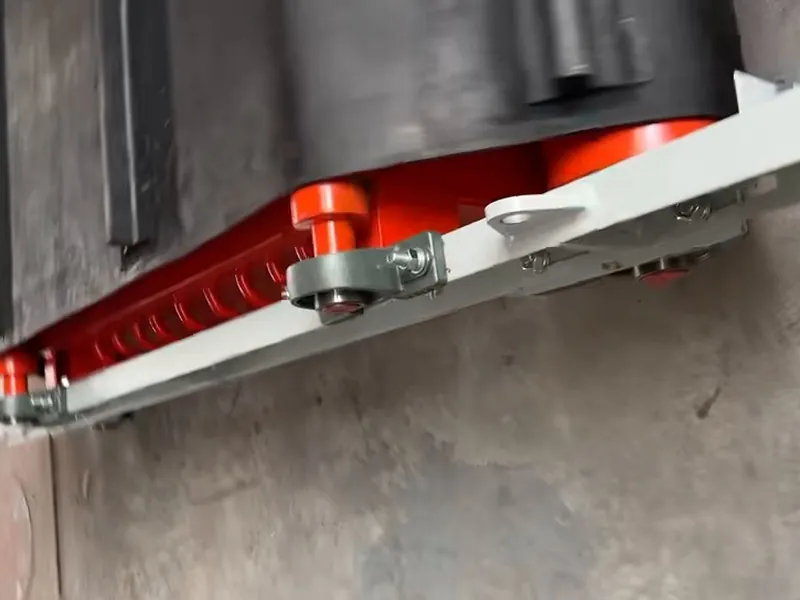
Cleaning belt roller and support detail on a Coverlan cross-belt electromagnetic separator
Cleaning-belt end roller and support arrangement on the RCDF self-cleaning system.
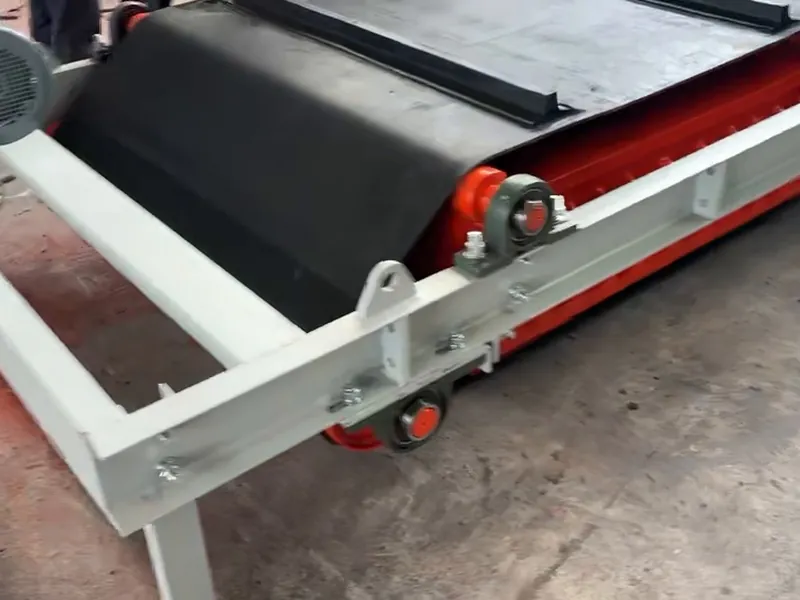
Self-cleaning belt path and frame structure on a Coverlan cross-belt electromagnetic separator
Cleaning-belt path and separator frame on the RCDF self-cleaning system.
Oil-cooled and self-cleaning describe different functions. Oil-cooled refers to thermal management of the energized electromagnet. Self-cleaning refers to automatic mechanical removal of captured iron by the driven discharge belt.
Harder Operating Conditions

What Makes Tramp-Iron Removal Harder?

Choose the model for the hardest normal operating condition, not the easiest one. Check the maximum material depth, the highest normal belt speed and the iron piece that will sit farthest from the magnet.

Your ConditionWhat to DoWhy
Shallow material + belt speed within the RCDF reference rangeUse the standard RCDF tableChoose a row that covers conveyor width, suspension height and maximum material depth.
Deep material + belt speed within the RCDF reference rangeMove to a larger model with more reachDo not keep the belt-width model if the material depth is above its listed limit.
Belt speed above 2.5 m/sDo not choose directly from the standard RCDF tableThe RCDF family table is listed for belt speeds of 2.5 m/s or less. A faster conveyor needs a separate high-speed check.
Deep material + high belt speedUse a custom selectionThe magnet has to reach farther, and the iron has less time to move. Do not choose the model from conveyor width alone.
Deep material + high speed + small ironDo not use the standard table aloneDefine the target iron and the test condition before we confirm the model.
Material depth changes a lot during normal productionUse the maximum normal material depthDo not use the average depth when normal peaks are much deeper.

How Far Is the Hardest Iron Piece From the Magnet?

The hardest iron to remove is usually the piece farthest from the magnet. Suspension height is only part of that distance. A deep material layer moves buried iron even farther away. We choose the model for the hardest normal position, not for an easy piece sitting on top of the material.

Is a Higher Gauss or mT Number Always Better?

No. The RCDF table lists 60 or 70 mT depending on model, but a magnetic-field number alone does not tell you whether the separator will remove your iron. Magnetic flux density, shown in mT or Gauss, is not pull force and is not separation efficiency. If you need a magnetic-field value on the order, tell us where and how you want it checked.

RCDF Model Whys

How to Choose Your Starting RCDF Model

Start with three numbers: conveyor width, suspension height and maximum material depth. The RCDF model must cover all three. Do not choose a model from conveyor width alone.

What the terms mean: suspension height is the distance from the magnet face to the conveyor reference position. Material depth, also called burden depth, is how deep the material sits on the conveyor.
Simple rule: the model row must cover conveyor width, suspension height and maximum material depth at the same time. If one value is too high, move to the first larger RCDF model that covers all three. If no standard row fits, use a custom setup.
Conveyor WidthMax Suspension HeightMax Material DepthStart With
500 mm150 mm100 mmRCDF-5
600/650 mm180 mm130 mmRCDF-6
650 mm200 mm150 mmRCDF-6.5
800 mm250 mm200 mmRCDF-8
1000 mm300 mm250 mmRCDF-10
1200 mm350 mm300 mmRCDF-12
1400 mm400 mm350 mmRCDF-14
1600 mm450 mm400 mmRCDF-16
1800 mm500 mm450 mmRCDF-18
2000 mm550 mm500 mmRCDF-20

Three Simple Examples

Example A — RCDF-10

1000 mm conveyor + 200 mm material depth + 280 mm suspension height.

RCDF-10 covers the three reference conditions: 1000 mm belt, 250 mm material depth and 300 mm rated suspension height. Start with RCDF-10.

Example B — RCDF-6.5

650 mm conveyor + 150 mm material depth + 195 mm suspension height.

RCDF-6 does not cover the 150 mm burden or 195 mm suspension. RCDF-6.5 covers 650 / 150 / 200 mm. Start with RCDF-6.5.

Example C — When RCDF-10 Is Too Small

1000 mm conveyor + 300 mm material depth.

RCDF-10 is listed for up to 250 mm material depth, so do not choose RCDF-10 just because the conveyor is 1000 mm wide. Move to the next RCDF size that covers the material depth, then check whether the larger machine fits. If no standard row fits, use a custom setup.

RCDF Range at a Glance

Type: oil-cooled self-unloading / self-cleaning electromagnetic iron separator.

Cleaning: powered automatic discharge belt.

Range: RCDF-5 through RCDF-20.

Inclined conveyor: send the conveyor angle before we confirm the model and layout.

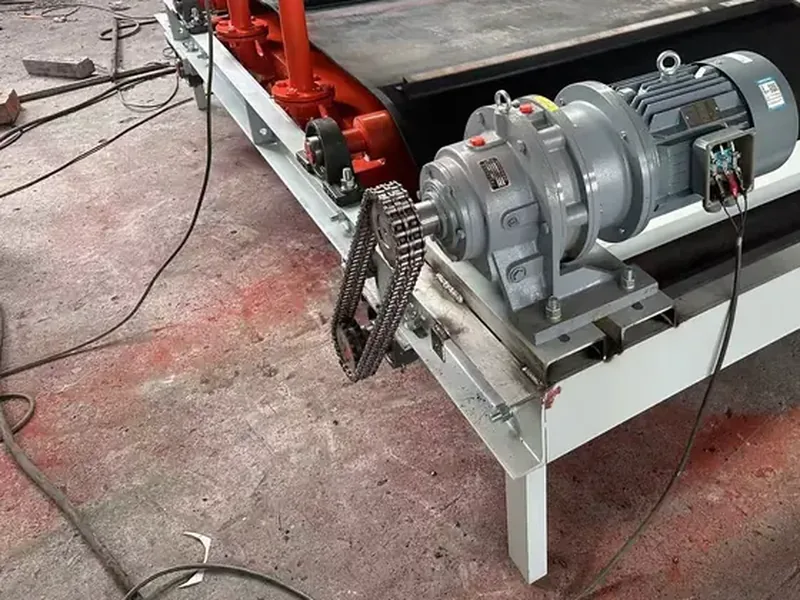
Motor gearbox and chain drive on a Coverlan self-cleaning cross-belt electromagnetic separator
Motor, reducer and chain drive used to move the self-cleaning discharge belt.
RCDF Family Reference Data

RCDF Series Reference Specifications

Use this table as the standard RCDF starting range. We confirm the final model, power, dimensions and layout in the quotation and approved drawings.

Do not select a model from conveyor width alone. The model row must also cover the required suspension height and maximum material depth. A belt speed above 2.5 m/s is outside the standard family-table selection route.
ModelConveyor Width (mm)Suspension Height h (mm)Max Material Depth (mm)Excitation Power ≤ (kW)Magnetic Field (mT)*Drive Power ≤ (kW)Max Belt Speed (m/s)Weight (kg)
RCDF-55001501001.2601.52.51100
RCDF-6600/6501801301.8601.52.51500
RCDF-6.56502001502.0701.52.51800
RCDF-88002502003.0702.22.52500
RCDF-1010003002504.5703.02.53550
RCDF-1212003503006.5704.02.54650
RCDF-1414004003508.5704.02.56290
RCDF-16160045040013705.52.57850
RCDF-18180050045018705.52.59100
RCDF-20200055050020705.52.59500

* RCDF-5 and RCDF-6 list ≥60 mT; RCDF-6.5 through RCDF-20 list ≥70 mT. The RCDF family table does not state the measuring point, instrument or test method. Do not treat these numbers as pull force or separation efficiency.

Reference Outline Dimensions

ModelA (mm)B (mm)C (mm)D (mm)E (mm)
RCDF-519009008006501050
RCDF-6205010008507001170
RCDF-6.5216510509007501270
RCDF-8235011509708101420
RCDF-102660140010808101580
RCDF-122860150012009401780
RCDF-143225194513009401950
RCDF-163550201014009402180
RCDF-183650240015009402315
RCDF-203850280016009402400

A–E match the RCDF family outline drawing. Confirm the final general arrangement (GA) drawing for your selected unit before you make the supports or install the separator.

Installation Checks

Check These Items Before You Finalize the Cross-Belt Layout

A correctly sized magnet can still be installed badly. Check the discharge path, nearby steel, clearances and separator direction before you finalize the layout.

Is There Enough Space for the Removed Iron?

If there is clear side-discharge space and a safe collection area: use the self-cleaning cross-belt setup.

If there is no clear side-discharge space: do not use the standard cross-belt setup. Change the discharge side, change the conveyor layout or use another separator arrangement.

Is the Conveyor Inclined?

Horizontal conveyor: use the normal cross-belt selection steps.

Inclined conveyor: send the angle and layout before we confirm the model. We check separator direction, discharge side, structural clearance and the collection area together.

Is There Steel Too Close to the Magnet?

Steel idlers, chutes, beams or frames too close to the magnet can change the magnetic field. Move them, use a suitable non-magnetic part where needed, or change the separator position before you finalize the layout.

Where Will the Removed Iron Go?

Provide a chute, bin or clear collection area below the discharge side. If the iron load is heavy, use enough collection space so metal cannot build up into the cleaning belt or return path.

Is the Site Hot, Wet, Dusty or Corrosive?

Oil cooling does not make the separator suitable for every site. Tell us if the area is unusually hot, dusty, wet or corrosive, or if hot material passes close to the separator. We will match the electrical system, drive and cooling setup to the site. If the area has hazardous-location requirements, tell us before ordering.

Before installation: make sure the conveyor direction, separator direction, discharge side, suspension position and maintenance clearance all match the approved general arrangement (GA) drawing.
Cleaning, Maintenance & Safety

What Should You Check During Routine Inspection?

Self-cleaning removes captured iron automatically, but the moving parts still need inspection. Isolate electrical and mechanical energy before service. Follow your approved site lockout procedure.

  • Make sure the cleaning belt runs straight
  • Look for cuts or damage on the cleaning belt
  • Check belt tension
  • Make sure the rollers turn freely
  • Check the bearings
  • Check the motor
  • Check the gearbox / reducer
  • Check the chain or transmission
  • Check bolts, fasteners and suspension connections
  • Check the guards
  • Remove built-up tramp iron
  • Check the discharge chute / collection bin
  • Check electrical connections
  • Look for unusual heat
  • Listen and check for unusual noise or vibration
  • Keep maintenance access clear around the belt and drive
Maintenance intervals depend on the selected unit and site conditions. Use the inspection list above for routine checks. Follow the final equipment manual and your site maintenance plan for the actual service interval.
How We Choose

How Corvelan Chooses the Right RCDF Setup for Your Conveyor

We check four things before we confirm the machine: the separator type, RCDF size, installation space and any required test.

1. Is This the Right Separator Type?

We check that the target is magnetic iron or steel, the process uses a belt conveyor, the discharge path works and automatic cleaning is needed. If not, we move to another separator type before choosing an RCDF size.

2. Which RCDF Size Covers Your Conveyor?

We check conveyor width, suspension height, maximum material depth and belt speed. If one value is above a row in the standard table, we do not use that row.

3. Will It Fit and Discharge Correctly?

We check the supports, centerline, conveyor angle, discharge direction, clearances, nearby steel, collection area and maintenance access. If the layout does not work, fix the layout before confirming the machine.

4. Do You Need a Specific Test?

If the order includes a magnetic-field or iron-capture test, agree on the test condition first. Define what will be checked, where it will be checked and what result you need.

If You Need a Magnetic-Field Test

Do not use “70 mT” by itself as the full test requirement. Define the measuring point, distance from the magnet face, energized condition, instrument or test method and minimum reading.

If the Real Question Is “Can It Catch This Piece of Iron?”

Send the actual iron piece or a clear photo if possible. Tell us its approximate size and weight, maximum material depth, belt speed and working distance. We can then build the test around the real piece you need to remove.

Product & Test Checks

How We Check What Matters

Different questions need different checks. A product photo shows the machine structure. A drawing shows whether it will fit. A magnetic reading shows the field at one stated point. A target-iron test shows what happened under one stated operating condition.

What We Already Have for the RCDF Series

Whole-Machine Photo

Shows the oil-cooled self-cleaning machine, cleaning belt, frame and drive arrangement.

Drive Detail

Shows the motor, reducer, transmission and mechanical drive used for the cleaning belt.

Belt & Roller Video Frames

Show the cleaning-belt path, end roller and physical construction.

RCDF Series Specifications

Give the RCDF-5 to RCDF-20 reference range for belt width, suspension height, material depth, power, belt speed, weight and outline dimensions.

What Each Check Tells You

What You Want to KnowWhat We CheckWhat You Get
Is this the real machine structure?Product photos and machine drawingA clear view of the machine layout, cleaning belt, frame and drive.
Will it fit my conveyor?Final machine drawing + site/conveyor drawingOverall size, suspension points, direction, clearance and discharge side.
What is the magnetic field at a set position?Magnetic-field measurement at an agreed point and distanceA recorded mT or Gauss reading for that stated test condition.
Can it catch a specific piece of iron?Target-iron test using the stated iron, distance, material depth and belt speedA result for that exact test condition.
Does the self-cleaning system run correctly?Cleaning-belt running checkBelt movement, tracking, roller operation and discharge direction.
Does the machine match the final drawing?Dimension and suspension-point checkKey dimensions and mounting positions compared with the approved drawing.

How We Test What Matters

Test 1

Magnetic-Field Check

Agree on the measuring point, working distance, energized condition, instrument and minimum reading. Record the result together with those conditions.

Test 2

Target-Iron Test

Define the actual iron piece, size, weight, position, material depth, belt speed and working distance. Record the result for that exact setup.

Test 3

Cleaning-Belt Running Check

Run the cleaning belt and check tracking, rollers, motor, reducer, transmission, guards and discharge path.

Test 4

Drawing & Dimension Check

Compare key dimensions, suspension points, motor side and discharge direction with the approved drawing before installation.

Use every result only for the condition that was checked. A magnetic-field reading is not a pull-force result. A test with one iron piece does not guarantee the same result for every iron size, working distance or belt speed.
Before Shipment

What We Check Before Shipment

Machine Size

Check key dimensions against the approved drawing.

Suspension Points

Check the lifting and suspension positions shown on the final drawing.

Cleaning Belt

Run the belt and check movement, tracking and roller operation.

Drive System

Check the motor, reducer, transmission and guards.

Electrical System

Check the ordered electrical setup before packing.

Ordered Test

If the order includes a magnetic-field or target-iron test, complete the agreed test and record the result under the stated condition.

Drawing, Delivery & Receiving Checks

What Should You Confirm Before Installation?

What You Should Confirm on the Final Drawing

Before you make the supports or install the separator, confirm:

  • Overall machine dimensions
  • Suspension points and spacing
  • Conveyor direction
  • Cleaning-belt direction
  • Iron discharge side
  • Motor / gearbox side
  • Required site power
  • Magnet position above the conveyor
  • Conveyor incline angle when applicable
  • Space for belt, roller and drive maintenance
  • Collection chute / bin position

What to Check When the Separator Arrives

When the separator arrives, check:

  • Model / nameplate against the order
  • Overall shipping condition
  • Lifting points
  • Cleaning belt and rollers
  • Motor and gearbox
  • Transmission and guards
  • Electrical enclosure and terminals
  • Loose parts / accessories
  • Key drawing dimensions
  • Visible shipping damage
Before energizing: confirm mechanical clearance for the cleaning belt and discharge path. If the belt, pulley, guard or captured metal can contact surrounding structure, correct the installation before operation.
Typical Selection Examples

Six Typical Selection Examples

These examples show how the selection works. They are not customer project reports. Each example gives one clear route for one clear set of conditions.

Example A · Standard RCDF-12

1200 mm Belt + 300 mm Material + 320 mm Suspension

Condition: 1200 mm conveyor, 300 mm maximum material depth, 320 mm suspension height, 1.8 m/s belt speed and recurring carbon-steel bolts or broken crusher parts.

Choose: Start with RCDF-12.

Why: RCDF-12 covers a 1200 mm belt, up to 350 mm reference suspension height and up to 300 mm material depth. The 1.8 m/s speed is inside the ≤2.5 m/s RCDF series reference.

What to send us: target-iron photo or size, conveyor layout and the required discharge side.

Example B · Manual Cleaning Is Enough

800 mm Belt + Very Occasional Iron

Condition: 800 mm conveyor, 100 mm material depth, 1.2 m/s speed, one large bolt only occasionally, and production can stop for magnet cleaning.

Choose: Compare a manual-clean suspended magnet first.

Why: Automatic discharge is not the main need. A self-cleaning RCDF adds a cleaning belt, motor, reducer and rollers that may not be needed for very low tramp-iron frequency.

What to send us: tell us how often iron appears and whether the conveyor can stop for cleaning.

Example C · RCDF-10 Is Too Small

1000 mm Belt + 300 mm Material + 320 mm Suspension

Condition: 1000 mm conveyor, 300 mm maximum material depth, 320 mm suspension height, 1.9 m/s belt speed and recurring iron.

Choose: Do not choose RCDF-10. Start with RCDF-12 if the larger machine fits the available space.

Why: RCDF-10 matches the 1000 mm belt, but its reference values are 250 mm material depth and 300 mm suspension height. Both are below the required condition. RCDF-12 covers 300 mm material depth and 350 mm suspension height.

What to send us: conveyor drawing, suspension structure, side clearance and discharge path.

Example D · Belt Speed Above 2.5 m/s

1200 mm Belt + 2.9 m/s Speed

Condition: 1200 mm conveyor, 250 mm material depth, 300 mm suspension height and 2.9 m/s belt speed.

Choose: Do not choose directly from the standard RCDF table.

Why: The RCDF series table lists belt speed at 2.5 m/s or less. At 2.9 m/s, the target has less time to leave the material and move toward the magnet.

What to send us: actual conveyor speed, target-iron photo or sample and the real working condition for a high-speed test if required.

Example E · Aluminum or Copper

Aluminum and Copper Are the Main Targets

Condition: a dry recycling conveyor where the main recovery targets are aluminum and copper rather than iron or steel.

Choose: Do not use RCDF as the primary recovery machine. Use an eddy current separator.

Why: RCDF is an electromagnetic tramp-iron separator for strongly magnetic iron and steel.

What to send us: material composition, particle size, non-ferrous target size, throughput and moisture.

Example F · No Safe Side-Discharge Space

No Safe Side-Discharge Space

Condition: there is enough headroom above the conveyor, but a wall, beam, walkway or equipment blocks the side where captured iron would discharge.

Choose: Do not approve the standard cross-belt layout.

Why: The machine may fit above the belt but still fail as an installation because the removed iron has nowhere safe to go.

What to send us: conveyor or site drawing with walls, beams, walkways, collection area and the proposed discharge path. We can change the discharge side, move the separator or compare an in-line setup.

Why Corvelan

How Corvelan Helps You Choose the Right Separator

We Start With Your Conveyor

Send the belt width, material depth, belt speed, installation position and available discharge space.

We Look at the Iron You Need to Remove

Send a photo beside a ruler when possible. Size, shape, approximate weight and how often it appears all matter.

We Choose the RCDF Range

We compare your conveyor condition with the RCDF series table and tell you the first model range that covers the listed limits.

We Check the Installation

We look at discharge space, nearby steelwork, conveyor angle, suspension position and maintenance access.

We Agree on Any Required Test

If you need a magnetic-field or target-iron test, we agree on the test condition before the order is finalized.

We Confirm the Final Drawing

The drawing should show the machine size, suspension points, conveyor direction, discharge side and installation height.

Find Your Starting RCDF Model

Send conveyor width, maximum material depth, suspension height, belt speed and a photo of the iron you need to remove. We will tell you which RCDF range to start with or whether you need a larger model or custom setup.

FAQ

Common Selection Questions

When should I choose a self-cleaning electromagnet instead of a manual-clean unit?

Choose self-cleaning when iron appears regularly or when you do not want to stop the conveyor for manual magnet cleaning. Choose manual-clean when iron appears only occasionally and periodic cleaning is acceptable.

When should I choose cross-belt instead of in-line installation?

Choose cross-belt when the magnet must sit over the main conveyor and there is clear space at the side for automatic iron discharge. If the magnet can sit over the head pulley, especially with deep material or a fast conveyor, compare an in-line setup first.

Can I select the RCDF model from conveyor belt width alone?

No. The starting RCDF model must cover conveyor width, suspension height and maximum material depth. If one value is above that row, do not choose that row.

What should I do if conveyor speed is above 2.5 m/s?

Do not choose directly from the standard RCDF table. The RCDF table lists belt speeds of 2.5 m/s or less. A faster conveyor needs a separate high-speed check.

Is 70 mT enough for my tramp iron?

No. A 70 mT value alone does not tell you whether the separator will remove your iron. Tell us the target iron, maximum material depth, belt speed and actual working distance. If you need a magnetic-field test, also define the measuring point, gap, instrument and operating condition.

How should I describe the tramp iron for selection?

Send a photo of the iron beside a ruler whenever possible. Also give the approximate length, width, thickness and weight if known. Tell us whether the iron appears occasionally, regularly or in heavy amounts.

Can this separator remove aluminum or copper?

No. Do not use an RCDF suspended electromagnet as the main technology for aluminum or copper recovery. Use an eddy current separator for non-ferrous metal recovery.

Can it be used on an inclined conveyor?

Yes. Send the conveyor angle before we confirm the model. We check the angle together with separator direction, discharge side, structural clearance and the collection area.

What should be agreed before a magnetic-field test?

Agree on the measuring point, working gap, energized condition, instrument or test method, target iron if you use a capture test, and the pass/fail result. Do not use an mT value by itself as the full test requirement.

What should I send Corvelan for selection and quotation?

Send the material and a photo of the target iron. Also send conveyor width, maximum material depth, suspension height, and normal and maximum belt speed. Add throughput or loading, installation direction, incline angle if needed, discharge side, available space, site power and any test requirement.

RFQ Inputs

Send These Details for Selection and Quotation

Start with the items below. If you have a conveyor drawing, installation photo or photo of the target iron, attach it. A clear drawing or photo often answers questions faster than a long description.

1. MaterialMaterial name, particle/lump condition, moisture if relevant and any unusually high temperature.
2. Target Tramp IronPhoto beside a ruler if possible; otherwise size, shape, weight and occasional / recurring / heavy frequency.
3. Conveyor WidthActual belt width in mm.
4. Maximum Material Depth (Burden Depth)Burden depth means how deep the material sits on the conveyor. Use the highest normal operating depth, not only the average.
5. Suspension HeightSuspension height is the planned distance from the magnet face to the conveyor reference position.
6. Belt SpeedNormal and maximum speed in m/s. If above 2.5 m/s, identify it as a high-speed application.
7. Throughput / LoadingOperating throughput or loading pattern, including major surges if present.
8. InstallationCross-belt location, conveyor direction, horizontal/inclined condition and incline angle.
9. Discharge & SpacePreferred discharge side, headroom, side clearance and planned collection chute/bin.
10. Site & Test RequirementsPower supply, severe dust/corrosion/temperature conditions, destination market and any required test or pass/fail requirement.

What Corvelan Will Tell You From Your Data

We will tell you which separator type fits, which RCDF model range to start with, which limits are outside the standard table, and what still needs to be checked on the drawing or in a test.

Send Your Separation Requirement

Send your material, target-iron photo, conveyor width, maximum material depth, suspension height and belt speed. Corvelan will tell you which separator route fits, which RCDF range to start with, and what still needs to be checked before the final drawing or test.

Get An Instant Quotation Now